

Chemically adaptive nanolaminates: A new paradigm through oxygen dynamic partitioning
14.08.2026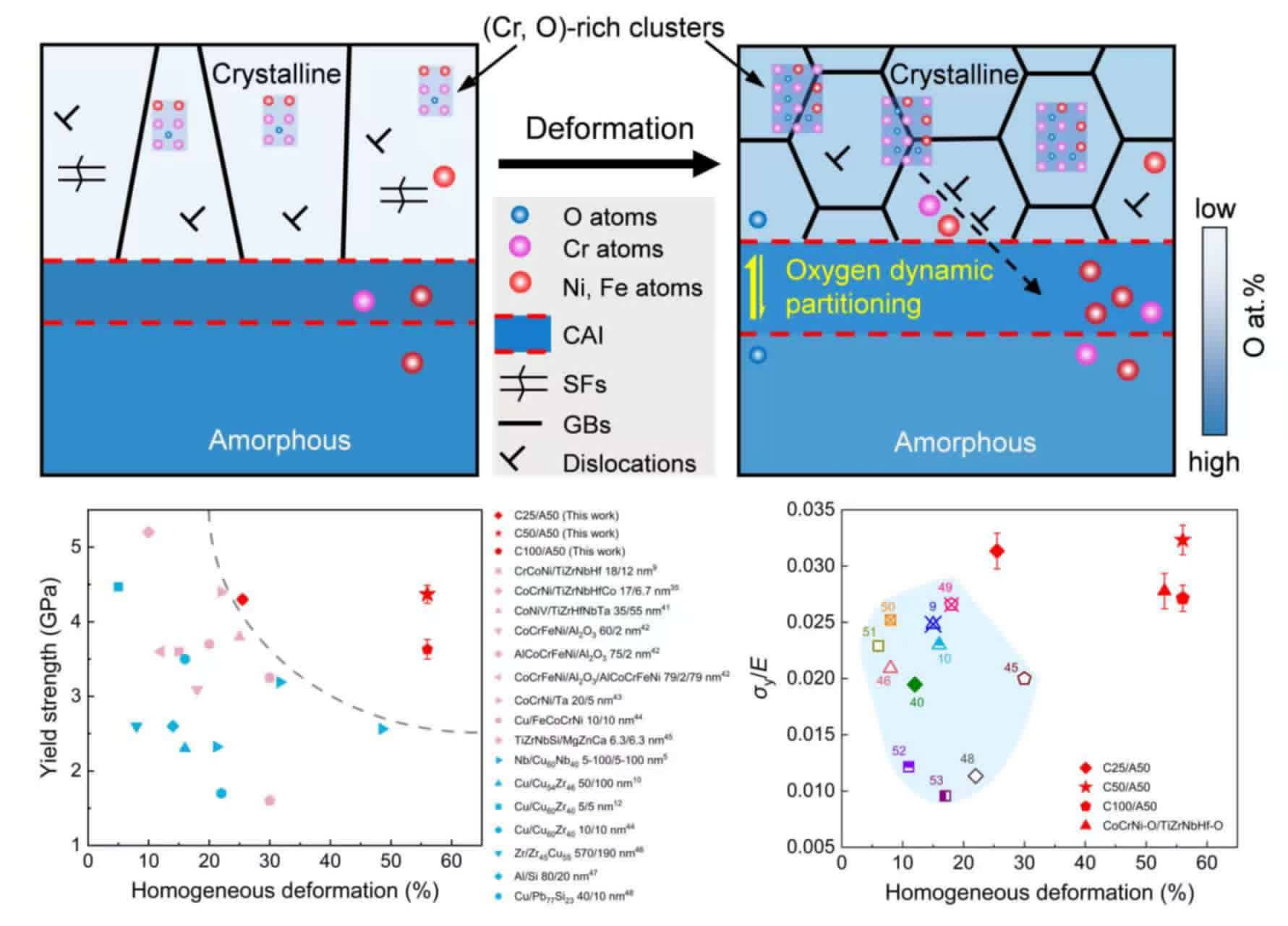
A recent study by Xilei Bian and co-workers from Shanghai University, together with Daniel Şopu, Christoph Gammer, Lukus Schretter and Jürgen Eckert from the Erich Schmid Institute (ESI) and the Montanuniversität Leoben, introduces a new design paradigm based on oxygen dynamic partitioning. During deformation, interstitial oxygen redistributes from the amorphous layers and interfaces into the crystalline layers without forming oxides, progressively strengthening the crystalline phase while reducing the mechanical mismatch between the two constituents. This self-adaptive chemo-mechanical coupling enables coordinated deformation, resulting in an exceptional combination of ultrahigh yield strength (approaching E/30) and homogeneous compressive strains exceeding 50% without shear-band formation. The concept establishes chemical reconfiguration as a powerful strategy for designing structural materials that actively adapt to mechanical loading.
Further details can be found here: https://www.sciencedirect.com/science/article/abs/pii/S1369702126002968