


Clio Unger
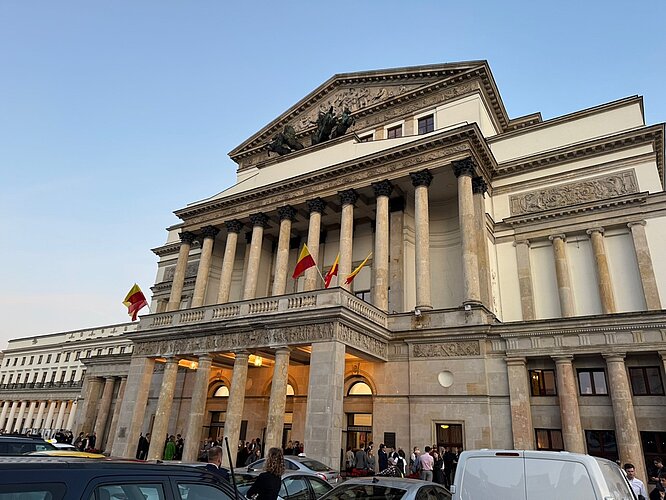
Although I had never been to Poland before, I expected that Warsaw and Berlin would share the strongest affinities among our case studies. Both cities were razed to the ground in 1945 and had to be completely rebuilt. Both were shaped by communism and the collapse of the Soviet Union. And both sustain a repertoire-driven, state-supported theatre system. Much of this proved true – but I was not prepared for the scale of reconstruction in Warsaw. Our attendance at the opening night of The Best City in the World: An Opera About Warsaw, commissioned by Sinfonia Varsovia and produced by the Polish National Opera, revealed just how much further the socialist city had taken the project of reconstruction. While Berlin’s postwar rebuilding sought to restore the old, Warsaw reinvented itself, striving toward the ideal of a fully functional, flexible, and egalitarian city. The theatre system, too, impressed me with its sheer size: nineteen municipally funded theatres, each with full-time ensembles and staff—outnumbering Berlin’s publicly funded stages by a significant margin. Over the weekend I found myself drawn in by the familiarity of the repertoire model, only to be continually surprised by the differences in scale and ambition.
Throughout our time in Warsaw, I kept returning to something Rüstem Ertuğ Altınay had observed during our “Writing the City” event in Vienna earlier this year. Speaking about the Istanbul case study, he reflected on the connections between queer nightlife and gentrification—the way queer life often takes root in underground or marginal spaces that are particularly vulnerable to urban redevelopment, and how tensions can arise between these spaces and longer-standing, more traditional communities. His observation came back to me vividly when we encountered two Warsaw performances that both foregrounded queer life and its entanglement with the city.
At the Teatr Dramatyczny, we saw Angels in Warsaw, written by Julia Holewińska and directed by Wojciech Faruga. Inspired by Tony Kushner’s Angels in America and by Krzysztof Warlikowski’s 2007 staging, the production traces the Polish experience of AIDS, endowing the epidemic with an urban history. It was, in many ways, a quintessential repertoire production (something I have not seen in a while) and it reminded me of the deep kinship between the Polish and German theatre systems. The play revisits a largely unexplored history: the forgotten experiences of people living through the early AIDS epidemic in Warsaw during the 1980s – stories silenced by stigma, misinformation, and fear. While AIDS did not reach the same scale of devastation in Poland as in the West, Holewińska and Faruga reconstruct individual stories of how the virus haunted Warsaw’s bohemia, the social outcasts around the Central Station, and eventually the broader public.
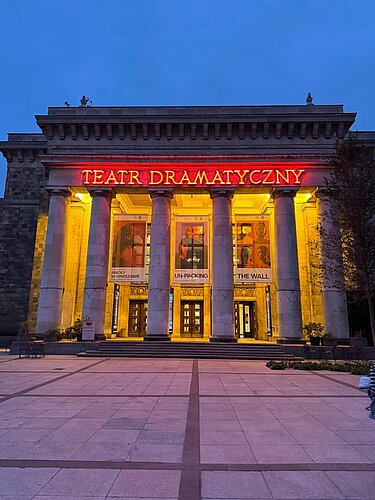
Angels in Warsaw at Teatr Dramatyczny – Photo Credit: Clio Unger
Some, like Piotr Gruszczyński, dramaturg at Nowy Teatr, feel that the play overstates the cultural impact of AIDS in Poland. Yet its depiction of Operation Hyacinth – the police raids targeting queer and “undesirable” citizens – felt sharply truthful, and resonant beyond its local setting. In Gentrification of the Mind: Witness to a Lost Imagination, Sarah Schulman has argued that the AIDS crisis in New York accelerated gentrification by displacing tenants and erasing countercultural communities; while Warsaw’s trajectory differed, the rapid transformation around the Central Station – now dominated by banks, hotels, and glass-clad office towers – suggests similar dynamics of erasure and sanitisation. The play thus reclaims an untold history, linking processes of stigma and spatial transformation in ways that feel urgently relevant.
The second performance that recalled Ertuğ’s reflections was Dries Verhoeven’s NarcoSexuals, presented as a guest performance at Nowy Teatr. For this piece, the theatre had erected a replica of an apartment in its courtyard; constructed from shipping containers, ringed with windows, and dimly lit. Spectators wandered around the exterior, peering in as a group of men enacted a slow, ritualised chemsex party inside. Wearing harnesses, cockrings, and contact lenses with large pupils, the performers moved sometimes languidly, sometimes urgently across beds, floors, and furniture, their gestures alternately intimate and distant. Through headphones, we listened to a collective monologue that wove reflections on desire, subversion, and community. The text positioned chemsex as a form of radical queer practice—one that resists domestication through monogamy, marriage, or other institutionalised models of intimacy.
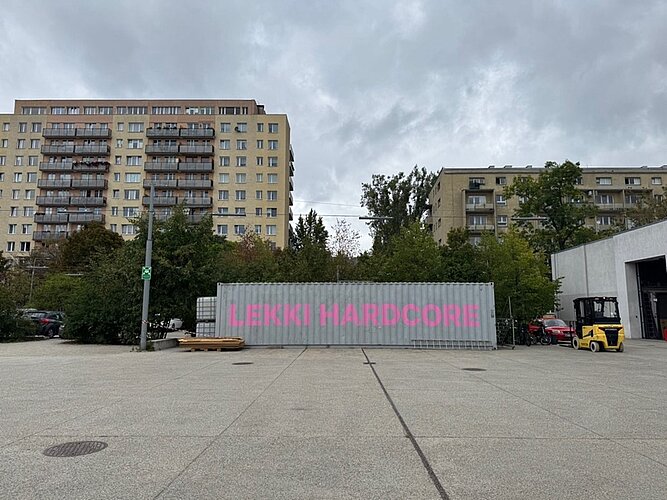
During our tour of Nowy Teatr the previous day, Gruszczyński had told us about the theatre’s ongoing tensions with its neighbours. Located in a quiet residential district, the venue often faces noise complaints and suspicion from local residents. To pre-empt objections to NarcoSexuals, large tarpaulins were hung around the courtyard to shield the performance from outside view. As I moved among the spectators, I became aware of the strange distance between the performance and its surroundings: this charged, queer spectacle felt out of step with the calm, middle-class neighbourhood enveloping it. In our discussion afterwards, we found ourselves asking whether this was the “right” performance for this place. The question felt uncomfortable. Why should this production, more than others, be asked to account for its local context? Was it because it was a visiting work, because its provocation was more visible, or because queer performance still carries a heavier burden of justification?
What remained clear, however, was how powerfully the performance sharpened our awareness of the relations between queer space and urban life. Here, queer culture was not confined to hidden or alternative venues but inserted directly into the public fabric of the city – a gesture of visibility that feels vital at a moment when anti-LGBTQ sentiment in Poland is again intensifying.
By the end of our visit, Warsaw felt at once familiar and entirely new: a city rebuilding itself through cultural ambition, where theatre continues to serve as both mirror and testing ground for urban transformation.