Joseph Prestwich
During our first research trip to Berlin, we visited Wir bleiben, a small exhibition on gentrification and resistance at the Humbolt Forum. Participants in a video presented as part of the display noted two cities that they hoped Berlin would avoid becoming like: London and Paris. I always understood the reference to my case study city of London, a place known for its large-scale, fast-paced regeneration, declining social housing, rising rents, and increased unaffordability. Despite having only visited Paris briefly in 2013, to label it in this way seemed to me a misnomer. Indeed, as Aurélien has noted throughout our project, the word gentrification itself has an ambiguous place in the French-language urban studies academic discourse. I was nevertheless intrigued to discover where this view came from, and what processes of gentrification would be visible to us as made our way around the city.
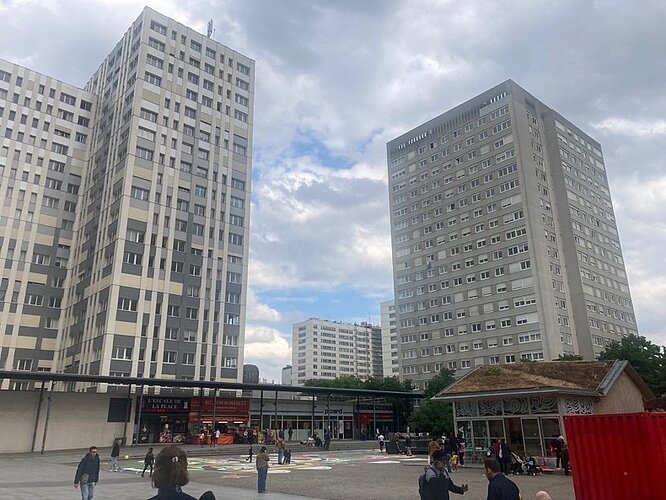
We were staying just off the Rue de Belleville. The street marks the border between the 19th and 20th arrondissement and, in a 2024 Time Out article, was called the twentieth ‘coolest street in the world’. Our first walk took us up to the Place des Fêtes in the 19th, a mid-century residential complex with a high concentration of social housing surrounding a bustling and (seemingly) socially mixed square. At the centre of this open public space sat Le Cabanon de la Place des Fêtes, a “citizen kiosk” that defines itself as a “unifying and local hub” for information sharing and the hosting of community and civic events. I was struck by the literal and metaphorical centring of this space and service amongst the high-rise housing blocks. It was here that we posed a question that arose continuously throughout our research trip: what makes a place (whether civic or cultural) inviting? What draws a mixed social crowd in?
Centquatre put forward a compelling answer to those questions. This mixed-use cultural venue opened in 2008 in a renovated municipal funeral services centre that hosts art exhibitions, cultural events, and performances. Our bags were inspected on the way into a courtyard which led into a cavernous, post-industrial space, not too dissimilar to the Turbine Hall in London’s Tate Modern: it even had the same glazed, grey, concrete floor. But rather than hosting a centrepiece art exhibition, the vast room was filled with people of all ages dancing. Small groups rehearsing routines, couples engaged in varying forms of ballroom dancing, young men spinning on their heads and breakdancing, jugglers. I found the spectacle fascinating from a people-watching perspective. The space is free to use, and the diversity of forms on display (and the people enacting them) was clear to see. Around the open floor space were small shops, cafes, restaurants. We stopped at one for lunch. Our server, happy to speak English and ask us about our research, trusted us to grab some metal cutlery, eat wherever we like in the centre, and bring back our utensils. He told us about the different ‘crowds’ Centquatre holds, and how the daytime crowd we were seeing was very different to the crowds that arrived at night, when the more typical middle-class cultural consumer arrived for ticketed shows and performances. This teased the centre’s broader financial model of patronage. But what are the chances of these crowds mixing? What would tempt those utilising the space during the day to engage in the evening cultural programmes?
Centquatre reminded me strongly of London’s National Theatre, a similarly open cultural venue that creates space for individual or civic activities without necessarily having to become a commercial consumer to gain access. The National Theatre’s carpets, desks, and chairs gear activities more towards desk-based work, writing, and the testing and playing of board games, rather than the more embodied performance forms on display at Centquatre. Where the institutions differ is embeddedness in a local community. The National Theatre sits as a monumental theatre within a broader cultural and tourist location (Southbank). Centquatre is literally surrounded by the mixed residential communities it seeks to serve, with tower blocks peeking out over the top of the building as reminders of this commitment to localism.

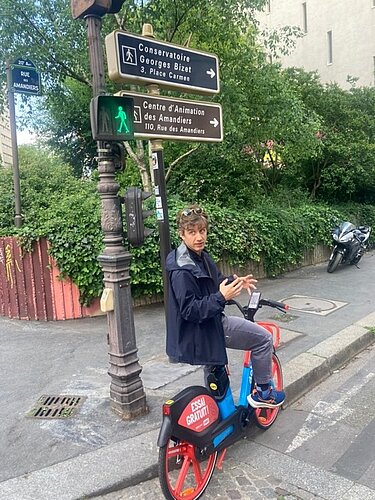
I left Paris thinking a lot about social mix. Is this a fantasy? From Centquatre to Place Henri-Krasucki, it seemed like we’d witnessed attempts in the broadest sense at establishing and maintaining this urban mixity. Similarly, the large percentages of social housing across the different arrondissement (40% in the 19th) suggest a concerted effort to support lower-income residents, rather than exclude. Of course, we saw venues that architecturally and symbolically excluded, with Théâtre Ouvert being the starkest example. But it is the memory of Centquatre that remains the most potent in my mind. Well, that and the sight of my research colleagues navigating the Parisian traffic on electric bikes… Returning briefly to Wir bleiben, I must admit that I did not find myself despairing as we walked and cycled around Paris. Quite the opposite: I felt hopeful about the strength of cultural institutions to make equitable space for artistic agency to flourish.