


Emine Fişek
As the core research and writing phase of our collective project draws to a close, I am realizing how much of a relationship I have developed to each of our cities. Istanbul, my own case study (and the city where I was born and grew up), stands apart for obvious reasons. Of the remaining cities, however, Paris was the one in which I had spent the most time, and where I was expecting to experience the strongest sense of emplacement. Turns out, I could not have been more wrong!
From 2007 to 2010, I spent quite a bit of time in Paris, where I was conducting research for my doctoral dissertation. I was interested in the range of theatre and performance productions that had emerged in response to the controversial immigration politics of the time, including a crackdown on undocumented immigration and increased surveillance of banlieues. (This period coincided with the longue durée of the post-9/11 war on terror, as well as the aftermath of the 2005 banlieue protests.) There were performances popping up everywhere – in local cultural centers, organized by immigrants’ rights associations, as well as in more traditional venues. As a result, my experience of the city was very fleeting: looking back, I remember spending hours on the urban metro and suburban RER train lines, going from Barbès to Blanc-Mesnil, or from Porte des Lilas to Montreuil. Back then, as now, going from one banlieue to another was quite difficult, and almost always required re-routing through the city center. So I would wander through the central transit hub of Châtelet, trying to remember the direction in which I was taking a particular line. (My longest research stay was in 2007 – long before I acquired a smartphone!) At the time, all of this was exciting to me, but also exhausting, and I have vivid memories of coming home at the end of the day and collapsing from mental and physical overload.
In contrast, the Paris that I encountered during our research trip was… smooth! Electric bikes were stationed throughout the city, trains had been upgraded, former RER stops had been turned into extended stops on metro lines, and new lines were being completed. (Travel between banlieues is still difficult – as we discovered when we found ourselves standing in front of the Théâtre Gérard-Philipe in Saint-Denis an hour before a performance we were due to see would start at the Théâtre des Amandiers in Nanterre!) Nonetheless, everywhere I looked I felt like I saw infrastructure that was meant to ease movement, increase access, and generally incentivize mass public transit. What could go wrong?
Turns out, quite a few things. At the start of our journey, Aurélien reminded us that many of these changes were associated with dual, and controversial, developments: the urban developments that had preceded the 2024 Paris Olympics, and the ongoing preparations for transforming the Paris region into a vaguely defined yet decidedly real “Grande Paris”. As gentrification scholar Anne Clerval has argued, Grande Paris has already resulted in increased development and speculation surrounding the new transport hubs that are emerging in the city’s suburbs, particularly in the northeast and east. As these zones become better connected to the center, major renovation work, as well as the construction of new housing units are threatening to trigger unprecedented gentrification(s) and destroy the social mix that the city’s Socialist-run municipality has worked to generate. Meanwhile, social mix itself is turning out to be part of the problem: this benign sounding term often involves “mixing” working-class neighborhoods, rather than diversifying the city’s better-off Western districts, where district municipalities are willing to pay high penalties to halt the implementation of new social housing. In the end, riding the city’s new train lines was comfortable, but I was forced to ask myself: when is something that is good for someone like me, essentially a tourist passing through, also good for the city’s working inhabitants?
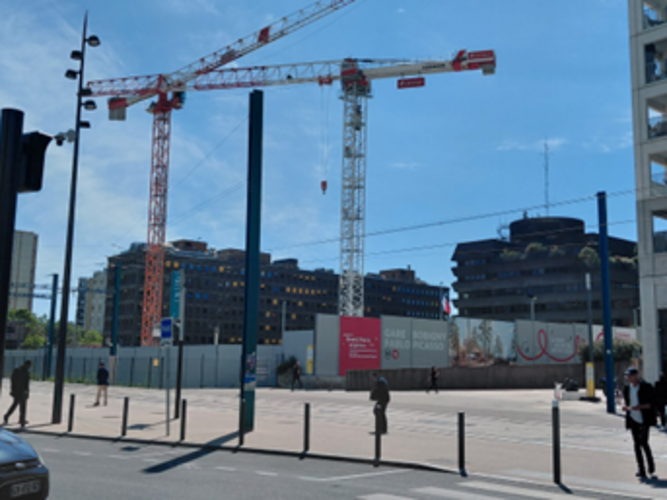
Throughout our Paris trip, this theme of self vs. other kept coming back, and crystallized when we discussed issues of spatial inclusion and performance reception. Aurélien makes a strong argument for how the chain of displacement and replacement that has structured cultural institutions in the city’s northeast is a product of an ingrained cultural hierarchy: community-oriented theaters producing accessible work are being replaced with prestigious yet often inaccessible, avant-garde-identified theaters. As we walked through and around these venues, we found ourselves asking: 1) What makes a space inviting and inclusive? 2) What makes a performance inviting and inclusive? Throughout our trip, we saw examples of how different institutions tackled the first question. In Bobigny, the Bibliothèque Municipale Elsa Triolet used bright colors, user-generated signs in multiple languages, and extensive youth-oriented programming to address the area’s mixed local residents. At the Centquatre, in the nineteenth arrondissement, the wide-open spaces of a former city-run mortuary were left unstructured, as a result of which different groups of performers were using different corners for rehearsal. In contrast, the Théâtre des Amandiers’s newly-renovated theatre in Nanterre was often accessed by shuttle. We were there to see a Comédie Française production of Georges Feydeau’s Une puce à l’oreille (A Flea in her Ear)– when we went to see what the dynamics were like following the performance, we saw that the shuttle had already left, taking its riders back home to Paris.
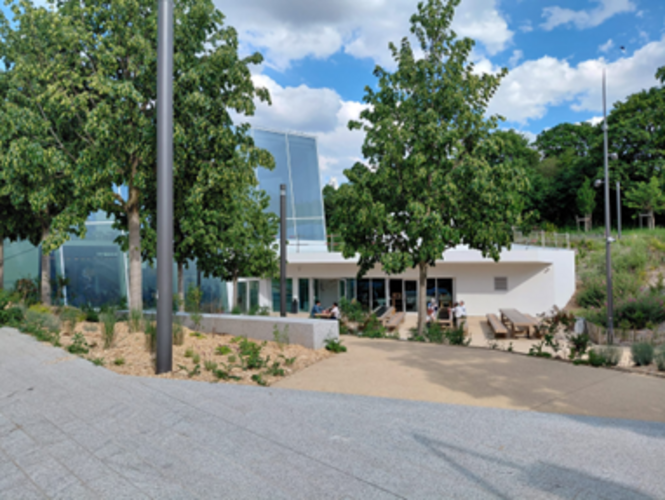
Une puce à l’oreille provided us with an opportunity to debate the second question: when is a performance (in terms borrowed from the German context) “low-threshold”? This is a very difficult question: much like Pierre Bourdieu, we have little interest in arguing that the relationship between class and consumption is determined and unchangeable. We know that artistic sensibilities are shaped via schooling, family, exposure, and mediation. At the same time, Bourdesian sociology can produce its own determinisms, and we know that individual habitus can be shaped and re-shaped as individuals move through intersecting fields. What consequences does this have for reception? Une puce à l’oreille is a classic example of a well-made play, often performed as a farce, about marital fidelity (or lack thereof). It is… well, somewhat lacking in substance. The Comédie Française production leaned into physical comedy, enjoyed good pacing, and with excellent actors at the helm, provided an enjoyable two hours. The play is as canonical as it gets, but also very fun to watch… does this make it low-threshold? More generally, which factors lower the threshold? The presence of actors known from other media industries? Adaptation to a local cultural context? The use of local dialects? As we left Nanterre, I was reminded of how numerous cultural workers in postwar France had devoted careers to debating exactly these questions: What secures cultural decentralization and democratization? How can cultural resources be durably installed within communities and sustained across generations? How does one put aside one’s own cultural proclivities to focus on the needs of another? Our trip to Paris reminded us that there are no easy answers, but we were grateful for the opportunity to remember, once again, the richness of these questions.