


Aurélien Bellucci
From September 18 to 21, 2025, after Berlin and Istanbul, our team gathered for a third research trip in Warsaw. Although we’re already far into the project, a few steps on this trip made me realize the European scope of THEAGENT, within which indeed we are studying “the European city.” Initially, knowing that my work would focus on Paris, I envisioned the research within a national frame which, as a comparatist, I was a little apprehensive about. That was a mistake: it is mostly through international comparisons with other cities that I am observing new aspects of French theater and gentrification in Paris. I understand my case study much better thanks to newly acquired knowledge on other case studies.
To a certain extent, like Istanbul, like Berlin, Warsaw could not be more different from Paris. The near-total destruction of the city during World War Two sets it apart in our project, even though Berlin also suffered massive destructions at that time, and Istanbul went through intensive waves of urban development that transformed the face of the city. To find a comparable upheaval in the history of Paris, one would have to go back to Haussmann’s renovation (1853-1870), which involved the demolition of medieval quarters; it was a decisive step in the city’s embourgeoisement, as well as, some argue, a premise to gentrification.
As we walked through the Polish capital city, we couldn’t help thinking about its destruction, as it had happened to me over my recent IFTR conference stay in Manila, to some accounts the second-most destroyed city in World War Two, after Warsaw. Prior to our trip, I learned from a guidebook that the old town had been rebuilt thanks to paintings by a disciple of Canaletto, who spent the last part of his career at the king of Poland’s court. At Teatr Wielki, we attended an opera commemorating Warsaw’s reconstruction, The Best City in the World, the first scene of which offered a chilling representation of the city’s buildings’ destruction: a large horizontal panel hung over the stage, tipped over, and let numerous little cubes fall onto the ground.
One could observe the different steps of the reconstruction process through the city’s eclectic layers of architecture. We first met at the Palace of Culture and Science, a Stalinist skyscraper that has dominated the city since 1955: in an article on the skyscraper, Michal Murawski writes that “45% of Varsovians can see the Palace from their windows.” We were told, as we walked past an old building were Michel Foucault once lived, that the building inspired his elaboration on the panopticon. The Palace of Culture and Science is a sort of communist cathedral, which towers above the city and celebrates, instead of God, the citizens of the Polish People’s Republic who gathered in congress halls, libraries, research centers, museums, and theaters. At its Teatr Dramatyczny, we attended an adaptation of Tony Kushner’s Angels in America based on Krzysztof Warlikowski’s 2007 production, Angels in Warsaw, which offered another kind of reconstruction, an artistic reconstruction of the AIDS epidemic’s narrative in Poland, drawing on previously unheard testimonies.
The Palace of Culture and Science isn’t the tallest building in Warsaw anymore: the neomodern Varso skyscraper—also the EU’s tallest building—whose observation deck was completed the week before our arrival, has surpassed in height Stalin’s “gift” and put higher in the sky of Warsaw office, commercial, and service spaces, as do other skyscrapers that surround the communist cathedral and symbolize the transition to a capitalist era. Likewise, what used to be the largest public square in Europe, Parade Square (Plac Defilad), has been reorganized and narrowed with the building of the modernist, blocky Museum of Modern Art that engages in a symbolic negotiation with the Palace of Culture as it also shrinks public space. The same dynamic applies to the adjacent new theater building for TR Warszawa, which is under construction.
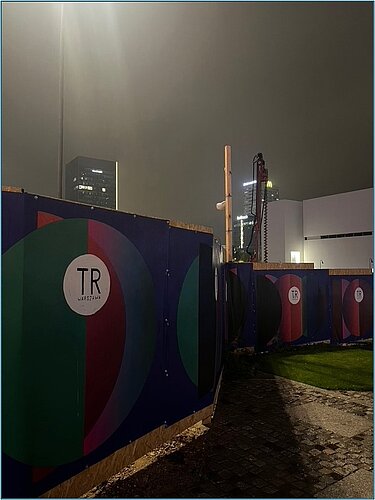
Although one should rejoice, everywhere, in the building of a new theater, one can still legitimately question the reduction of public space it entails. Why build a new theater next to the palace complex which already houses four theaters, including a total of six stages? Why diminish the size of a public square where people can meet, unite, and play their part as citizens? TR Warszawa is admittedly a public theater, but who will be the audience? These questions tie into broader considerations in our project on the use of public funding and the dilemmas it entails: as a theater scholar, I need to be critical of public institutions that could better fulfill their public mission, yet I am wary of giving ammunitions to detractors of public support for the arts. In a conversation with a theater maker over Wedel hot chocolate, we were told that public theaters—Warsaw funds about twenty—struggle to attract audiences (Angels in Warsaw had a half house); I couldn’t help thinking of an interviewee in Paris who complained, likewise: “we fund empty seats.”
In Warsaw, as in Paris, it seems that some public theaters are better at leading the avant-garde than they are at attracting new audiences. Even when they are built in working-class neighborhoods, for local communities, they attract the usual theatergoers. Nowy Teatr is a case in point. Located in a former garage in Mokotow, it was conceived by Warlikowski as a “new and daring place,” presenting both Polish and international artists. Administrators do not have to justify their audience to obtain public funding, and they lead the same kind of “open policy” as new theaters in northeastern Paris, like the Centquatre, with a trendy bookshop and a vegan restaurant. As we attended Dries Verhoeven’s NarcoSexuals in the theater’s backyard, I felt that the performance’s location was not right: we were in the shoes of voyeurs walking around a mobile home and observing an ongoing chem sex party inside, at the center of a residential neighborhood; it reminded me of the misplaced production of Castellucci’s Bros at the MC93, Bobigny’s House of Culture, which would make for a terrible first theater experience, should it be attended by new spectators…
As we embarked on a guided tour aboard a vintage Jelcz 043 bus to Praga, across the Vistula, on the “dark side of Warsaw,” in our guide’s words, we stopped by another former industrial place that was renovated into a cultural space: the Praga Koneser Center (former Vodka Factory Koneser), which I could have mistaken for Berlin’s Kulturbrauerei or Istanbul’s Bomonti Bira Fabrikası. The former vodka factory was also turned into a complex of residential, office, and cultural facilities. It was there that Nowy Teatr was inaugurated in 2009, with Warlikowski’s (A)pollonia, before it moved to its new venue in Mokotow in 2014.
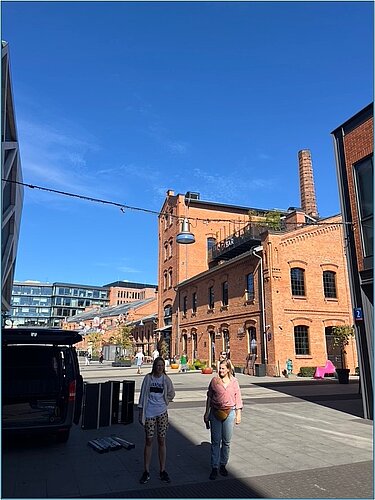
Our tour guide reminded us that whereas about 80% of Warsaw’s left bank had been destroyed during World War II, it was the case of approximately 20% of the right bank, which is “what makes Praga valuable.” He added that gentrification thrived on the closing of local factories and would make Praga “one of the most expensive parts of Warsaw in ten to fifteen years.” The Jelcz 043 took us from de-industrialized areas to revitalized complexes through decaying buildings adjoining luxury housing. As we went through Stalowa, he told us that this street had “a lot of potential because on both sides it’s kept its architecture.” Indeed, long banners promising an embellishment of the neighborhood (“Praga na nowo”) enclosed beautiful old buildings made of red bricks that stood in a dilapidated state. Below the name of the housing complex, “Stalowa 39,” one could see the local brand of a French real-estate developer: Bouygues Immobilier Polska.
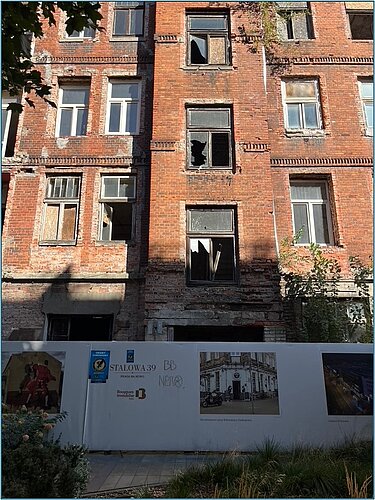
Going out of Stalowa 39 back into our vintage bus, we passed a few fashionable stores and a bistro offering a selection of natural wine. One might have thought then that the street lacked a cultural facility for the gentrification process to be complete, yet there is actually an annual street festival that turns Stalowa into a cultural hub with concerts, performances, and exhibitions… Or would it be that this festival was itself a trigger of this local process? It may sound unfair to criticize public theaters for occupying public space. After all, many of them struggle to keep their own venue under developmental pressure. TR Warszawa is moving to Parade Square because it is losing its venue, and Teatr Żydowski im or Komuna Warszawa, which we visited on the left bank, both feel this kind of pressure. If and when they relocate, what kind of space will they take? A public square? Renovated buildings in Praga? Or will they replace older institutions as it happens in Paris?