


Joe Prestwich
Similar to my colleagues, when faced with deciding on the itinerary for our penultimate research trip, I faced two major questions. Firstly, how to account for London’s long history of gentrification within three days? Ruth Glass’ Islington, Tim Butler and Loretta Lees’ Barnsbury, Andy Pratt and Andrew Harris’ Hoxton…there are a multitude of neighbourhoods that all hold within them an enticing and relevant story of urban regeneration. Paired with this was my second issue: how to navigate the city without forcing the group to spend hours of the day in the cloying and dirty heat of the Underground? The resulting route attempted to recreate the journey my reader goes on in my case study chapter, a journey from commercial centre outwards to London’s more peripheral gentrifying neighbourhoods. My choice of hotel was, in this regard, purposeful. Right at the crossroads of Tottenham Court Road and Oxford Street, each day’s journey invited a comparison between the city’s commercial heart and its radial districts.
Thursday Evening
A brief but productive meeting gave way to our first walk in the city. Passing by @sohoplace, the first new-build West End theatre in 50 years, we entered Soho, a district known for its boutique restaurants and shops, as well as its LGBTQ+ nightlife. The area’s salubrious past and gentrified present continue to sit side-by-side. A quick passage through Walker’s Court sees the neon signs of a sex shop reflect on the pristine beige brick of pop-up storefronts and the newly built Boulevard Theatre, currently run by Underbelly.
Heading back to the hotel after dinner, we passed by Outernet, a mixed-use live entertainment complex housing a performance venue and an almost non-stop ‘immersive’ audio-visual ‘experience’. We stopped by here to gawp at the (admittedly impressive) Ultra HD displays showcasing works by various visual artists. I kept thinking in this free exhibition: what’s the catch? What (or who) is the product here? What are we being sold? Not finding a conclusive answer, we let our eyes adjust back to the darkness of Tottenham Court Road and called it a day.
Friday
Our first port of call was the Queen Elizabeth Olympic Park in east London. Built on a brownfield site specifically for London 2012, this area is still undergoing major redevelopment in efforts to make it a cultural and academic hub. Passing through Westfield Shopping Centre took us to the so-called East Bank, a canal-side row of new structures including a new dance theatre (Sadler’s Wells East), a museum (V&A East), a concert hall (BBC Music Studios) and university buildings (for London College of Fashion, and University College London).
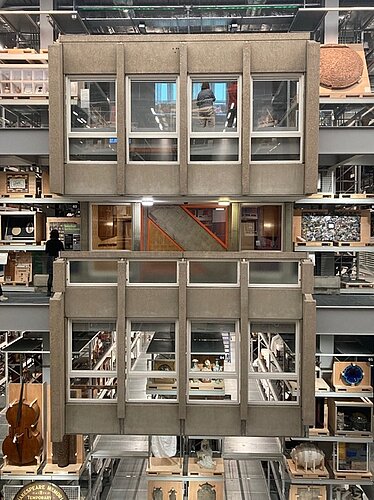
We then stopped off at V&A Storehouse East, another new museum that presents as a curated warehouse, displaying various objects often without context. A fully reconstructed 1920s Frankfurt Kitchen sits round the corner from the façade of Robin Hood Gardens, a social housing estate demolished in 2024 but partly preserved here. London’s social housing history symbolically rendered as something fit only for a museum.
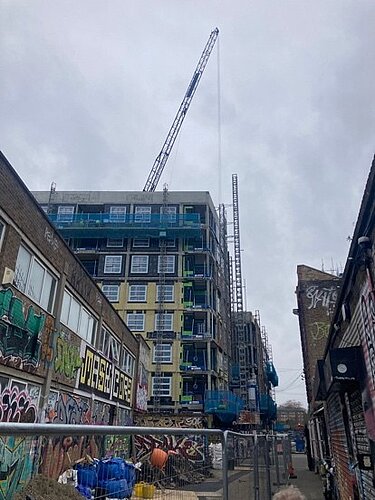
We connected with urban studies scholar Andy Pratt, who gave us an excellent potted history of Olympic Park and adjacent Hackney Wick and Fish Island. Taking us on a brief walk, he showed us the world’s first plastic factory and Two More Years, another mixed-use building with co-working spaces and a bar, but crucially, a provider of cheap studio spaces for local creatives. This space encapsulates Hackney Wish and Fish Island as a neighbourhood battling to preserve its status as a home for the creatives that have inhabited the area since the turn of the century in the midst of large-scale development.
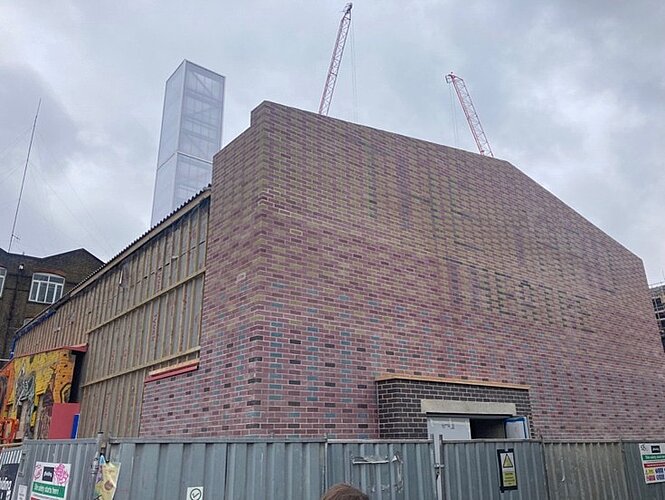
From east we moved rapidly to what I refer to in my chapter as the symbolic centre of London’s subsidized theatrical field: the Southbank. Theatre and performance scholar Michael McKinnie took us on a brief tour of the Vaults, Royal Festival Hall, and the National Theatre, taking in these monumental cultural venues and their significance in relation to public arts funding in the post-war period. That evening, we attended a performance of The Authenticator by Winsome Pinnock in the Dorfman Theatre at the National Theatre. The three-hander provided an excellent example of contemporary British theatre writing, an ironic take on the relationship between histories of enslaved people and English national heritage.
Saturday
Our final day took us through affluent Bloomsbury, past Ruth Glass’ (supposed) former office, to see Camden People’s Theatre (one of my case study theatres alongside Hackney Wick’s Yard Theatre) and New Diorama Theatre, a theatre constructed in 2010 through a section 106 agreement, legally binding contracts between local councils and private developers frequently used in the UK for the provision of new or renovated cultural venues. We stopped by Tolmer’s Square, an enclave of social and private housing with a notable history of squatting and resident-led resistance. Afterwards, we took a spontaneous trip to A Space for Us? People’s Museum Somers Town, a community-led museum archiving the areas working class histories. We bumped into Diana Foster, director of the museum, and later, Esther Leslie, another co-director of the initiative and its academic lead. We had a spirited conversation about the neighbourhood: is it gentrifying or not? Sure, people are being priced out, but is that gentrification?
The day wasn’t over yet however! We moved swiftly down to Elephant & Castle to experience a typical example of contemporary new-build gentrification. We walked from the station down Walworth Road, witnessing the shift in businesses and housing as we moved further from Elephant Park in a sort of reversal of gentrification, and had lunch at one of London’s last remaining pie, mash and eel shops (the eels did no go down well). To warm up, we took a trip to a nearby Gail’s, a coffee shop and bakery chain now synonymous with gentrification in the city. If a Gail’s moves in, it’s a sign the neighbourhood has changed, and the prevalence of the café chain was noted by one of our group, calling it a ‘Trojan horse’ of gentrification.
From Elephant and Castle we moved further south to Peckham, stopping by Theatre Peckham (another theatre built through a section 106 agreement). The contrast to New Diorama Theatre was stark. Whilst NDT sat within a campus of offices and cafes, Theatre Peckham resides in a residential district, and the space was open and set up for community use when we visited. We visited Peckham’s self-styled ‘cultural quarter’, Copeland Park (formerly known as the Bussey Building). I found this space markedly changed since the last time I had visited. More bars, more infrastructure, more commercialised. But still an area aimed squarely at young creatives looking for studio space in a now-desirable part of London.
Our marathon day ended in Woolwich, south-east London, to experience Lander 23, a live-action video game created by immersive theatre pioneers Punchdrunk. I chose this as a fun way of demonstrating the experience economy that is so noticeable in London’s theatre and performance scene. And with that, the trip was done. Onwards to Paris for our final stop!