Aurélien Bellucci
From March 26 to 29, 2026, our team gathered for our fourth field trip on theatre and gentrification, in London, where it all started! Ruth Glass coined the concept of “gentrification” in the British capital in 1964 to describe a process by which “all or most of the original working-class occupiers are displaced, and the whole social character or [a] district is changed.” It had happened in “Hampstead and Chelsea,” and it was then spreading “to Islington, Paddington, North Kensington – even to the ‘shady’ parts of Notting Hill – to Battersea.”
I hadn’t been to London for about ten years, I didn’t remember its geography very well, and, almost three years into our project, I could finally put real places to those names. At the same time, I was reminded of accounts we’d heard during our first field trip to Berlin, in September 2024: people there hoped that their city wouldn’t become “another London or Paris,” implying that gentrification had long transformed these cities. As I am organizing our next field trip to the French capital, it felt only right to first pass by Ruth Glass’s UCL office and think about what had happened to London, as always, from a comparative perspective.
We were based in Bloomsbury, itself an area associated with writers and intellectual life, right on the edge of London’s West End theatre district. Although some of the nearby Georgian squares – such as Bedford Square and its private garden – seem to have been upscale neighborhoods for a long time, other parts of Bloomsbury must once have been more affordable and attractive for writers, students, and academics. What part did the legacy of the Bloomsbury Group and the proximity of the theatre district play in the rise of property values? What role was played by the expansion of the University of London and the British Museum, and by the development of tourism? Wandering through the area, and wondering about its past transformations, was a pleasant way to begin the trip before meeting colleagues.
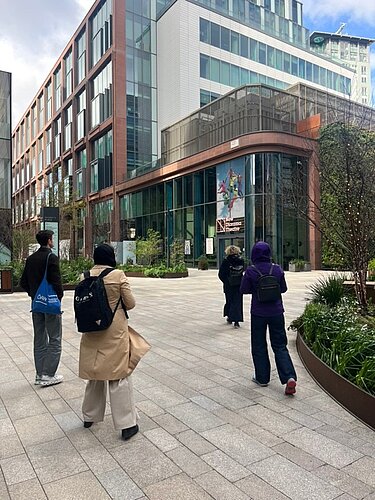
The study of recent trends in gentrification, of course, required that we explore areas beyond Central London. On Friday morning, we took the Tube to Stratford and walked to Hackney Wick through the Olympic Park. The whole area was redeveloped for the 2012 Olympic Games and everything looked brand new, and quite deserted as well. Aside from the massive sport installations, such as the London Stadium, we could observe how the East Bank has become a new cultural cluster for a global creative city. After entering the new Sadler’s Wells dance theatre and training hub, located alongside the London College of Fashion and future BBC studios, we visited the interesting V&A East Storehouse, and we passed by the construction site of The Yard Theatre, one of our colleague Joe’s case studies, which we had heard and read much about and very much were looking forward to seeing.
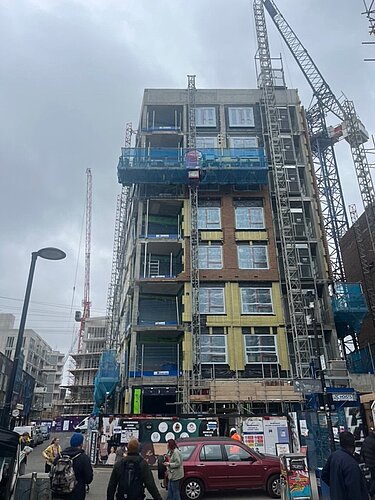
Originally a temporary theatre opened in 2011, The Yard quickly became one of London’s most innovative fringe venues, and the question is now whether its institutionalization – as a permanent, larger, well-funded theatre – will still be conducive to the creation of cutting-edge works, a question that also arose, during our previous field trip, for TR Warszawa. The construction site was one among many in Hackney Wick. I cannot actually remember, in my travels, seeing so many cranes in such a small perimeter; fourteen years after the Olympics, the area’s development hasn’t stopped. Over lunch with Andy Pratt, we discussed how the area used to be renowned for having the highest concentration of artists in Europe, before they were priced out. A creative city without creatives?
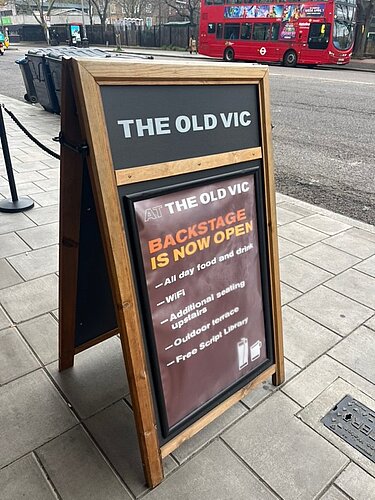
In a different context, in the Parisian district of Belleville where we will soon be staying, observers have argued that the decrease in the number of artist workshops over the past fifteen years is a token of gentrification’s progression (Hacène Belmessous, Paris n’est plus une fête, 155-156). And the recent building of new cultural venues does not imply that artists can stay put, nor that the district’s residents make the most of these new venues. Reaching out to residents, and to new publics in general, remains a public imperative as well as wishful thinking for cultural venues in Paris as in London. It is interesting to observe, here and there, the similarity of theatres’ hospitality policies. On Friday afternoon, we had coffee at the Old Vic’s Backstage, a recently inaugurated building with a daytime café and workspace that turns into a bar and restaurant at night. It is described as a “space shaped by people, open to all, built for creativity and rooted in community.”
Does Backstage attract new crowds, non-theatregoers? If it does, do they go on to attend a performance after coffee or drinks? After the Old Vic, we walked through the Vaults to the original cultural hub of the South Bank, an early example of urban regeneration through cultural clustering that stretches toward the National Theatre, the Globe, and Tate Modern, which announces itself in capital letters high on its façade: “TATE MODERN – FREE AND OPEN TO ALL.” The antagonism between development that prices out residents and artists and the hospitality policy of theatres and cultural institutions that seek to reach out to the greatest number is observable in other boroughs of London as well, though they might attract less attention than the South Bank.
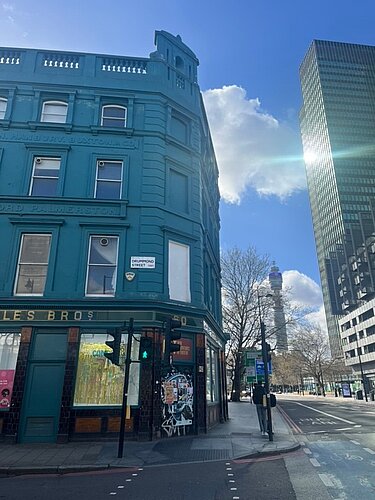
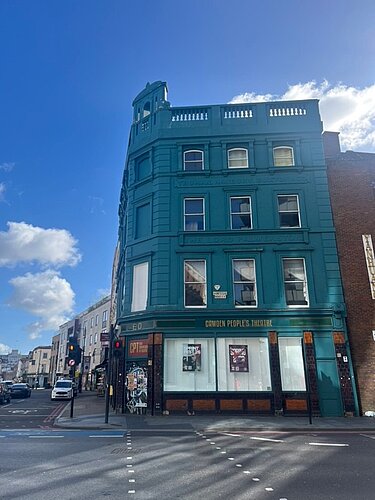
On Saturday, in the central borough of Camden, we passed by two other theatres Joe had written about, the New Diorama and the Camden People’s Theatre. Both institutions have been known for supporting emerging artists and companies and for offering accessible, politically engaged works. Yet both are also embedded in processes of renovation of the borough: the first one opened as part of a Section 106 agreement in 2010, within the Regent’s Park development plan; the second one’s building itself has been undergoing redevelopment since 2020. Who are these new theatres meant for, old or new residents? While the New Diorama looks like an anomaly at the foot of brand-new office buildings, the CPT lies at the border between the towers of Regent’s Park and the historic social housing of Euston. Further away, in Somers Town, we stumbled upon the People’s Museum, where we learnt about the area’s social housing history – much influenced by Karl-Marx-Hof in Vienna, which we visited last year – and the challenges residents face.
Somers Town’s social housing is stuck between the large-scale redevelopment of King’s Cross to the north and east and the institutional and infrastructural transformations around Regent’s Park to the west. As we stumbled upon and introduced ourselves to the museum’s founder, she told us that the area is not experiencing gentrification so much as it is threatened by “development, institutions,” as well as the adjacent “Knowledge Quarter” (around the nearby British Library). She also shared with us programs of the Unity Theatre. The people’s theatre group originated in the area and acted for the area’s working class through the twentieth century, for about sixty years, until its activities ceased in 1994. By then, members of the group founded the CPT. What is left of their legacy today?