


How to capture, in just three days, the contradictory faces and competing visions of a city that has been fundamentally reimagined several times over the course of little more than a century? Warsaw presents itself as an eclectic collage of urban ideologies – prewar tenements layered beneath socialist modernism, selective preservation and historical reconstruction, and the current wave of aggressive development in the process of becoming a global city. The task of planning our Warsaw itinerary demanded balance: between artistic experiences and characteristic neighborhoods, between theatre visits and the visible manifestations of gentrification (a process that, unlike in other European capitals, remains curiously absent from mainstream public discourse, and recognized mainly in the districts most acutely affected by it).
The selection of performances posed its own difficulties. What would be available and what might best address our themes? Urban transformation and gentrification still remain nearly invisible subjects in Polish theatre, which tends instead toward existential and identity-driven explorations. Yet here we were extraordinarily fortunate: the world premiere of an opera inaugurating the renowned contemporary music festival Warsaw Autumn – The Best City in the World: The Opera about Warsaw – felt almost as if commissioned with our research interest in mind. Our theatre program would span different visions and historical moments of Warsaw, from postwar reconstruction, through late communist Warsaw in the mid ’80s, to the contemporary.
Our itinerary would take us from the prewar tenements of Praga, a district now undergoing intensive gentrification, through Mariensztat, the first postwar housing estate, past socialist modernist residential blocks, into the hyper-gentrified center, and finally to the newest developer estates marketed as "investment units". We would visit Plac Centralny, the Museum of Modern Art, and the under-construction new home of TR Warszawa – destined to become one of Europe's most advanced theatrical buildings, embodying culture's role in building the city’s image.
We began our journey – how else? – at the Palace of Culture and Science, Warsaw’s most recognisable and ambivalent symbol (sometimes dubbed ‘Stalin’s middle finger’). The Palace itself framed our first encounter with Warsaw’s contradictions: a gift that was also an imposition, still dominating the skyline and impossible to ignore, yet by now well integrated into the city’s cultural, commercial, and social life. It houses several theatres, a concert hall, cinemas, museums, and popular cafés. We stopped by Café Kulturalna and attended Angels in Warsaw at Teatr Dramatyczny.
Our first full day began with chocolate at Wedel’s historic café and a conversation with Dr Paweł Płoski, whose deep knowledge of Polish theatre and perceptive understanding of its challenges proved invaluable. From there, we made our way to Plac Centralny and the Museum of Modern Art. The new MSN building, opened in 2024 on Plac Defilad, has already sparked controversy — not only aesthetic objections, but also deeper questions about its coherence with the surrounding architecture. The city authorities’ decision to keep this valuable central space open and accessible — for people rather than for business — stands both as a declaration of values and as an investment in city branding through culture. The new TR Warszawa theatre, currently under construction nearby, further reinforces this cultural vision.
We then walked to Osiedle Za Żelazną Bramą (‘Behind the Iron Gate’) the first modernist residential complex that became a prototype for functional housing later replicated across Poland. Built in the 1960s and early 1970s, the estate exemplifies how ambitious architectural ideals were gradually compromised by state-imposed requirements: adding more floors and apartments, reducing living space, and simplifying design. Located in the very heart of the city, it was also among the first housing estates to experience gentrification, beginning already in the 1990s. Today, many of its original spatial qualities — particularly its green areas — have disappeared, while numerous new residential blocks have been constructed between the older ones. The area thus embodies a double transformation: from socialist ideal to socialist reality, and then from centrally planned socialism to capitalist, market-driven urban development.
A starkly different example in our itinerary posed Osiedle Bliska Wola, the so-called "Warsaw Hong Kong". Built in 2020, these "luxury" residential blocks offer micro-apartments falling below Poland's official housing standards – the legal minimum is 25 square meters. Marketed as "investment units" for rental purposes, these flats can only be purchased in cash, since they do not qualify as residential properties and cannot be financed with mortgages. The estate exemplifies "patodeweloperka" – a term describing the pathology of a housing market driven primarily by developers' interests. Yet developers counter that these units respond to market demand, fulfilling young people's aspirations and are suited to an "urban lifestyle." The rhetorical gap between pathology and aspiration also seems to capture something essential in debates about Warsaw's contemporary development.
In the afternoon, we visited two of Warsaw’s most recognisable centres of avant-garde theatre. At Nowy Teatr, dramaturg and deputy director Piotr Gruszczyński guided us through the venue and spoke about its mission and ongoing challenges. From there, we walked through the rapidly changing southern districts to TR Warszawa, where director Anna Rochowska shared insights into the theatre’s operations and the construction of its new building. The scale of investment in the new TR facility — located next to the Museum of Modern Art on Plac Centralny — signals the theatre’s intended role in Warsaw’s cultural rebranding.
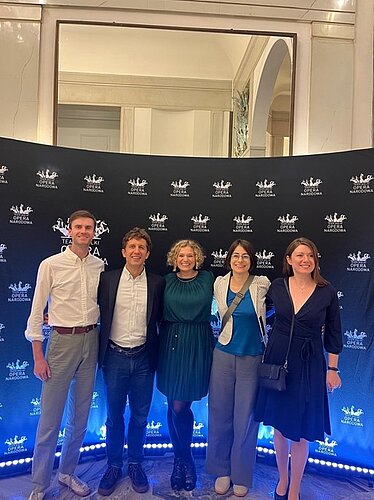
That evening brought us to Teatr Wielki Opera Narodowa (National Opera) — for the world premiere of The Best City in the World: An Opera about Warsaw. Co-produced by Opera Narodowa and Sinfonia Varsovia, the work grappled with the mythology of post-war reconstruction: the fierce determination to resurrect Warsaw from ruins, the ideological investments in that process, and the costs and compromises it entailed. The opera felt uncannily aligned with our itinerary, weaving together different historical moments and competing visions of the city.
On our second day, we began with a guided tour of Praga Północ aboard a retro bus — the Dark Side of Warsaw tour. The commercial packaging of Praga’s “atmospheric” character as a tourist attraction — combining elements of local urban culture with its once semi-criminal reputation and its newer image of street art and independent culture — was itself a characteristic narrative of gentrification. The tour took us past the Koneser Centre (the former vodka factory), the Wedel factory, Różycki Market, the severely neglected tenement houses on Brzeska Street, layers of graffiti, and the developer-built apartment blocks now sprouting everywhere. The format proved practical for covering a large area, though we noted how the discourse of gentrification frames Praga differently from the city centre — here, the process remains more visible, more contested, perhaps because displacement is more immediate.
We had lunch at Bar Mleczny Świętokrzyska, one of Warsaw’s few surviving state-subsidised cafeterias from the socialist era, before exploring the Old Town: Plac Piłsudskiego — site of the planned reconstruction of the iconic Pałac Saski — and the Ogród Saski. We also visited, albeit briefly, two theatres caught in the pressures of gentrification. The Jewish Theatre has waited years to return to its home, closed without notice for “modernisation” by the building’s new owner — with promises of restoration never fulfilled. Since late 2016, it has operated from temporary venues. Teatr Kamienica has likewise fought for years to remain in its tenement home, battling a new owner who attempted to register fictitious organisations to engineer its eviction.
We then explored Mariensztat, the first housing estate built during postwar reconstruction, constructed largely from rubble materials. Designed in socialist realist style and heavily promoted through culture – including the film Adventure in Mariensztat, Poland's first color movie – the district was meant to symbolize the new city. Construction became a field of competition among workers racing to complete buildings in record time; a city legend claims 19 days for one building. Predictably, speed compromised quality – walls cracked, structural problems appeared, appeal diminished. Today, Mariensztat is still waiting to be rediscovered for tourism; stands nearly deserted right beneath the restored castle and Old Town, Warsaw’s main tourist attractions. We then rushed back to Praga for Kobieta Samotna (A Lonely Woman) at Teatr Powszechny – an engagement with contemporary precarious realities and the pressures of rising living costs. We ended the day visiting a performance of NarcoSexuals by Dries Verhoeven, part of the New Europe International Festival at Nowy Teatr.
The next morning, we concluded our expedition with a visit to Komuna Warszawa. Operating in a former school building at Emilii Plater 31, Komuna has its roots as an independent collective and has pioneered a unique social cultural institution model. For over 30 years, it has supported grassroots creativity, offering residency programmes and becoming one of the most influential institutions for independent artists nationwide. Previously operating in a Praga tenement at Lubelska 30/32, the group relocated to the center after that building's closure. The school building no longer serves its original educational function, as there are not enough children living in the super-gentrified center. Komuna occupies a paradoxical position: holding preferential status as a social cultural institution, yet fearing eviction now that zoning plans permit buildings up to 100 meters on the plot.
In retrospect, the density of information and experience over these three days seems to trace the movements that remain the city's defining characteristic: a place perpetually under construction, never quite finished, always negotiating between competing claims about what it has been and what it might become.