Regina Lissowska-Postaremczak
"Istanbul is the new cool" serves as the catchy slogan for the city's new tourism campaign.
While this tagline certainly captures Istanbul's exceptional appeal, it also reveals something deeper about the city's evolving identity. Behind this marketing phrase lies a deliberate strategy to reshape urban spaces primarily around tourism and consumer experiences. So, from the perspective of our research and observations, the slogan resonates somewhat ambivalently, raising the question: cool for whom?
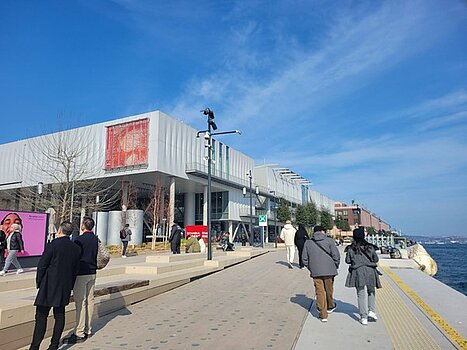
Walking through Istanbul, particularly in its upscale, gentrified areas, we couldn’t help but notice how public spaces seem increasingly exclusive. Many areas that appear public are actually highly commercialized and heavily monitored with security checkpoints and police presence. What's strikingly absent are truly open, non-commercial public spaces. The city, at least as much as we could see, has remarkably few accessible parks, green areas, or even simple benches where residents can gather without spending money. In such dense urban development, this planning approach not only diminishes quality of life for locals but also raises practical safety concerns (i.e. where do people go during emergencies when evacuation areas are so limited?).
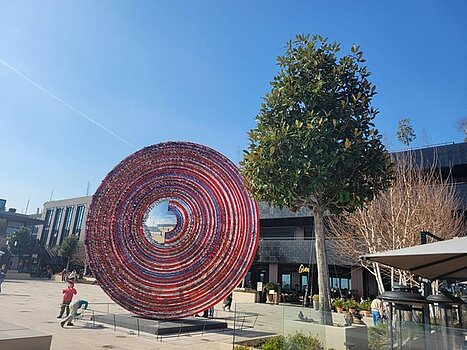
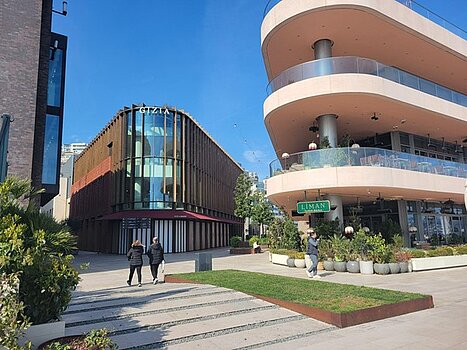
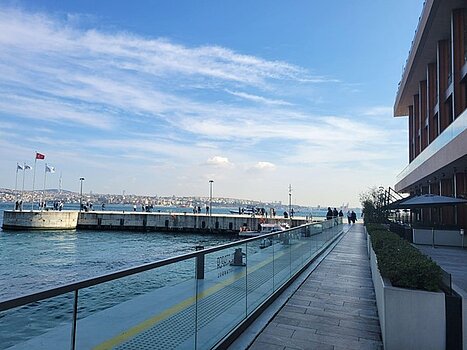
The Galata Port promenade perfectly illustrates this trend. This impressive waterfront development combines contemporary art, high-end dining, luxury hotels, and international retail with stunning views of the bay and historic Istanbul. Yet this space is clearly designed with tourists in mind, particularly cruise ship passengers arriving at the port. Most telling is how a glass barrier physically separates this area from the adjacent, densely populated Karaköy neighborhood. To enter this "public" promenade, visitors must pass through security checkpoints housed within fancy retail establishments.
This spatial arrangement reveals much about who is welcome in Istanbul's reimagined "cool" spaces - and who might be left looking in from the outside.
Independent Theatres on the Edge
We explored several independent theater venues across Istanbul. These visits gave us insight not only into their physical spaces and infrastructure, but also their artistic programming, operational models and challenges - mainly centered around their constant struggle for economic survival. While each theater has its unique character, a common pattern emerged across these cultural outposts.
These theaters exist primarily through the passion and commitment of its creators, who face a twofold struggle: seeking artistic recognition and legitimacy while simultaneously navigating the harsh realities of market economics. Physically, they often occupy spaces that exist somewhat on the margins of the city's prestigious and tourist-oriented areas - repurposed basements, converted apartments, transformed cinemas, and adapted galleries serving as performance venues.
Institutional support options are few, and those available often put their identity at risk, accompanied by various forms of self-censorship. At the same time, this isn't theater as an export commodity - it doesn't aspire to international audiences, instead positioning itself in political opposition and raising socially important questions. Based on observations of audiences and theatrical spaces, I suspect this type of participation likely creates a sense of identity/belonging to a community anchored in shared values and viewpoints.
This theatrical ecosystem suggested to me strong similarities to Poland's independent theater movement during its political transition period (1980s-2000s). Many of those theatres faced comparable challenges: minimal resources, uncertain funding, and the struggle to maintain artistic integrity while surviving economically. Interestingly, many Polish theater practitioners now look back on that challenging period with nostalgia, remembering it as a time of exceptional creativity and authenticity. Despite their material limitations, these theaters - both in contemporary Istanbul and transitional Poland - seem to function less as entertainment venues and more as crucial spaces for intellectual development and critical public discourse. Though often small-scale and sometimes labeled "elite," they seem to perform an essential democratic function by creating alternative public spheres where important social conversations can happen outside mainstream channels.
Reading Beyond Words
During our packed Istanbul visit, we were lucky to see two theatrical performances. As my first encounter with Turkish dramatic theatre, these shows presented an intriguing challenge: how much could I understand without knowing the language? What communicates beyond words? As it turns out, the universal language of theatre speaks volumes.
The first one, "Duo," was a performative evening, originally written and performed by the collective Balat Monologlar Müzesi. This production featured five short dialogues performed simultaneously throughout a three-story house in the historic Balat district. The setting itself was remarkable - intimate rooms accommodating only 5-10 viewers at once, creating an almost voyeuristic experience. Each audience member could choose their own journey through the building, seeing four of the five available scenes.
The physical structure of the house became integral to the storytelling. Each room contained characters living in the same building. Their separate stories were apparently subtly interconnected through passing references. Despite the language barrier, the realistic acting style made emotional arcs surprisingly accessible. Performers relied heavily on physical expression, making intentions clear even when words weren't understood.
The production's modest aesthetics - minimal sets, everyday costumes, repurposed household objects - reflected the economic realities of independent theatre companies operating without government funding. These artistic choices also enhanced the authenticity of the domestic setting.
What became increasingly apparent was the shared dramatic structure across all scenes. Each began with characters in conflict situations, gradually revealing elements of their personal histories and vulnerabilities to each other until reaching mutual understanding of motivations. This process inevitably drew viewers deeply into these intimate exchanges. The pattern of similar dramatic arcs across different personal stories suggested a more universal reading of these dialogues - as a portrait of a local community sharing the same physical space and existential conditions, though vividly differing in their worldviews and personal aspirations.
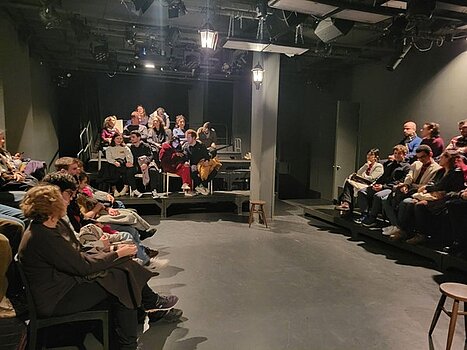
The second performance, titled Öteki Venedik Taciri (The Other Merchant of Venice), staged at Kumbaracı50, presented an adaptation of William Shakespeare's play. Similar to the previous production, this performance embraced visual minimalism. The set design for the stage - surrounded on all four sides by the audience - consisted essentially of two stools, a few necessary props, and a movable "dollhouse" that primarily signaled scene location changes during Portia's appearances (while cleverly housing the caskets and other props related to her storyline).
As in the previous performance, the acting emphasized physical expressiveness, though here with particular focus on aggressively "macho" gestural conventions, evidently referencing specific social codes and behavioral norms.
This interpretation of Shakespeare's drama primarily highlighted themes of tolerance, prejudice, and cultural divisions that fuel social injustice and exclusion. However, in an ending newly crafted by the director, Antonio also becomes visibly excluded and humiliated as an "other" due to his revealed sexual orientation. In this ambiguous conclusion, which subversively reinterprets Shakespeare's theme of mercy, Antonio is equated with Shylock—who invites him to sit, but as far away as possible. This powerful gesture, pushing a chair across the stage, simultaneously signals both aversion and tolerance. The production also subtly alluded to the historical events of the 1955 - pogroms against non-Muslim populations - notably through sounds accompanying the final scenes.