


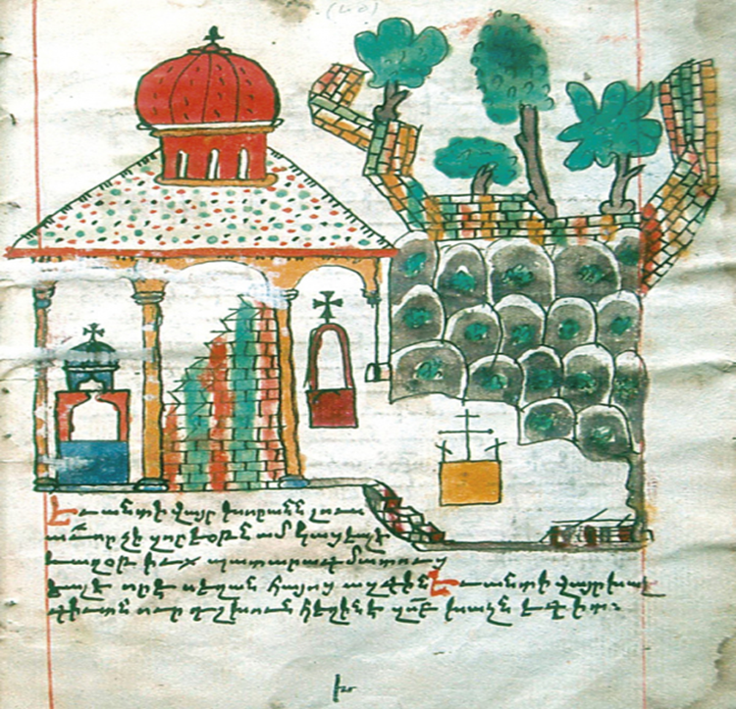
Creating or reviving sacral traditions of specific sites in the late ancient and medieval Caucasus, Armenian highlands, and Upper Mesopotamia was part of a process by which objects and material artifacts gained legitimacy. Regional literary sources such as Armenian and Georgian historiographies, geographies, chronicles, and 'minor' literary texts (poems, sermons, martyrologies, epistolography, travelogues and pilgrimage accounts), as well as archaeological and material evidence, show strategic and institutional approaches to construct, explain, and support the existence and propagation of socio-religious practices that were meant to legitimize a group or a position of authority through inclusion or alienation.
The construction of distinctly sacred spaces and examples of hierophany in the medieval Caucasus can be interpreted both on their own terms and within their wider environment. Hierotopic projects might evoke a wider Christian topography in a vast network of interwoven holy spaces, just as they might reflect the struggle for religious legitimacy and authority. The process of creating holy spaces, such as places of pilgrimage, and of locating relics in a specific geographical and cultural spaces served not only to establish or reinforce connections between the territory and the faith community (‘Glaubensgemeinschaft’) but also to delimitate the social and institutional borders between different religious and confessional identities.
Defining the sacral topography of the Caucasus as a multi-faith and interreligious space and drawing on inter-disciplinary research approaches, this workshop seeks to explore the history of hierotopy in the medieval Caucasus, the organisation and functionality of its sacred spaces, and their social, political, religious, economic, legal, gendered, cultural, visual, and material significance.
The workshop will run over two consecutive days in person on the 4th and 5th of October 2024, with a keynote talk and wine reception on the evening of the 3rd of October. The event will consist of four sessions on day one and two sessions on day two, with each session consisting of two one-hour presentation slots (40–45-minute papers and 15–20 minutes for questions). The languages of the workshop will be English and French.
download PDF
ProgrammePlaces for the keynote lecture are limited. Please contact Benedetta Contin (benedetta.contin[at]oeaw.at.ac) directly by 20.09 if you wish to attend. | |
Thursday, 3 Oktober | |
18:00 | Welcome Address - H.E. Mr. Armen Papikyan |
18:15-18:40 | Opening Remarks - Benedetta Contin, Lewis Read, Anahit Safaryan |
18:45‒19:45 | Keynote Address |
19:45 | Wine Reception |
Friday, 4 Oktober | |
09:30-09:45 | Welcoming Address | Claudia Rapp and Andreas Rhoby |
| Opening Remarks | Benedetta Contin and Adrian C. Pirtea |
09:45-10:00 | Chair: Claudia Rapp |
| Nikoloz Alexidze | Saints, Objects, and Landscape in Highland Svaneti |
11:30‒12:00 | Coffee Break |
12:00‒13:30 | Chair: Adrian C. Pirtea |
| Lewis Read | Commemorating Saint Eudoxius: Armenian Hagiography and the Byzantine Empire |
13:30- 14:45 | Lunch Break |
14:45- 16:15 | |
| Valentina Calzolari | Relics, burials and places of worship in the Armenian Christian apocryphal literature |
16:15- 16:45 | Coffee Break |
16:45- 18:15 | Chair: Johannes Preiser-Kapeller |
| Mariam Chkhartishvili | At the Origins of Georgian Christian Hierotopy |
19:15 | Dinner for Invited Guests |
Saturday, 5 Oktober | |
09:30 - 11:00 | Chair: Paolo Sartori |
| Victoria Arakelova | Sacral Topography of Cross-Cultural Zones: Armenians, Alevi Zazas, Yezidis |
11:00 - 11:30 | Coffee Break |
11:30 - 13:00 | |
| Eve MacDonald | Of men, mountains and gods: High Alpine Landscapes, Spatial Construction of the Divine and the Realpolitik of the Dariali Fort in the Late Antique and Early Medieval Caucasus |
13:00 - 13:15 | Closing Remarks |
13:30 | Lunch (at own expense) - Optional |
15:00 | Visit to the Museum and Library of the Mekhitarist Congregation in Vienna - Optional |
Subject to Change
Information
Dates
3-5 October 2024
Locations
3 October:
The Embassy of Armenia to Austria
28, Hadikgasse
1140 Vienna, Austria
4-5 October:
Austrian Academy of Sciences
Institute for Medieval Research
5th floor, Seminar room 8
Georg-Coch-Platz 2
1010 VIENNA
Conveners
Benedetta Contin
Austrian Academy of Sciences
Lewis Read
University of Vienna
Anahit Safaryan
University of Vienna
Adrian Pirtea
Austrian Academy of Sciences
Host institutions
University of Vienna
Austrian Academy of Sciences
Partners
Embassy of Armenia to Austria Austrian-Armenian Studies Society (ÖASG)
Funding
Calouste Gulbenkian Foundation
ERC Research Fund
PARTICIPANTS
Nikoloz Aleksidze
Free University of Tbilisi
Tara Andrews
University of Vienna
Victoria Arakelova
Russian-Armenian Slavonic University
Valentina Calzolari
University of Geneva
Mariam Chkhartishvili
Ivane Javakhishvili Tbilisi State University
Benedetta Contin
Austrian Academy of Sciences
Nazenie Garibian
Mesrop Mashtots Institute of Ancient Manuscripts
Samvel Grigoryan
Austrian Academy of Sciences
Eve MacDonald
University of Cardiff
Adrian C. Pirtea
Austrian Academy of Sciences
Johannes Preiser-Kapeller
Austrian Academy of Sciences
Claudia Rapp
University of Vienna/Austrian Academy of Sciences
Lewis Read
University of Vienna
Andreas Rhoby
Austrian Academy of Sciences
Anahit Safaryan
University of Vienna
Paolo Sartori
Austrian Academy of Sciences
Sara Scarpellini
University of Florence
Lioba Theis
University of Vienna
Kevin Tuite
University of Montréal
Boghos L. Zekiyan
University Ca ‘ Foscari Venice (Emeritus)