


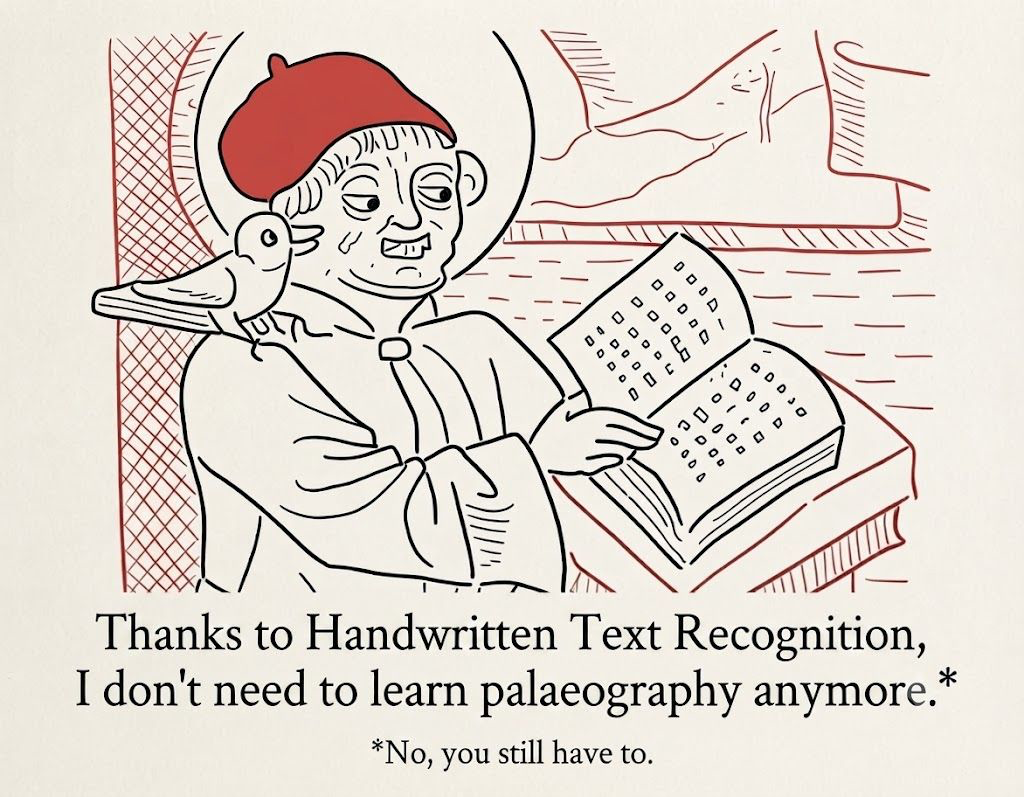
The use of AI for reading historical sources (known as Automated or Handwritten Text Recognition) is becoming an expected and necessary part of many DH projects. Nevertheless, there are still many challenges, from choosing between a growing number of options for HTR, to learning how to prepare ground truth and train models, and to navigating new methodological issues.
The Winter School: HTR of Historical Sources, 2026 (further as HTR Winter School) started in 2022 and has evolved along with technological developments and the current state of research. Most importantly: Its participants learn not only the basics of HTR, but contribute to growing datasets for particular languages and scripts.
Working groups
This year, there will be working groups for the following languages/scripts:
- Carolingian Latin
- Late Medieval Latin
- Early Modern German
- Byzantine Greek
- Syriac
- Old Icelandic
- Church Slavonic
Each of these groups will work on its own materials and has its own requirements for participation. Please check them before registering.
Only participants who fulfill their tasks in the language/script groups will receive the final digital certificate.
Timetable
This year, the Winter School will take place online only (with the exception of the Old Icelandic group), resuming in-person participation in 2027.
There are five virtual sessions, always on Friday from 2PM to 5PM, Central European Time:
- 2nd October
- 16th October
- 30th October
- 13th November
- 27th November
Each session consists of a plenary part (lecture) and a working group part. For all sessions except the last one, the plenary part will be 45 minutes long and the group part 2 hours long.
The last session will be dedicated to presenting the results.
Call for applications
Call for application is open until 11th September 2026.
Learn more and apply to the Winter School: https://indico.global/e/htr-2026
Information
Organisation
Institute for Medieval Research (IMAFO)
Austrian Academy of Sciences, Austria
Manuscript, Rare Books and Archival Studies Initiative (MARBAS)
Princeton University, USA
Cooperation Partner
Institute for Habsburg and Balkan Studies (IHB)
Austrian Academy of Sciences, Austria
General organizers
- Jan Odstrčilík (Digital Lab, IMAFO, Austrian Academy of Sciences)
- Cinzia Grifoni (Department of History, University of Vienna)
- Ephrem Aboud Ishac (IMAFO, Austrian Academy of Sciences)
AI and IT Expertise
- Martin Roček (Digital Lab, IMAFO, Austrian Academy of Sciences)
Digital Communication Management
- Bianca Plattner (University of Vienna)
External Lecturer
- Anna Michalcová (IMAFO, Austrian Academy of Sciences and Czech Language Institute, Czech Academy of Sciences)
Groups and supervisors
Carolingian Latin
Cinzia Grifoni
Department of History, University of Vienna
Jeremy Thompson
Göttingen University
Gerda Heydemann
Friedrich Meinecke Insitut für Geschichte und Historische Kulturwissenschaften, Freie Universität Berlin
Late medieval Latin
Jan Odstrčilík
Digital Lab coordinator, Institute for Medieval Research, Austrian Academy of Sciences
Zuzana Čermáková Lukšová
Masaryk University, Faculty of Arts, Department of Classical Studies
Annamária Kovács
Eötvös Loránd University
Anna Zajchowska-Bołtromiuk
Tadeusz Manteuffel Institute of History of Polish Academy of Sciences
Zdzisław Koczarski
Centre for Medieval Studies, Catholic University of Lublin
Urszula Zachara-Związek
Digital History Lab, The Tadeusz Manteuffel Institute of History, Polish Academy of Sciences
Early Modern German
Petr Maťa
Austrian Academy of Sciences
Petra Křenková
Charles University in Prague
Byzantine Greek
Eirini Afentoulidou
Austrian Academy of Sciences
Ekaterini Mitsiou
University of Vienna
Georgi Mitov
Austrian Academy of Sciences
Syriac
Ephrem Aboud Ishac
Austrian Academy of Sciences
Christine Roughan
Princeton University
Old Icelandic
Katrín Lísa L. Mikaelsdóttir
University of Iceland
Alice Mary Barbara Heeley
University of Iceland
Church Slavonic
Olga Kalashnikova
University of Naples-Orientale