


Knowledge - Economy - Public
Scientific and Economic Societies in Vienna (1850–1925)
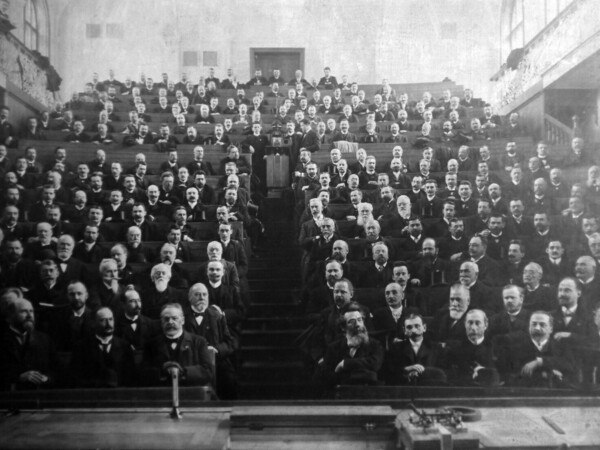
Processes of knowledge exchange between scholars, businesspeople, technicians, and the public reveal new insights into the changing semantics of Vienna as a location for both business and science. New aspects of the project are the function of civil societies as alliances between science and economy and their influence on the production and dissemination of knowledge in the context of the monarchy. This will be examined across associations.
Societies such as the Austrian Association of Engineers and Architects (Österreichischer Ingenieur- und Architektenverein), the Commerce Club of Lower Austria (Niederösterreichischer Gewerbeverein) or the Imperial-Royal Agricultural Society (k.k. Landwirtschafts-Gesellschaft) maintained scientific lecture and journal series, carried out research contracts and international exhibitions, set technological standards and initiated the founding of museums as well as institutions of higher and public education. As scientific-economic associations, they made use of political, economic, and communicative resources. They promoted the exchange of knowledge and technology between different social groups. As a result, these associations played a significant role in shaping the urban landscape of business and science. The research project examines these long-term processes and contrasts them with developments in other European countries.
Head of Project: Johannes Mattes
Collaborators: Sandra Klos, Sarah Sabina Zöchling
Funding: Jubiläumsfonds der Österreichischen Nationalbank (Grant number: 18684)
Duration: 2021/10/01 – 2025/09/30
Research Findings:
- Scientific–economic societies are newly assessed as active producers of research, not merely as institutions of popularization.
- Knowledge production appears as a process unfolding in urban intermediary spaces, where state, economic, and civic actors were tightly interwoven.
- Cooperative research: The case studies reveal how scientific expertise, economic interests, and state-led modernization projects merged, creating new alliances between the nobility, the bourgeoisie, and administrative elites.
- New perspectives on professionalization and public engagement show how “professional” and “lay” knowledge mutually shaped each other, and how inclusive certain societies already were before universities formally admitted female students.
- Transimperial comparisons demonstrate the strong orientation of Viennese societies toward British knowledge networks, which served as models for local association-building.
Outcomes:
- Sarah Sabina Zöchling: Innovation durch ,einverständliche(s) Zusammenwirken': Der Beitrag des Österreichischen Ingenieur- und Architekten-Vereins zur Entwicklung der Technikwissenschaften in der Habsburgermonarchie (1848-1867). (Masterarbeit)
- Sandra Klos: Zwischen Dokumentation und Selbstinszenierung. Selbstverfasste Lebensläufe von Mitgliedern der Österreichischen Akademie der Wissenschaften, 1847–1955 (Dissertation)
- Johannes Mattes:Cooperative Polar Research? Arctic Agendas and Geographical Societies in the Habsburg Monarchy.In: The Arctic in Eastern Europe (Brill, Arctic Humanities Series). Manuscript submitted 05/2025.
- Johannes Mattes:Political and Public Currents: How the Vienna Adriatic Society Underpinned Collaborative Marine Research. In: Adriatic: Marine Biology at the Zoological Station in Trieste (1870–1918) (Vienna University Press). Manuscript submitted 05/2025.
- Johannes Mattes:Cooperative Empires: Scientific Societies, Habsburg’s Imperial Agents, and the “Orient”. In: Empire of Circulation (Bloomsbury). Manuscript submitted 08/2025.
Cooperation:
Photo: © Austrian Association of Engineers and Architects, Meeting of the Austrian Association of Engineers and Architects in the Electrotechnical Institute of Technological College of Vienna, 10.04.1904.