


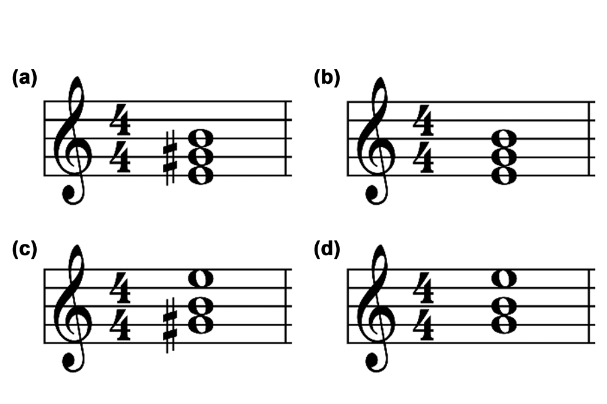
Can non-consciously perceived stimuli be processed (e.g., semantically) on a higher cognitive level, or is processing limited to a peripheral automatic level? In this article this question was investigated using visual and auditory musical material (triads in written notes or as heard sounds). For this purpose, a priming paradigm was employed. This is a common psychological research method with which, among others, one can investigate whether a non-consciously perceived stimulus facilitates processing of a conscious stimulus. In our experiment, visual notes were presented very shortly such that only non-conscious (but not conscious) processing was possible, and followed by an acoustically presented triad. In both visual and auditory presentation, the mode (i.e., major vs. minor) as well as the position (i.e., root position or inversion) could vary. Musicians had to decide whether the heard triad was in major or minor mode, and response times were measured. Participants showed, for example, shorter response times when both mode (the task-relevant feature) and position (the task-irrelevant feature) corresponded in visual and auditory triads than when only one of the features corresponded.
On the one hand, results imply, that the non-consciously perceived visual input influenced perception of the conscious auditory input and that both contents were integrated despite stemming from different modalities (auditory and visual).
On the other hand, for the first time it was shown that, due to the interaction in processing task-relevant and task-irrelevant stimulus features, even non-consciously perceived stimulus features are processed semantically (i.e., on a higher cognitive level). Hence, conscious processing was not necessary to grasp the meaning of a feature.
Augsten, Marie-Luise; Eder, Stephanie. J.; Büsel, Christian; Valuch, Christian; Ansorge, Ulrich (2023): ”Influences of Music Reading on Auditory Chord Discrimination: A Novel Test Bed for Nonconscious Processing of Irrelevant Prime Meaning” in: Open Psychology, Vol. 5/1: 20220132, pp 1-15, https://doi.org/10.1515/psych-2022-0132