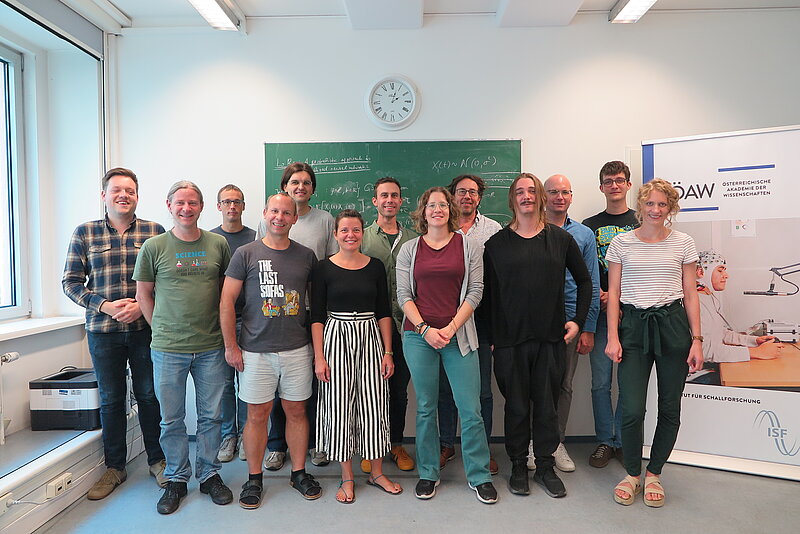
In the Hearing cluster we study basic auditory perception, with projects being centered around the topic of spatial hearing. Tested populations include normal-hearing (NH) listeners and listeners suffering from complete or partial hearing loss. In such cases cochlear implants (CIs) can restore auditory sensation by electrical stimulation of the auditory nerve.
Our main goal is to extend knowledge about basic phenomena and the underlying mechanisms. We carefully design our research questions to contribute to new approaches for improving hearing, particularly in challenging listening situations.
Equipped with state-of-the-art facilities, our lab facilitates sound-shielded rooms, semi-anechoic rooms, and electrically-treated rooms. We employ specialized tools for purposes such as acoustic measurements of listener-specific head-related transfer functions (HRTFs) with high spatial resolution, sound localization experiments in virtual reality within a spherical array of 91 loudspeakers, non-invasive physiological measurements capturing brain responses through electroencephalography (EEG) and pupil dilations through eye tracking, and psychophysical experiments with calibrated acoustic or electric stimulus presentation via headphones and cochlear implants, respectively.
Head: Bernhard Laback
We use mainly behavioral (e.g., psychophysical) measures and often include quantitative modeling of psychophysical results. Important branches of our research are binaural hearing and sound localization. Other more recent topics include basic mechanisms of pitch perception, auditory masking and masking release, auditory grouping, music harmony perception, or contextual effects in localization.
For electric stimulation in bilaterally or unilaterally implanted CI listeners, we use a research interface (MaxBox) that enables direct and binaurally highly controlled stimulation of CI electrodes. Recently, we also developed an interest in comparing psychophysical measures with neural responses of the peripheral auditory system such as eCAP (electric compound action potentials with CIs) and ASSR (auditory steady-state response) or in early responses of the central auditory system such as MMN (mismatch negativity) or ERAN (Early right anterior negativity). Incorporating such measures into our research is still underway.
Head: Robert Baumgartner
We study the neuronal processes that underlie auditory perception in dynamic environments. Our primary focus areas encompass spatial and temporal perception, including attentional control, arousal mediation, and associated short- and long-term learning processes facilitated by sensory adaptation and neural plasticity.
Key specific topics within our research scope include auditory localization and perceptual externalization, perceptual belief updating and statistical learning, as well as spatial selective attention, both voluntarily (known as the cocktail party problem) and involuntarily (warning mechanisms such as the looming bias). Through longstanding collaborations, we extend our investigations to encompass an evolutionary perspective, by examining other species, and a developmental perspective, by studying newborn listeners.
To tackle these diverse topics, we employ a multifaceted approach combining computational modeling with behavioral experiments and non-invasive neurophysiology, mainly EEG and pupillometry. Our computational methods range from template matching approaches and probabilistic evidence accumulation to Bayesian models of causal uncertainty. We leverage state-of-the-art functional connectivity analyses on high-density EEG data to unveil the cortical networks at play, providing a high temporal resolution in our investigations.
Head: Piotr Majdak
Our work is motivated by the general research questions centred around spatial hearing in humans. The projects range from auditory modelling to the development of tools and applications in binaural audio. In order to reach out to the community, we lead the so-called AABBA group promoting the development and applications in spatial hearing.
One focus of our work is modelling auditory processes, implementation of such models, and applying them in various scenarios and projects. This work even extends to mechanisms outside the spatial-hearing aspects and includes development of tools such as the Auditory Modeling Toolbox (AMT).
Spatial hearing allows us to localize sound sources and focus our attention on a sound source of interest in complex acoustic environments, which, in turn, is pivotal for hazard recognition and selective speech understanding. Spatial hearing involves both bottom-up (i.e., acoustic) and top-down factors (e.g., expectation, context, or experience). Despite extensive past and present research in this field, many aspects of spatial hearing are far from being fully understood. Gaps in our knowledge become particularly apparent when it comes to impaired hearing or listeners bilaterally supplied with cochlear implants (CIs). While it is known that CI and hearing-impaired listeners show marked deficits in spatial hearing and in demanding tasks such as following a single speaker in the presence of competing speakers, the main factors underlying these deficits are not yet identified. This is related to the fact that the mechanisms underlying such complex tasks in normal hearing are far from being fully understood. We combine approaches from psychophysics, cognitive neuroscience, numerical acoustics, computer modeling, mathematical signal processing, and speech science, attempting to
address the complexity of bottom-up and top-down factors and their potential interactions in spatial and selective hearing,
fill important gaps in our knowledge about the intact and the impaired spatial auditory system, and
devise innovative approaches to identify and compensate for deficits in spatial selective hearing across the human lifespan.
We study bottom-up processes related to the encoding of spatial information (interaural time and level differences as well as spectral-shape cues) and of other cues important for source segregation (like pitch), by comparing behavioral and objective measures (brainstem-evoked potentials in humans and midbrain recordings in cross-species comparison) to predictions of models of the auditory periphery. Top-down and cross-modal factors, e.g., learning and plasticity of new spatial information or context and prediction coding, are studied by comparing cortical EEG responses with behavioral responses and, in some projects, comparative behavior with other primates. The role of acoustic factors is studied through numerical simulation of sound transmission from the sound source to the listener's ears. Finally, the development of new stimulation methods to compensate for hearing deficits in impaired populations is aided by mathematical approaches (such as irregular-sampling and sparse-coding theory).
All this work relies on close cooperation with other working groups at ARI (e.g., mathematics, speech, or numerics) and with external cooperation partners (e.g., neurophysiology, cognitive biology, infant cognitive development). We believe that such interdisciplinary cooperation has the greatest potential to unravel key current questions in hearing science and, thus, to improve hazard recognition and speech communication in challenging acoustic environments.