


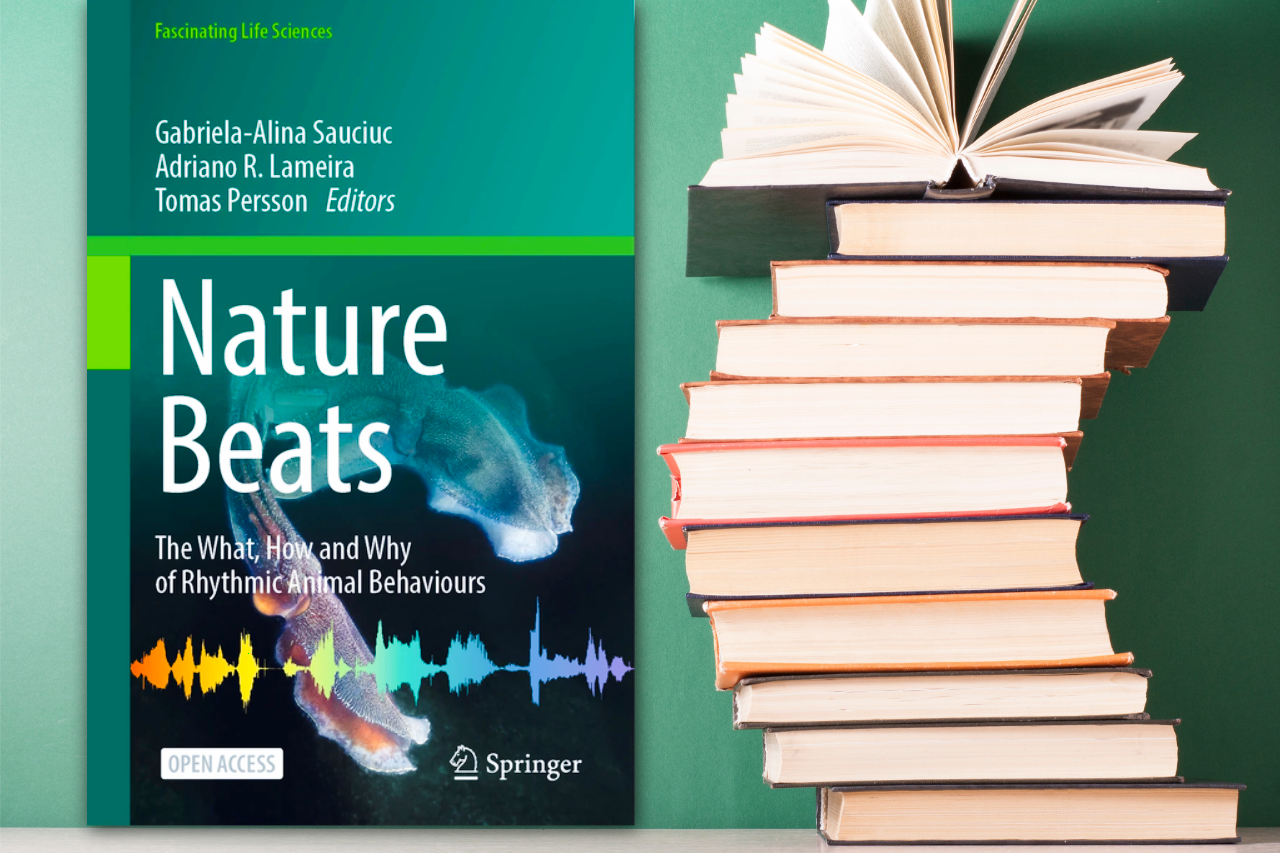
About the book
From drumming woodpeckers and chorusing frogs, to dancing birds and synchronized fireflies, the natural world is full of rhythm. But what do these beats and pulses really mean? And what can they tell us about the evolution of music?
This open access book offers the first comprehensive, interdisciplinary exploration of rhythmic behavior across the animal kingdom, bringing together leading researchers in comparative cognition, ethology, evolutionary musicology, neurobiology, and related fields.
The volume examines how animals use timing, tempo, and patterned coordination to communicate, compete, and coordinate, revealing rhythmicity as a powerful, yet often overlooked dimension of animal signaling.
Editors
Gabriela-Alina Sauciuc, Adriano R. Lameira, Tomas Persson
Among the co-authors is ARI researcher Marisa Hoeschele, who co-authored the chapter:
What is Rhythm and How Can We Study it
Burchardt, L.S., Hoeschele, M., Honing, H., Large, E.W., Merker, B., Schneider, J.N. (2026). What is Rhythm and How Can We Study It?. In: Sauciuc, GA., Lameira, A.R., Persson, T. (eds) Nature Beats. Fascinating Life Sciences. Springer, Cham. https://doi.org/10.1007/978-3-032-24250-1_1