Arabidopsis immune system is triggered by small bacterial fatty acids
Like humans and animals, plants defend themselves against pathogens with the help of their immune system. But how do they activate their cellular defenses? Youssef Belkhadir's lab at the GMI studies cell-surface receptor kinases, which plants use to…
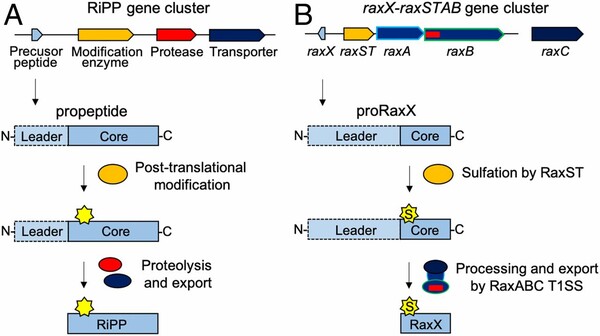
Biogenesis of a microbial peptide and its interaction with a rice immune receptor
The plant immune system uses specialized proteins called receptor kinases to detect and respond to microbial pathogens. In new work published in PNAS, an international team led by Pamela Ronald at UC Davis that included Youssef Belkhadir and PhD…
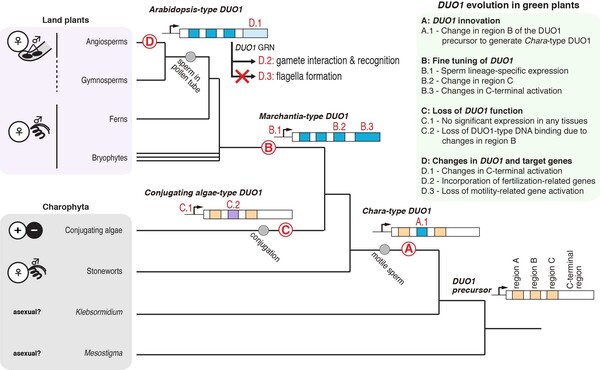
The evolution of sperm started with a single molecular change
How new cell types evolve remains a major question in biology. Across multi-cellular organisms, reproduction generally occurs via small, motile sperm that fertilize large immotile eggs. However, the widely varied morphologies of sperm makes one…
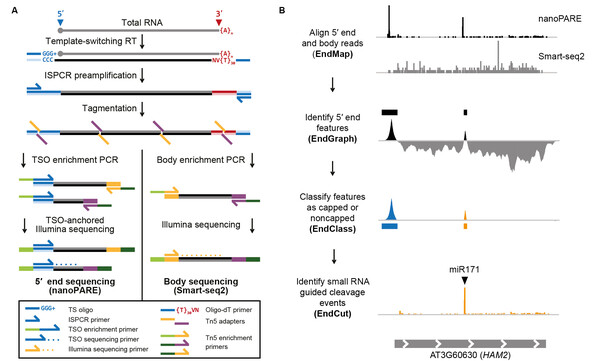
nanoPARE: Parallel analysis of RNA 5′ ends from low-input RNA
In a recent publication in Genome Research, PhD and Master Students from the Nodine lab report a novel next-generation sequencing based method for the identification of RNA 5' ends from single-cell levels of RNA, at least 10,000 fold less than…
Sequencing the Aquilegia genome uncovers one chromosome evolving differently than the rest
Aquilegia is a plant with strikingly beautiful flowers with around 70 species extending across the Northern Hemisphere, four of which are found in Austria. This diversity is driven by a process called adaptive radiation, whereby new species arise…
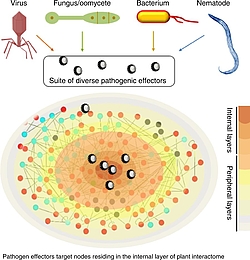
Network biology reveals pathogen targets in the model plant Arabidopsis thaliana
How are proteins in the cells of a flowering plant similar to social networks on Twitter or Facebook? And how might both of those be related to the way pathogens make plants or people sick?
GMI and MFPL researchers develop a new method for rapidly identifying genes that contribute to pathogen virulence
To combat pathogen infection in both animals and plants, it is important to know which genes in the pathogen are important for successfully infecting their host. Traditionally, identifying such genes has been laborious and time consuming. Researchers…
An extracellular network map of Arabidopsis LRR receptor kinases demonstrates that they operate as unified regulatory network
In a landmark study, an international consortium of laboratories (3 groups from Austria, 2 from Canada, 2 from the USA, and 1 from the UK) spearheaded by Youssef Belkhadir at the Gregor Mendel Institute of Molecular Plant Biology of the Austrian…
Genetic adaptation to SIV protects Vervet monkeys from immunodeficiency
Wild vervet monkeys (genus Chlorocebus) are frequently infected by the Simian Immunodeficiency Virus (SIV), a close relative of HIV. However, they do not progress to AIDS. A scientific study published today in the journal Nature Genetics suggests…
The simple liverwort provides new insights into plant evolution
For most people, the simple liverwort, a moss-like shrub, is a common garden nuisance. For Frederic Berger of the Gregor Mendel Institute for Molecular Plant Biology of the Austrian Academy of Sciences, this plant is a key to understanding the…
Diese Website verwendet Cookies. Sie gewährleisten wesentliche Funktionalitäten der Website und ermöglichen uns, Inhalte laufend zu optimieren. Helfen Sie uns dabei, indem Sie der Erhebung statistischer Daten und der Darstellung externer multimedialer Inhalte zustimmen. Die Zustimmung ist jederzeit widerrufbar. Weitere Informationen finden Sie in den Cookie-Einstellungen sowie in der Datenschutzerklärung.