


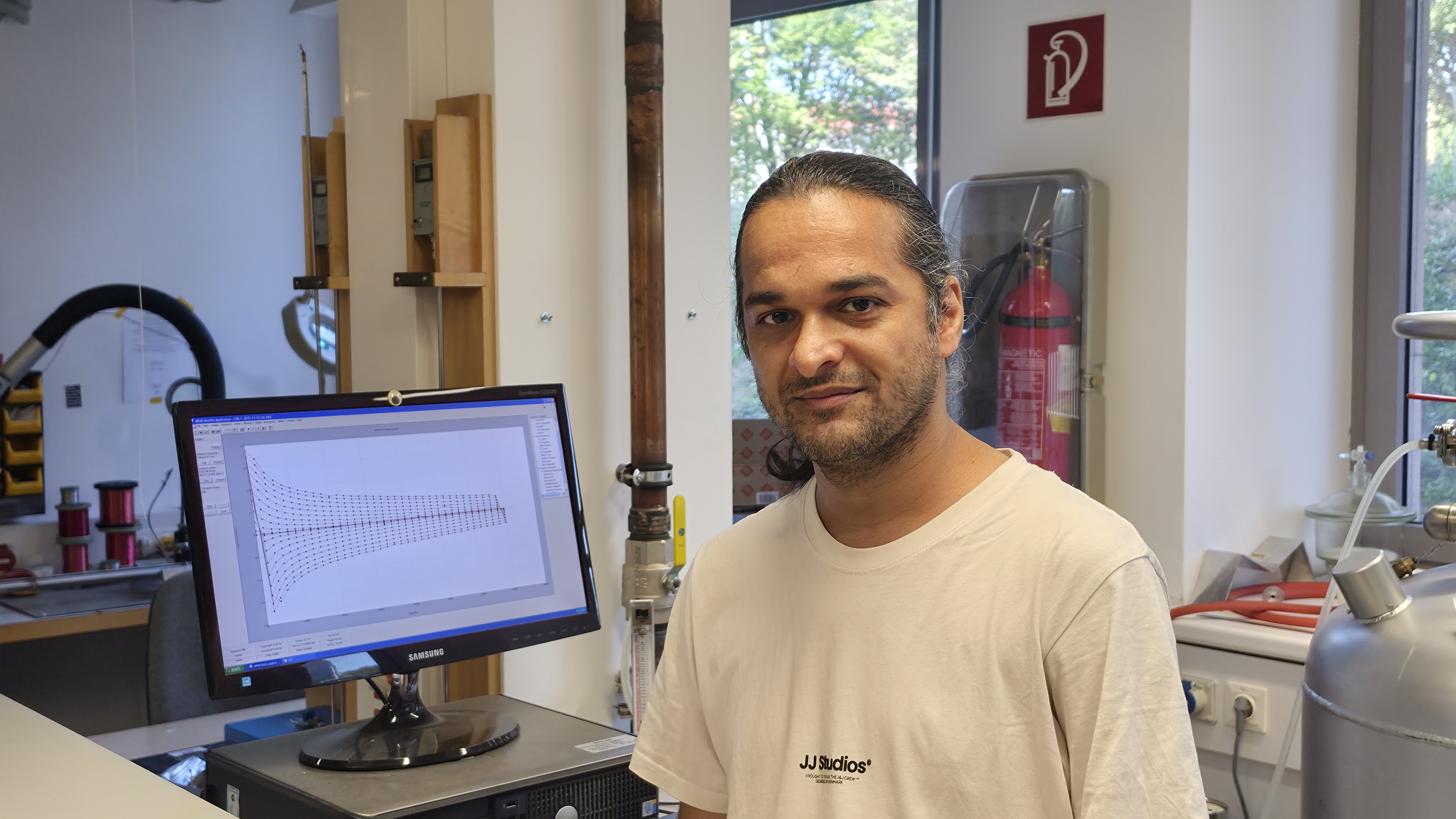
What is the topic of your Ph.D. thesis?
My main topic is "The Effect of Neutron Irradiation on the Degradation of Pinning in Nb3Sn." The title isn't final yet and might change a bit, but this has been a long-term project that started back in 2010. We're now finally approaching the end.
What is the focus of research?
Right now, I'm working on a two-component model of pinning in neutron-irradiated Nb3Sn. As I mentioned, this is a long-term project that started back in 2010. At lower irradiation levels, neutron irradiation actually improves pinning, but after a certain fluence, it starts causing degradation. We are now at that degradation stage and are developing a two-component model to explain this behavior and to predict how the superconducting properties will change.
What is the benefit for fusion research?
As you know, in fusion reactors, the extremely hot plasma must be confined away from the chamber walls to prevent it from melting or damaging them. This is achieved through magnetic confinement using a system of superconducting coils, one of the main materials of which is Nb3Sn.
Each fusion reaction releases a 14.1 MeV neutron. Since neutrons carry no electric charge, the confining magnetic field has no effect on them. They stream outward in straight lines until they collide with solid materials - including the Nb3Sn coils.
Because the reactor operates for long periods and replacing these coils would require a very costly and lengthy shutdown, it is essential to understand the effects of neutron irradiation on Nb3Sn and to predict resulting changes in its key superconducting properties, such as critical temperature, critical current density, and critical magnetic field.
What are the biggest challenges?
Even though the physics I'm working with isn't new, every project has its own challenges. There are always some parameters that don't fit perfectly, and you have to come up with a reasonable explanation for them. Sometimes you find a good one, and sometimes you don't! And occasionally, going back to previous papers doesn't help either, because they can contradict each other.
What plans do you have for your future? What will you be doing in five years? Would you like to continue research or are you going to work in the industry?
I haven't decided yet. Right now, my top priority is to finish the thesis. After that, I want to spend some quality extra time with my family – especially with my daughter. Actually, I really enjoy both research and industry. I've had good experience in both, so I'm open to either path.
What was your motivation to write a fusion relevant Ph.D. thesis? What fascinates you about nuclear fusion?
First of all, I've had the chance to work with a really great group over the last few years. From my supervisor to my colleagues, I've been surrounded by some of the best people in the field. On top of that, it feels incredibly rewarding to know that I'm contributing – even if just a small piece – to something that could have a big impact on the future.