

Joe Prestwich
On Saturday, we mounted a conspicuous communist-era Jelcz bus and embarked on the “Dark Side of Warsaw” tour. Whilst the title gave the impression, we’d be exploring the war crimes of the early twentieth century that affected much of Europe and Poland, a deep dive into Warsaw’s past as a city struggling to assert its identity in a long history of occupation and destruction, this tour offered something slightly less “dark”. We started at the affluent area of high-rise, glass-and-steel banking offices that surround the Palace of Culture and Science on the west side of the Vistula River. This district sees mid-century, functional housing developments sit between glossy offices and newer, higher-end condominiums, giving the architectural impression of social mix in the centre of Warsaw. We travelled from here together to Praga, a neighbourhood across the river that stands in contrast to this centre, a district that remained significantly less damaged than its western counterparts after World War II. Less the “dark side” and more “the only place in which you can feel the real spirit of past Warsaw” (as the tour website puts it), Praga is a district of converted 19th century housing stock and new-builds, marking it out as one of Warsaw’s most gentrifying areas.
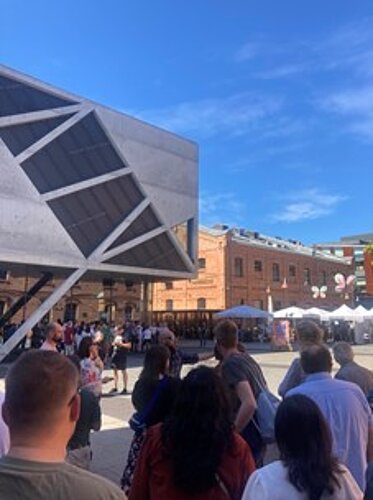
Maks, our hilarious tour guide, took us from a former vodka distillery converted into an arts and commercial centre to a flea market that in Soviet times was a crucial means of earning extra income but now stands eerily devoid of customers and commerce. We visited the Basilica of the Sacred Heart of Jesus, a church constructed between 1907 – 1923 and that remained unscathed after the destruction of Warsaw by Nazi forces in 1944. These sorts of mini histories that explain whether or not a building survived the war accompanied many of the places we visited across the Warsaw trip, highlighting the continued legacy of the wholesale destruction of the city almost 80 years later. This story was made literal in The Best City in the World, a new opera we were lucky to attend at its premiere at the Teatr Wielki - National Opera. In its opening scene, a huge three dimensional model of Warsaw, with buildings represented by white cuboids, was slowly tilted upwards forcing the blocks to come sliding and tumbling down to form piles of rubble on the bare stage. The map was violently split across the river, rendering the division between east and west Warsaw dramatically visible, all to the sound of gunfire and a blend of dissonant and drone-like orchestral and electronic music. The effect was stirring and devastating: the questions of how to rebuild, who for, and how long it will take made material.
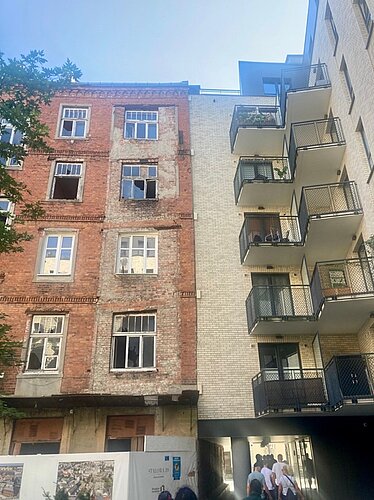
One of the most striking stops in the tour was to a small residential courtyard, 24 Strzelecka. Here, new-build gentrification was on display in stark fashion. Freshly constructed apartments literally jutted against derelict low-rise blocks of flats from which residents had been evicted to make way to renovations that never came (the developers went bankrupt, and work has since halted indefinitely). Whilst the older, historical flats evoke the “spirit of past Warsaw”, the more modern apartments resemble new-build blocks in London, Manchester, or Berlin: the individual character lost for a safer, cookie-cutter pattern of modern European apartment construction. Nearby streets displayed further evidence of a shift in the demographics and culture of the neighbourhood, with a natural wine bar and artisanal bakery appealing to a notionally affluent clientele with middle-class tastes. Whilst the post-war rebuilding that took place on the west side of the river represented the power and influence of the (Soviet) state in wholesale city reconstruction, contemporary construction projects such as the MSN Warsaw and forthcoming new TR Warszawa building demonstrate how a municipality can use its resources to steer development to prioritise the arts and culture in civic society. In Praga however, I got the impression that it’s market forces that are managing the redevelopment of the area and influencing who gets to live where. This is far from the natural way of doing things.