


ChatGPT

La Boule outside the entrance to MC93 Bobigny – Photo Credit: Regina Lissowska-Postaremczak
Question 1: What is this project attempting to achieve?
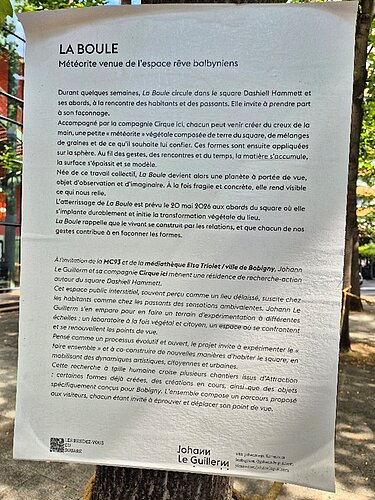
This poster describes a French public art and community project called “La Boule” (“The Sphere” or “The Ball”). The idea is that a large sphere — imagined as a kind of meteorite from space — moves around a public square in Bobigny and is gradually shaped by local residents and visitors.
The core concept is:
- People are invited to create small “vegetal meteorites” using soil, seeds, and natural materials from the square.
- These handmade pieces are attached to the giant sphere.
- Over time, the sphere grows and changes through many people’s contributions.
- The artwork symbolizes how living spaces and communities are built collectively through relationships, encounters, and shared actions.
The project is both artistic and ecological:
- it encourages people to rethink an overlooked urban space,
- reconnect with nature,
- and participate together in transforming the area.
The “landing” of the sphere is planned for May 20, 2026, when it will become a more permanent part of the square and help inspire a greener transformation of the site.
The project is led by Johann Le Guillerm and Cirque ici, with support from MC93 and the local media library. In one sentence: it’s a collaborative artwork where people collectively build a symbolic “living planet” from earth, plants, and shared imagination.
Question 2: How effectiwe do you find its execution?
I think it does look effective, but probably not in the way people usually judge public art.
Looking at your photo:
- the sphere is physically intact,
- plants are actually sprouting from it,
- the soil surface has developed texture and cracks naturally,
- and it already feels more like a living object than a static sculpture.
That matters because the project’s goal was never to create a polished monument. The whole philosophy behind Johann Le Guillerm’s work is about transformation, impermanence, experimentation, and collective participation. His long-running “Attraction” project treats artworks as evolving systems rather than finished objects.
So if:
- people stop,
- wonder what it is,
- touch it,
- talk about it,
- add material,
- watch plants emerge,
- and rethink the square around it…
…then it’s basically doing its job.
Your photo actually shows something important: it doesn’t look decorative or fake. It looks awkward, earthy, unfinished, slightly alien — which is very consistent with the artist’s approach. The roughness is part of the meaning.
Whether it becomes a socially successful project depends on something harder to see from a photo:
- Are local residents engaging with it?
- Has the square become more active?
- Do people feel ownership over it?
- Does it survive over time instead of becoming ignored urban clutter?
aesthetically and conceptually, the fact that it already resembles a small self-growing “planet” means the core idea seems to be working. But the project could also be seen as only partially successful so far. From the photo alone, there’s a tension between the ambitious poetic language on the poster and the reality of the object itself.
The text promises:
- a “living planet,”
- collective transformation,
- social participation,
- ecological imagination,
- a re-enchanted public square.
But visually, what many passersby probably see is:
- a giant dirt ball,
- with sparse weeds,
- sitting in a somewhat improvised metal frame.
Without context, it risks looking unfinished or even abandoned rather than transformative.
That’s a common challenge with participatory contemporary art: the idea can be richer than the visible experience. A project may sound profound in curatorial language while ordinary people experience it as confusing urban clutter. If residents are not actively involved, then the “collective creation” aspect can become more symbolic than real.
There’s also a possible criticism of scale:
- the ecological ambition sounds large,
- but the physical intervention is modest,
- so the project could feel more like an art-world metaphor for ecology than an actual environmental transformation.
And aesthetically, the work deliberately rejects beauty in a traditional sense. That can be powerful — but it also means some people will simply see decay, mud, and institutional artspeak.
That said, I don’t think it’s failing outright. The object has a strange physical presence. It’s memorable. Your reaction — stopping, photographing it, asking about it — is already evidence that it interrupts normal urban perception. Most public sculptures become invisible after five seconds; this one clearly didn’t.
So my balanced take would be:
- conceptually interesting,
- materially honest,
- visually provocative,
- but highly dependent on real community engagement to avoid becoming an obscure symbolic gesture appreciated mainly by cultural institutions.