


Clio Unger
If London required me to relearn a familiar city, Paris confronted me with a different challenge altogether: how to hold together a city of stark and often dissonant contrasts. Over the course of the trip, what emerged most clearly was not a single narrative of urban transformation, but a series of juxtapositions – between centre and periphery, wealth and marginalisation, monumental scale and intimate everyday life, cultural prestige and experiments in access. Paris revealed itself less as a coherent urban system than as a city structured through separation.
This sense of contrast was immediately spatial. Moving through the city, we experienced a rapid oscillation between what might be called “postcard Paris” – Haussmannian boulevards, historic façades, carefully preserved cultural institutions – and its outer edges, where social housing estates, infrastructural developments, and ongoing processes of gentrification reshape the urban landscape. The difference between central Paris and suburbs such as Saint-Denis felt more pronounced than comparable divisions in London. At the same time, the city has changed in ways that complicate my memories of it. Returning after nearly a decade, I was struck by how much greener and more navigable Paris has become. The expansion of cycling infrastructure in particular has transformed the experience of moving through the city. Where Paris once felt dominated by traffic, it now offers a more accessible, porous urban environment – at least in certain areas. This shift towards sustainability and accessibility, however, sits alongside persistent inequalities in who can fully inhabit the city’s spaces.
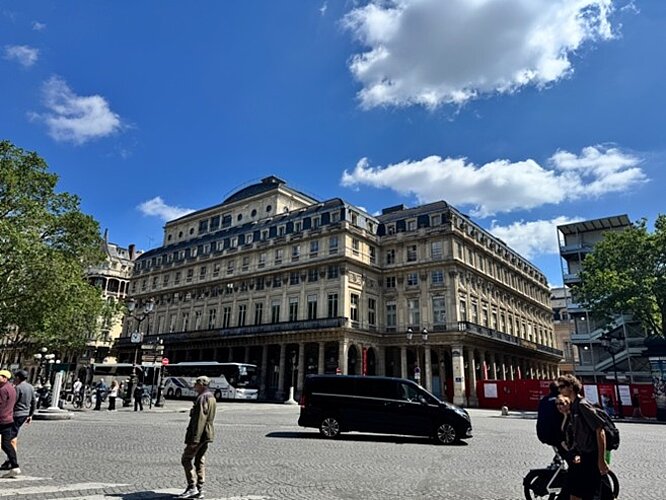
The scale of urban development also contributes to this sense of contrast. The Olympic stadium in Saint-Denis, with its monumental architecture and global visibility, stands in sharp tension with the small-scale urban life that defines much of Paris: narrow cafés, crowded terraces, improvised social spaces spilling onto pavements. This coexistence of global spectacle and everyday intimacy creates a particular urban rhythm – one that oscillates between grandeur and proximity.Within this landscape, the theatre institutions we visited offered a compelling lens through which to think about cultural access and participation. What became clear very quickly is that Paris presents a range of distinct models for how theatre might engage with its publics, each shaped by different historical and political imaginaries.
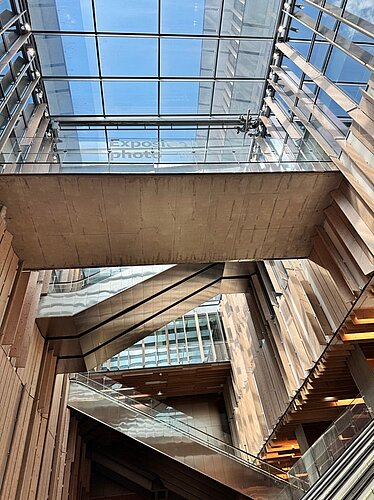
The model of the Maison de la Culturein the suburb of Bobigny, for instance, continues to reflect an ideal of cultural democracy rooted in post-war policy: the idea that high-quality art should be made accessible to all citizens. Yet what this means in practice remains open to question. Accessibility is not simply a matter of ticket pricing or programming, but also of who feels addressed by these institutions, and who feels comfortable entering them.
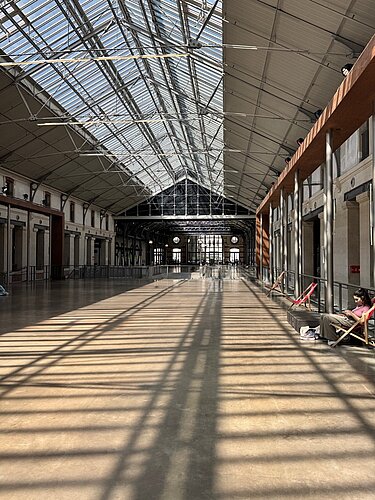
At CENTQUATRE, this question took on a particularly vivid form. The space itself is striking: a large, open cultural complex where, during the day, people gather informally – practising dance, meeting friends, spending time without the apparent obligation to consume. It immediately reminded me of spaces like Central Saint Martins at Coal Drops Yard in London: a hybrid between educational institution, cultural venue, and social hub. What stood out most was the sense that this was a public space people genuinely wanted to inhabit. Unlike many cultural venues, CENTQUATRE allows for forms of presence that are not tied to ticketed events or consumption. But conversations on site complicated this impression. As one café worker noted, the audience changes significantly in the evening, when performances begin. The daytime users – often younger, more diverse, more casually present – give way to a more affluent, older, and less diverse crowd. This temporal division within the same space raises important questions. Is CENTQUATRE successfully broadening access to culture, or does it simply host different publics at different times without fundamentally transforming who participates in its core artistic programme?
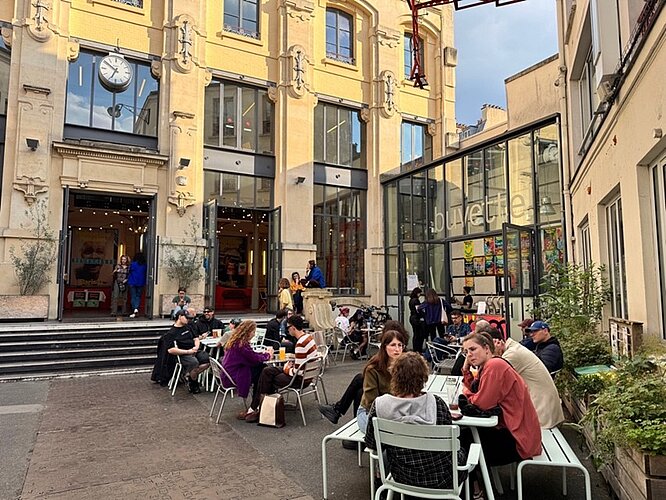
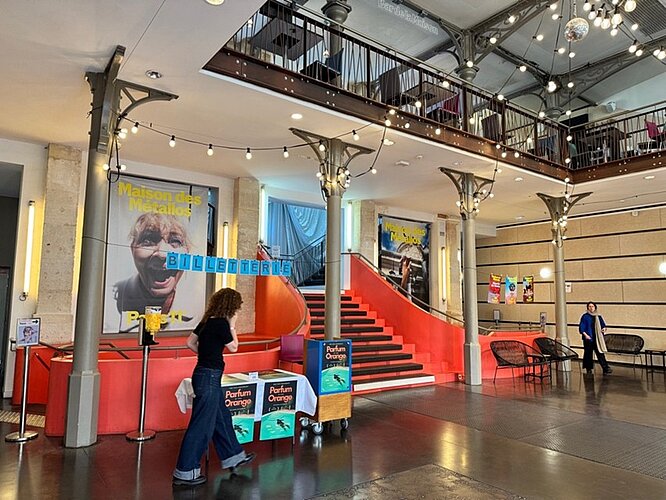
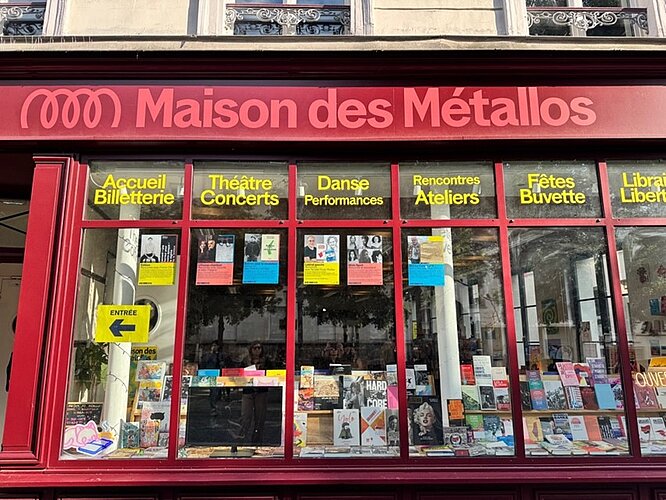
A different model emerged at Théâtre Gérard Philipe, where participatory practices are more explicitly embedded in the institution’s work. Here, the emphasis shifts from access to co-presence and collaboration, attempting to reconfigure the relationship between theatre and its surrounding community. Similarly, spaces like Maison des Métallos offered a more informal and socially integrated environment. Sitting in its courtyard, with music, a bar, and a mix of languages circulating, the space felt open and welcoming – though it was also notable that this was one of the first places where English became audible, a small but telling marker of the city’s shifting cultural economy.
If these venues suggested more experimental or socially engaged approaches, our visit to the Comédie-Française in their new satellite venue at the Théâtre Nanterre-Amandiers to the west of the city offered a striking counterpoint. Watching Feydeau’s A Flea in Her Ear, I found myself questioning what “access” means in this context. On one level, the production felt low-threshold: highly entertaining, well-executed, and immediately legible. Yet the audience composition – predominantly older, white, and affluent – pointed to a different kind of exclusivity. The performance itself, while technically accomplished, seemed to prioritise comfort over challenge. This raised an uncomfortable question: is this kind of theatre expanding access, or reinforcing a particular cultural habitus?
And yet, as we discussed afterwards, the answer is not straightforward. Perhaps such performances function as entry points, fostering familiarity and trust in the institution. Perhaps they create the conditions under which audiences might later engage with more demanding work. At the same time, it is difficult to ignore the sense that this was a self-sustaining aesthetic ecosystem, one that caters to an audience already at ease within it. Rather than opening outward, it risks becoming a closed loop – what felt, in the moment, less like an entry point than a kind of endpoint.
Beyond institutional spaces, the dynamics of gentrification were equally visible at the level of neighbourhoods. Walking through South Pigalle – just a short distance from the Moulin Rouge – we encountered a district that has become emblematic of contemporary urban change. Recently rebranded as “SoPi”, the area is filled with cafés, bars, and boutiques that signal a particular kind of curated urban lifestyle. While undeniably inviting, it also felt strangely interchangeable. This was perhaps the first place in Paris where I had the sense that I could be in almost any European city. The distinctiveness that characterises so many Parisian neighbourhoods seemed, here, to flatten into a more generic aesthetic of gentrification.
What, then, does Paris reveal when approached through the lens of theatre and urban transformation? More than anything, it foregrounds the question of separation: between publics, between spaces, between models of cultural engagement. Unlike London, where culture is often mobilised as a driver of development, or Berlin, where subsidies seek to support a wide array of cultural practices, Paris appears to maintain a stronger distinction between its prestigious cultural institutions and its more experimental or community-oriented spaces. Yet this distinction does not necessarily resolve questions of access. Instead, it produces a landscape in which different approaches coexist – sometimes productively, sometimes uneasily.
By the end of the trip, I was left with a sense that Paris does not offer a single model of cultural democracy, but rather a set of competing propositions. From open-access spaces like CENTQUATRE, to participatory theatres in the suburbs, to the enduring prestige of institutions like the Comédie-Française, the city stages multiple answers to the question of who theatre is for. Holding these answers together without collapsing their differences feels like the central challenge of understanding Paris today.