


Clio Unger
London, our fourth research, trip felt markedly different from our previous field visits. Unlike Istanbul or Warsaw, London is a city I know intimately. I have lived here since 2017, and many of the neighbourhoods on our itinerary were not sites of discovery for me but spaces I move through regularly as part of my own teaching and working life. This familiarity created an interesting tension throughout the trip. While my colleagues were encountering many of these districts for the first time, I found myself seeing them anew through the comparative lens of our project. Familiar streets, theatres, cafés, and development sites suddenly became research objects rather than simply parts of my everyday geography. The trip became less about discovering London than about re-learning it.
What struck me most over the course of these three days was the sheer scale and speed of urban transformation. London’s development is not subtle. It announces itself through cranes, demolition sites, hoardings, glass towers, and new transport infrastructure. Compared to Berlin, where processes of gentrification often unfold in layers through the adaptation of existing urban fabric, London frequently seems to remake itself through large-scale redevelopment. This was immediately visible in east London, particularly around Stratford, Hackney Wick, and Fish Island, where our research focused on the long aftermath of the 2012 Olympics.
Walking from Stratford into Queen Elizabeth Olympic Park, I was struck by the scale of what had been built – and what was still being built. The site itself tells a familiar story of urban regeneration. As Andy Pratt explained during our conversations, this land was once heavily polluted industrial terrain, so contaminated that it effectively had negative land value. Enormous public investment was needed simply to make it safe enough for development. The Olympics created the political and economic conditions to justify that investment. Yet what interested me was Pratt’s insistence that the Olympics were never simply about sport. Their long-term promise was always urban transformation: creating land value where none had existed before, and turning former industrial wasteland into a site of cultural, residential, and commercial value.
This became especially visible at East Bank and Here East, where culture has been positioned as a generator of regeneration. Institutions such as Sadler’s Wells East, the V&A Storehouse, the BBC studios, and university campuses now form a dense cultural cluster designed to attract investment, students, tourists, and creative workers. Walking through this area, I found myself thinking: this feels strangely familiar. In many ways Hackney Wick and Fish Island reminded me of Berlin’s post-industrial cultural zones – perhaps most strongly of areas like the Holzmarkt or the developments around the Spree – but also of the artist-led transformations we have studied elsewhere. Fish Island feels a bit like certain parts of Berlin: canal-side industrial remnants, graffiti, temporary studios, repurposed warehouses, and an atmosphere that still gestures toward alternative culture, even as luxury housing developments rise on all sides.
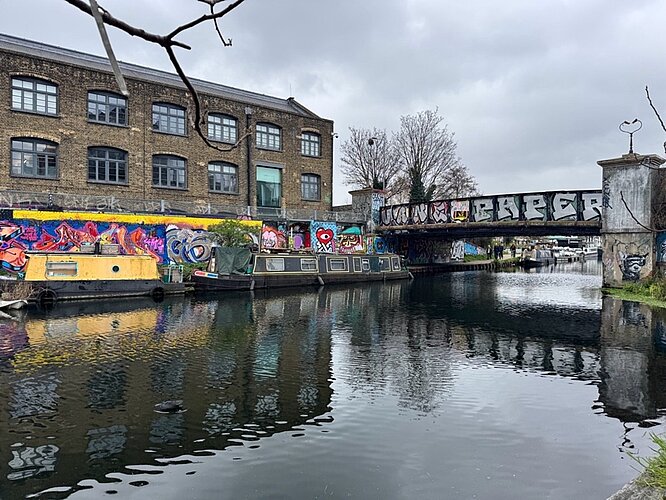
Yet this comparison only goes so far. One of the most productive aspects of our conversations with Andy Pratt was his challenge to simplistic comparative urbanism. Rather than looking for similarities between cities, he urged us to focus on differences – on what he called a kind of counter-comparative urbanism. Instead of asking how London resembles Berlin, we might ask what processes produce different outcomes in each place. This shift in perspective stayed with me throughout the trip. The question became not simply whether gentrification is happening, but how specific combinations of planning policy, public investment, cultural institutions, and private development shape urban transformation in distinct ways.
The role of theatre within these processes became increasingly visible as we moved through the city. One of the clearest patterns across our case studies is that theatres are not simply passive victims of gentrification, nor are they straightforward agents of it. Rather, they are embedded within larger cultural economies. The theatre sector cannot be separated from wider patterns of cultural development, real estate speculation, and urban branding.
This became particularly clear in sites such as the Yard Theatre in Hackney Wick, New Diorama in Camden, and Theatre Peckham in south London. Each of these institutions occupies a different relationship to its surrounding neighbourhood. The Yard, emerging from a temporary warehouse theatre into a more permanent institutional structure, now sits within one of London’s fastest changing districts. New Diorama, by contrast, is deeply embedded within a mixed-use commercial development, a product of planning agreements that require developers to include cultural provision. Theatre Peckham offered perhaps the most striking contrast. Having taught in Peckham for the past six years, I know this area well, but seeing it through the framework of our research highlighted how differently theatre can function depending on its urban context. Unlike New Diorama, which feels integrated into an office-led development model, Theatre Peckham remains visibly connected to its residential community.
Across these visits, one theme kept emerging: the erosion of public space. London increasingly feels like a city of managed spaces – commercial plazas, privately owned public squares, cultural foyers, and development-led “community spaces” that remain carefully regulated. This loss of genuinely public, informal space has profound implications for cultural life. As Pratt noted, some of the most vibrant social and artistic interactions happen in the in-between spaces: vacant lots, temporary studios, pop-up venues, improvised gathering points. These spaces allow experimentation, friction, encounter. Yet they are often the first casualties of redevelopment.
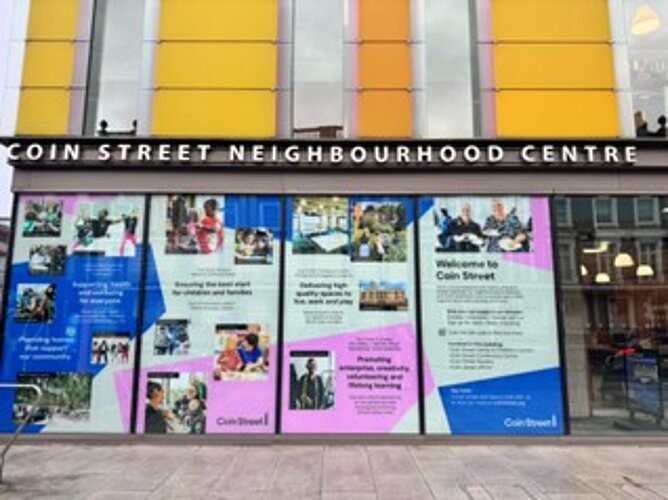
This raises important questions for theatre. If theatre is often imagined as a place where communities gather, what happens when the city itself no longer provides the public infrastructure needed to make those encounters possible? Theatres may create welcoming interiors, cafés, foyers, or outreach programmes, but they cannot fully replace the social affordances of genuinely public urban space.
By the end of the trip, I found myself thinking less about individual theatres and more about ecosystems. Theatre does not operate in isolation. It is embedded within transport systems, housing markets, planning regulations, education institutions, hospitality economies, and shifting public policies. London made this especially visible. Here, culture is often positioned as a catalyst for development – but this also means that cultural institutions are increasingly caught within contradictions. They are asked to generate vibrancy, identity, and community, while often operating in urban environments where the very conditions for collective life are becoming harder to sustain.
Returning home after the trip, what stayed with me most was not a single performance or building, but the question of what kind of city London is becoming. A city that still invests in culture, certainly – but increasingly one where culture is mobilised to create value, rather than simply to sustain public life. That tension, more than anything, shaped my experience of this field trip. And as someone who calls London home, it also made the research feel unexpectedly personal.