


Emine Fişek
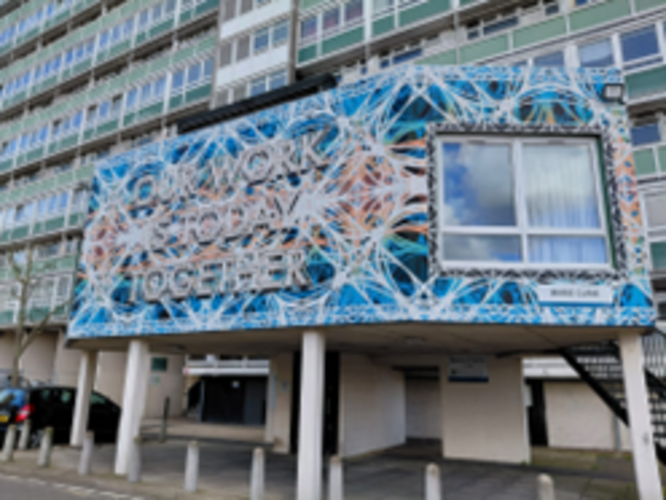
Although I had been to London previously, my expectation was that our project’s London itinerary would be a major departure from my previous routes through the city. This was indeed the case – by noon on the first day, we were stepping through dense and noisy construction sites on Fish Island, wondering if anyone ever called the hotline for the “Considerate Constructors Scheme” being advertised. By noon on our second day, we were sitting at Arments, one of the last remaining pie and mash shops in Walworth, trying to take in the contrasting storefronts lining Camberwell Road. Although not a recognizable itinerary for tracing “theatre in London”, our heterogeneous route was an illustration of the argument that Joe has been making about theatre and gentrification in the city: that some of the most interesting dynamics have been flourishing on the outer edges of the city’s traditional theatre landscape.
– Photo Credit: Emine Fişek
What I did not expect to find was how frequently we would run into images, signs, installations or other memorabilia that tried to tell the story of the city’s transformation, particularly via the loss and/or memory of social housing estates. Walking through an estate on the outer edges of Peckham, for example, there would suddenly be an installation marking the changing visual identity of the building. This trend began early on during our trip, at the V&A East Storehouse building in Hackney Wick. Here, visitors can walk through the V&A’s extensive collection, structured so as to keep guests guessing as to the rationale behind its (seemingly non-curated) curation. At the center of the Storehouse, stretching across two levels and facing the building’s inner enclosure, was a substantial chunk of the façade of Robin Hood Gardens, a former social housing estate in East London that was fully demolished in 2024. Visitors could walk through the installation, peer into rooms that had been preserved from former flats, and listen to oral histories from former residents. Stumbling across this installation in the midst of the Storehouse building was bizarre – what to make of an architectural slice from very recent history, sitting amidst medieval triptychs from Limoges, early modern dishes from Iran, and Irish jewelry from 800 BC?
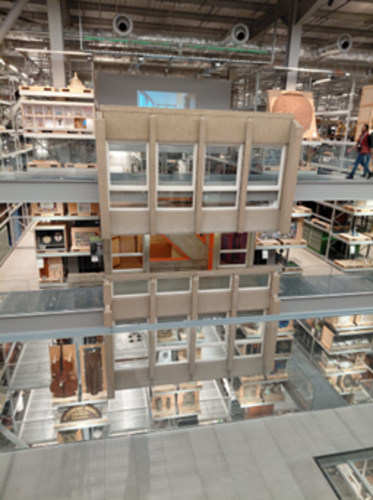
In many ways, this juxtaposition reminded me of the Humboldt Forum, which we visited during our first research trip as a group, to Berlin. At the Berlin Global exhibit, gentrification was the final stop on a “transnational” tour of the city’s history, including everything from the heyday of European imperialism to the labor migrations of the postwar period. Arriving at the Storehouse building almost two years later, I can now see what I could not quite perceive with clarity back then: the speed, unevenness, and inequality of contemporary urban transformation forces us to think about the present as a moment of history. This was what the “Robin Hood Gardens Façade” implied, that the famous “walkway in the sky” corridors that had been an architectural feature of this estate were already a thing of the past, unlikely to return, yet precious for what it (once) enabled for its residents.
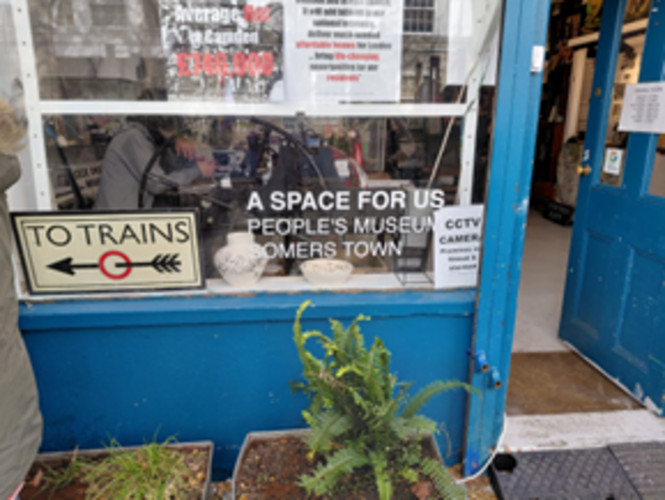
As we made our way through the city, I was also reminded that commemoration does not always have to take the polished and highly curated form that it took at the Storehouse building. While walking through the Somers Town Estate stretching behind the British Library in the borough of Camden, we visited an entirely different kind of museum: “A Space for Us”: the People’s Museum of Somers Town. In this single-room space, we read about the history of the area’s social housing estates (some of which drew inspiration from Vienna’s Karl-Marx-Hof) and about successive generations of housing activism in the area. Most importantly, the People’s Museum sought to document the history and everyday culture of an area it deemed “on the verge of extinction.” On the walls were costumes, photos, paintings, and posters, all of which had been carefully arranged. Upon hearing about our project, Director Diana Foster pulled out a non-descript black box with several drawers, across which they had collected posters, programs and rehearsal notes associated with the Unity Theatre. This precious archive was waiting to be digitized, but even in its current state, it testified to the area’s history as a cultural hub, and to theatre’s centrality to neighborhood life.
I was reminded of these dynamics of space, theatre, history and memory during Punchdrunk’s Lander 23. We saw the show on our last night, in the company’s new space in Woolwich, which comprises two former industrial buildings, both recognized for their historical value. In true Punchdrunk fashion, Lander 23 had us running, crouching and hiding throughout this vast space, as we immersed ourselves in a live action video game that involved locating new energy sources in an alien city. Truth be told, this was fun! But I also walked away wondering what story I had participated in: Where were we? Who were my teammates and I to each other? What did the new energy source mean? After the show, Clio told us that Lander 23 had essentially recycled a previous set, that for Punchdrunk’s 2022’s show, The Burnt City. This explained why we were running around fake flowers in outer space! Was Lander 23 just a placeholder then? Would it simply run until the company could re-fashion the space in a new and surprising way? As I walked away, I tried to think through the appeal this might hold for local audiences. In a city like London, where contemplating the urban present requires historical distance, and where historical self-consciousness manages to signal its stubborn presence even amidst the most rapid urban change, maybe Lander 23 was comforting precisely because it revealed Punchdrunk to be slowing down, considering its next step, and re-purposing its space in a way that retained the signs of its past.