


Aurélien Bellucci
After Berlin, Istanbul, Warsaw, and London, our project’s last field trip – before a future one, we hope! – took place in Paris, the city where gentrification has been ongoing for so long that, some argue, it no longer exists. To question this assessment, I prepared a three-day itinerary offering different perspectives on the French capital.
We met on Thursday, May 7, in the afternoon and began with a walk focusing on the district of Belleville. On Friday, we crossed the entire city by bicycle, moving from western Paris to eastern Paris, from postcard Paris to lively Paris. On Saturday, we took the metro to explore some of the northern suburbs of Greater Paris, the metropolitan area. On Sunday, we held our usual debrief meeting back in Belleville, at the hotel, which was located between Bas-Belleville, a social housing neighbourhood, where Charlotte Lagrange’s short play on gentrification – which we read together – takes place (The Deserted Square), and the Rue de Belleville, recently listed as one of the “30 coolest streets in the world” in Time Out, and along which one can observe gentrification at work.
This area was conducive to observing a distinctively Parisian dynamic: the city’s housing stock comprises 25% of social housing, next to 75% of unaffordable housing, which are juxtaposed in the northeastern districts. This is particularly the case in Belleville, a socially and ethnically mixed district, whereas the city centre and the west are, in contrast, homogeneously white and wealthy. Some central arrondissements are well below the legal limit of 25%, such as the six and seventh arrondissement, which have less than 5% social housing, whereas the northeastern nineteenth and twentieth arrondissements, which are separated by the Rue de Belleville, have about 45%. We started our first day’s walk from the middle of that street up to Place des Fêtes, where old Belleville buildings were razed to the ground in the 1960s and replaced by housing towers in the 1970s. On our way down from this high point in eastern Paris, we passed some of the district’s gentrification hotspots, such as Jourdain, a neighbourhood with trendy coffee shops, bars, and restaurants.
In Bas-Belleville, at the foot of social housing towers, we passed Parc de Belleville and its beautiful view of Paris, “the deserted square” of the play (Place Alphonse Allais), and stopped at an exhibition opening at the Belleville Artists Workshop Organization. The decline in the organization’s galleries, which have been established in the district for decades, marks a new wave of gentrification. Passing these familiar places with my colleagues opened up a number of new perspectives on my work. While gentrification in northeastern districts is limited by social housing, it still takes place along axes of communication, streets like Rue de Belleville or Rue des Pyrénées, as well as canals we later passed, such as canal Saint-Martin and canal de l’Ourcq.
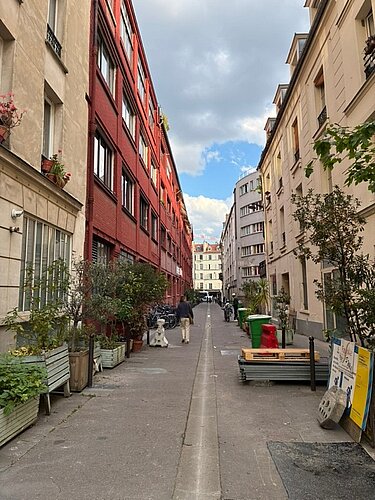
On our second and third days, our itinerary was organized around the capital’s public theatres. On Friday, we started our bicycle ride at the Palais de Chaillot, one of six national institutions – the one dedicated to dance – where Jean Vilar’s Théâtre National Populaire was formerly located (before it was “decentralized” to the suburbs of Lyon in the 1970s). We then headed toward the Comédie-Française – France’s national theatre dedicated to the classical repertory – and also had a distant look at the Palais Garnier, Paris National Opera’s historic venue, before and after which we observed the metamorphosis of the grand urban axes of Champs-Élysées and Boulevard Saint-Germain, where Parisian cultural life has progressively turned into international commercial hubs. Passing through the Quartier Latin, we circled the Odéon, the national theatre dedicated to the European avant-garde – from Ostermeier to Liddell and Castellucci – before crossing back from the left to the right bank and going toward Bastille, where the building of the Paris National Opera’s second house completely changed the face of the working-class Saint-Antoine neighbourhood, from industrial Paris to gentrified Paris. We finished our ride by visiting several emblematic institutions of the northeast: La Colline, the national theatre dedicated to contemporary theatre, Théâtre Ouvert, a national institution promoting new playwriting, and the Plateaux Sauvages, a municipal “cultural fabric” located between the Amandiers priority neighbourhood and the gentrifying axis of Rue de Ménilmontant.
Lastly, we took a walk around the Maison des métallos, observing the contrast between the industrial heritage of Cité Griset, the adjacent hip street of Oberkampf, and a social housing area in southern Bas-Belleville, before attending a concert of contemporary music at the cultural centre which aimed more at Parisian hipsters than at longtime residents of the neighbourhood. Two of my colleagues independently came up to me and remarked that it had been the first place during our trip where they heard English spoken.
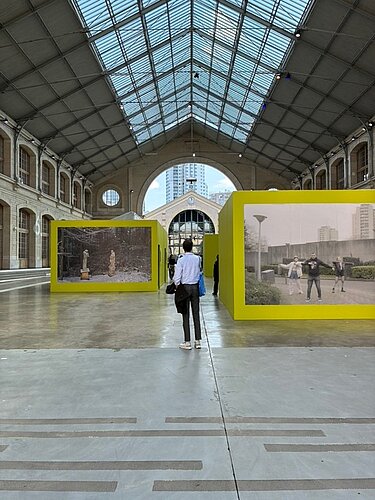
On Saturday, we visited northeastern Paris’s last, but not least, emblematic institution: the CENTQUATRE, an undeniably successful cultural venue located between working-class neighbourhoods of the nineteenth and eighteenth arrondissements. While the institution is open and used by hundreds of people daily for artistic practice, rehearsal, workshops, as well as a meeting space for families, with its café, restaurants, and shops, the main stage mostly attracts habitual theatregoers for contemporary performances of theatre, music, and dance. An employee of the venue told us that the daytime crowd – for these various activities – and the evening audience – for performances – could not be more different.
Before the CENTQUATRE, though, we had started with the MC93, or Maison de la Culture of the Seine-Saint-Denis département, whose programming – and audience – is usually not unlike what one would find at the Odéon: an avant-garde theatre that appeals to regular theatregoers, and not to the new audiences a house of culture is meant to attract.
Next to the Bobigny metro station, the landscape reminded us of the cityscape of Hackney Wick we observed a few weeks ago in London, with cranes everywhere, building a new transportation hub for Greater Paris. Between the station and the house of culture, many new buildings have emerged to accommodate new residents, and new audiences for the MC93. Isn’t the theatre’s programming already aimed at these future residents?
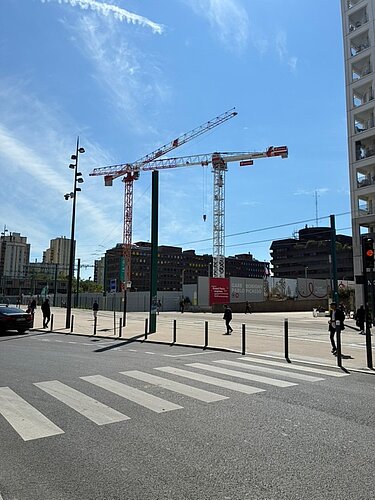
Once Greater Paris’s transportation infrastructure (the Grand Paris Express) is completed, with its new metro lines, it will be faster to travel from Bobigny to other parts of the metropolis. In order to reach our next destination, Saint-Denis, we had to return to central Paris from the east before taking another metro line northward. There, we took a walk from the brand-new Saint-Denis-Pleyel metro station, inaugurated for the 2024 Olympics, to the Olympic Aquatics Centre, which faces the Stade de France, before continuing to the city centre and its famous basilica, and finally to the Théâtre Gérard Philippe (TGP). We observed different kinds and layers of development, through sports infrastructure, from the 1990s national stadium to recent cultural heritage-led redevelopment around the city centre and its Gothic cathedral. As a National Dramatic Centre (CDN), the TGP is an institution of people’s theatre that has been a model of decentralization since its creation, offering theatre close to the people of Saint-Denis, though an increasing share of its audience comes from the centre of Paris. A shuttle takes them back to central Paris after performances, so they do not have to deal with the “unsafe” surroundings of the theatre.
As the final step in our suburban itinerary that day, we went to see a play at another CDN, the Théâtre Nanterre-Amandiers, which is also a prestigious institution from the inner suburbs (of the Hauts-de-Seine département) but which arguably belongs more to the cultural world of central Paris than the TGP. The newly renovated Amandiers is magnificent yet appears completely segregated from the Pablo-Picasso social housing estate surrounding it (it also offers a shuttle to its audience). Will the new direction integrate it more fully into its neighbourhood?
There, we attended a performance of a repertory production of a boulevard play by the Comédie-Française – while its own building is being renovated – that attracted, as expected, a Parisian audience. It was an occasion to see some of the finest acting in France through an accessible play, Feydeau’s Une puce à l’oreille, which could easily appeal to new theatregoers, if the theatre were truly accessible to them. Back in the centre of Paris, we finished a full day with a walk around the Moulin Rouge, from the Cité Véron, where Théâtre Ouvert used to be located before it was forced out of its premises by the iconic cabaret, to the hip district of South Pigalle, branded as So-Pi.
Through our Paris itinerary, we observed the specifically French practice of building major theatres in working-class neighbourhoods. Who does this policy serve? The people of these neighbourhoods? Regular theatregoers coming from other parts of the city? The city itself, seeking to redevelop these areas? Or private developers seeking to profit from it?