


Aurélien Bellucci
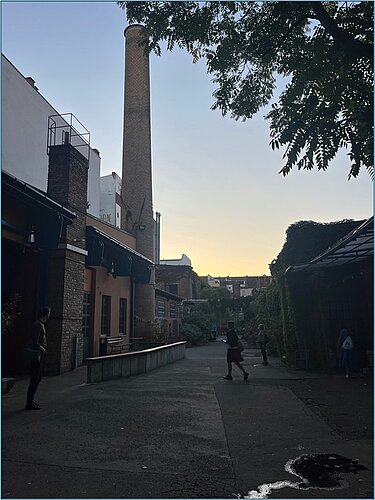
From September 19 to 22, 2024, THEAGENT’s research team gathered physically – after a year of online meetings! – for a field trip on theater and gentrification in Berlin. We visited landmarks of the German capital, such as the Humboldt Forum and its exhibition on “Berlin Global,” Tacheles, a former squat that turned into an art gallery, or the KulturBrauerei, a former brewery from the end of the nineteenth century – which used to be one of the largest in the world – that now hosts a cinema, theaters, clubs, the academic center of an American university, and restaurants in the middle of Prenzlauer Berg. We took an ethnographic walk through this district, as well as in Kreuzberg and Neukölln. And we attended local performances, including a cabaret-like Gazino Nights, a parodic dance performance on German hit songs (or Schlager music), and a “post-migrant” play.
I had heard several times about “post-migrant theater” as an important movement in the German performing arts, but I had never had a chance to see one of its plays. I remembered a meeting with fellow comparatists from Germany who had asked me whether my work on political theater engaged at all with this movement. To some extent it did, but I had to admit that the expression did not translate well into the French context. Does it in English? To French ears, at least, it sounds as if migrations belonged to a bygone era, let alone the fact that any mention of “immigration” or “ethnicity” is sensitive in France, whereas in Germany the expression refers to plays by dramatists of foreign descent which tackle questions of cultural identity. German scholars might label as such a show like Ma République et moi (My Republic and Me) by Issam Rachyq-Ahrad, which was on stage in Saint-Denis last Spring, yet French scholars would hesitate to do so…
At the Maxim Gorki Theater, which used to be a counterpart to the Berliner Ensemble in the German Democratic Republic, we attended Ellbogen (Elbow), the stage adaptation of a bestselling book telling the story of Hazal Akgündüz, a young woman who was born in Berlin from Turkish parents, embodied on stage by a single actress – as in Rachyq-Ahrad’s performance – who brought the audience into an immersive experience of being a first-generation German with a Migrationshintergrund, that is, a “migrant background.” Although urban transformation was not a major topic in the play, post-migrant theater in Germany and its equivalents abroad (like some of the plays created in the French theaters of Seine-Saint-Denis) may be a relevant source to study the representation of gentrification; indeed, the central districts where immigrant families reside often fall prey to gentrifiers of all kinds.
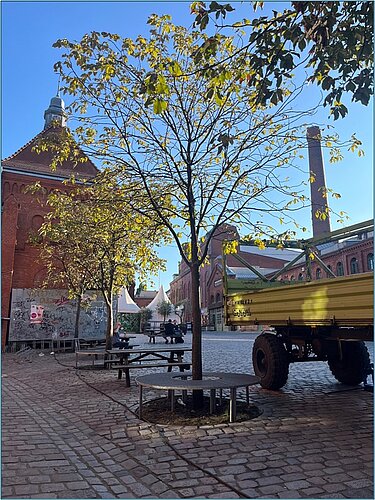
Much like Kreuzberg in West Berlin, Prenzlauer Berg used to be a counterculture center in East Berlin. As it went through quick gentrification after reunification, it became one of the most expensive districts of the capital city, its squats being replaced by luxury apartments – with the notable exception of Tuntenhaus – and its breweries being turned into cultural centers, such as the KulturBrauerei. With the help of our teaching material, we jotted down our impressions on paper as we wandered through the district, observing building renovations, thinking about different kinds of “upgrading,” having a look at the housing market (the price per square meter is still twice cheaper than in Paris or London), visiting shops, listening to previously-recorded interviews with residents, talking to people on the street, and trying to observe different phases of gentrification. Were these phases the same in Berlin as in other European cities, or as in the classical sequence coming from American urban studies? Could one see such phases through repertorial change in a gentrified area’s theater? And what about my own case study, Paris?
As a matter of fact, when we visited the exhibition “Berlin Global” at the Humboldt Forum, our first activity during the field trip, Paris was mentioned in various testimonies by Berlin residents. A small part of the exhibition, named “Wir Bleiben!” (“We’re staying!”), was devoted to “gentrification and resistance in Berlin.” Ironically enough, the setup was such that we could not find a comfortable position to make the most of all its precious material, mostly interviews about gentrification, as if we were ourselves denied the right to stay in that place… People spoke about Kreuzberg, Neukölln, and Prenzlauer Berg, a fitting introduction for our visit. A foreign student said how hard it had been for him to find decent housing in the city, a gay club owner shared his fear to witness the disappearance of Berlin’s subcultures, squatters talked about their way of living in community, a drag queen showed the sculptures she had created to fight against evictions, a scholar presented his research on the concept of gentrification, a woman told the story of her district after reunification, an American artist insisted that he was a migrant and not an expat: he had moved to Berlin since he could not afford to live in the US anymore. Some vehemently criticized gentrification, others recognized that they might be part of the problem, all were trying to make sense of rapid urban change in this global city. And a few of these interviewees mentioned Paris – most often along with London – as the example of a city they did not want Berlin to follow, as if it were the city of gentrification par excellence
As a resident of Paris, I was not so surprised to hear such testimonies: although there is in France some resistance to using this English concept to speak about the French context (some even favor the rival notion of “embourgeoisement”), gentrification in Paris has become an undeniable reality, with districts such as Saint-Germain-des-Prés being the Prenzlauer Berg of tomorrow. Yet I was surprised to hear them label Paris as the city of gentrification, along with London and rather than, say, New York: “We don’t want Berlin to become another London or Paris.” Maybe there is something properly European about the phenomenon they described. As a researcher, I thought that these testimonies would make for an ideal introduction to an article on gentrification in Paris. French people probably do not see their capital city as such, and they may think of Berlin as the ultimate example of gentrification. The comparative aspect of our project promises to bear fruit! These testimonies also assumed that Paris is the city center alone, whereas all its suburbs, or “Greater Paris” (including Seine-Saint-Denis), should be part of discussions on gentrification. In Paris as in Berlin, there is still space for “gentrification and resistance” to it.