


Emine Fişek
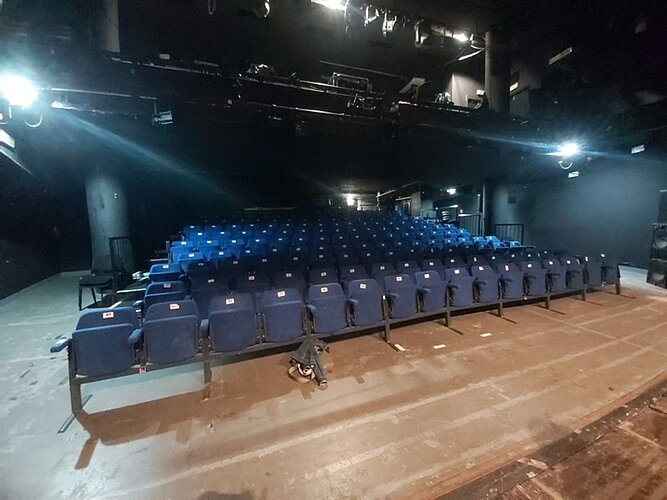
During our research trips, we all experience moments of affinity: a basement theatre in Warsaw looks exactly like underground performance venues that we saw in Istanbul; a regenerated former brewery in Berlin is almost indistinguishable from its counterparts in Istanbul and Warsaw; and despite working within very different institutional structures, theatre artists often sound the same when they narrate the challenges of operating in mixed, transforming neighborhoods. These moments of affinity are fruitful, but they can also be misleading, hindering (at least initially) our ability to recognize the different forces at play in how the theatre and performance fields of our respective cities have been shaped. So, one of the outcomes of our joint research trips has been learning to treat familiarity and affinity with caution, even as we avoid falling back on incommensurability.
During our recent research trip to Warsaw, I allowed myself brief opportunities to suspend this learned strategy, and the result was that everything looked intensely familiar! For example, we took a guided tour through Warsaw’s Praga district, which sits across the Vistula River from the city’s commercial and cultural center. During World War II, Praga sustained less damage to its infrastructure than central Warsaw, which has meant that it is one of the few places in the city with pre-war housing stock. At the same time, Praga was left behind during Warsaw’s reconstruction, when infrastructural investments focused on the left bank. In a shift that resonates across our different case studies, Praga’s neglected yet evocative buildings have been repurposed since 1989, with early artistic experimentation soon followed by large-scale investment. As we made our way between alleys, courtyards, and streets in Nowa Praga, our guide, Maks, told us that the gentrification of the district was inevitable, since it was the only area in the city where residents could “see” or experience their history. Equally importantly, Maks was pleased that the district was no longer synonymous with derelict buildings and crime, making it possible for visitors to experience a cleaner, brighter Warsaw that could display both a pre-war and a contemporary vibe.
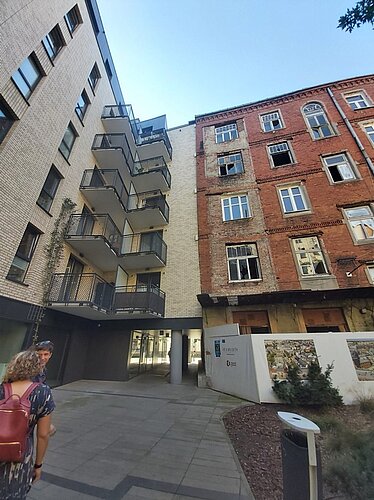
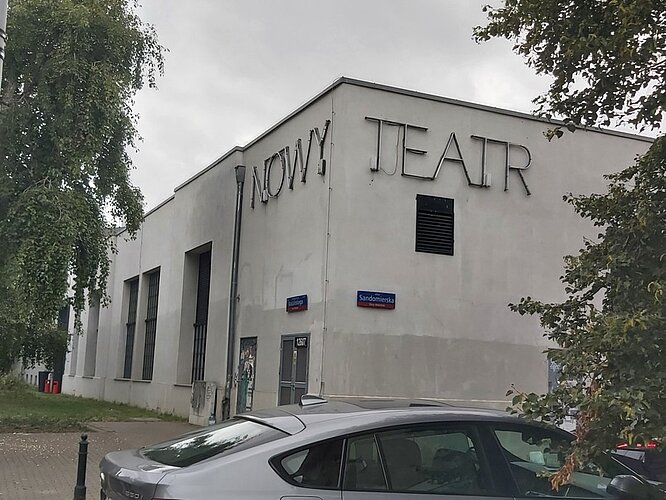
As students of gentrification, we are now familiar with Maks’s rhetorical moves, particularly the ways in which notions of historical authenticity become the rationale for redevelopment. But sprinkled into Maks’s commentary were other emphases: at times, Maks told the story of Warsaw’s reconstruction as a long-term process of Europeanization, sharing his pride over the city becoming a recognizable European tourist destination that could shed images of a postwar urban fabric or of communist urban planning. Listening to Maks, I was struck by how familiar these emphases were to someone from Turkey: the fraught process of Europeanization from the margins, pride in “looking like” the West, and the desire to reclaim historical episodes that now seem to point to another urbanity. Fueled by these strong attachments, the desire for gentrification seemed to reference both the immediate city, and metaphorically, the country as a whole. These sentiments are by no means foreign to Istanbulites, and were particularly heightened during the first decade of the twenty-first century. And different versions of this sentiment emerged during our time in Warsaw: the panel outside the ongoing reconstruction of the Saski Palace announced that “following the examples of other European capitals, a modern cultural center will be built”, while renowned director Krzysztof Warlikowski’s Nowy Teatr insisted on its subtitle as an “International Cultural Center”. Having allowed myself a brief interlude to revel in familiarity, I felt right at home!
At the same time, the rich array of performance that we witnessed in Warsaw seemed to anticipate my willingness to see my own experience reflected through the city, and often thematized the gaze of outsiders. In “The Best City in the World: An Opera About Warsaw”, commissioned by the Sinfonia Varsovia and produced by the Polish National Opera, Teatr Wielki, there are two central figures who serve as foils to one another. The first is an Architect who dreams of razing pre-war Warsaw to the ground in order build a fully functional, flexible and egalitarian city from scratch. Following the city’s near-total destruction during World War II, she throws herself headlong into reconstruction, horrified by the naïveté of her younger self. The second is a Journalist, an American who seeks to chronicle (and celebrate) Warsaw’s rebirth as an ideal of Communist urban planning. Through her friendship with the Architect, she encounters the enormity of the task that lies ahead for Warsaw, and rethinks her earlier commitments. These characters undergo both personal and political transformations, but the Teatr Wielki makes clear that it is the Architect who will continue to be embedded in Warsaw’s everyday reality, and the needs of its people.
At the Teatr Dramatyczny, we saw “Angels in Warsaw”, written by Julia Holewińska and directed by Wojciech Faruga. Inspired by Tony Kushner’s “Angels in America”, as well as by Krzysztof Warlikowski’s iconic 2007 production, “Angels in Warsaw” surveys the Polish experience of AIDS, endowing the epidemic with an urban history. Early on in the performance, characters situate 1980s Warsaw against a broader background: contemporary political developments from North America to the Middle East are rattled off, as if to depict Warsaw within a familiar global timeline, but also to underline its unique context and temporality. Not surprisingly, the tension and balance between the local and the global seemed to be one way in which audiences were responding to the production. Then, in Teatr Powszechny’s “Kobietna Samotna”, a performance inspired by Agniezska Holland’s “A Lonely Woman” and directed by Anna Smolar, I was reminded that I am not the only one doing the gazing. In the play, single mother Irena struggles to hold down a job, pay rent, and care for herself and her son in a contemporary Poland with few social safety nets. Listing the luxuries that seem both close and out of reach, Irena yells at one point that she would also like to go vacationing in the south of Turkey. And there it is – a reminder of the myriad ways that nations and peoples can be intertwined in a late capitalist world.
As we get ready to pool our case studies together and produce the first draft of our collective work, all of these moments point to the challenges of comparative research, of allowing ourselves the opportunity to imagine connections, then finding a balance between affinity and disparity.