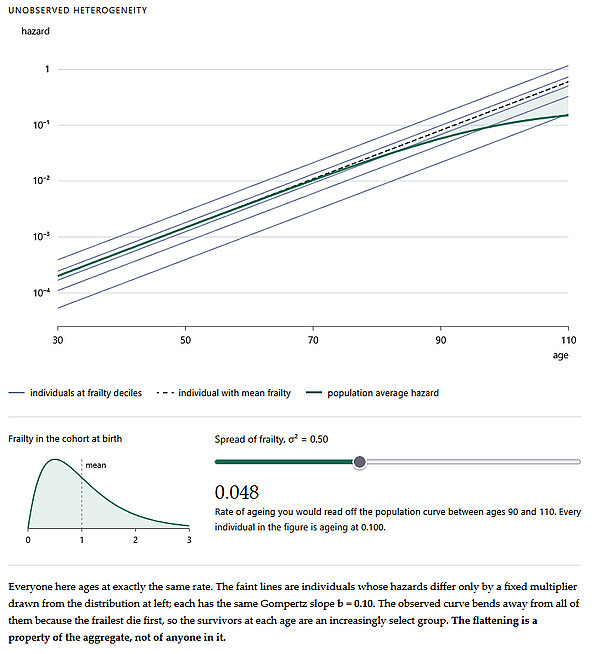
In the field of demography, summary measures of population health aim to capture the current health and mortality conditions, facilitating comparisons across populations. However, these statistics are affected by a compositional bias resulting from past conditions, which means they may not fully reflect the current health and mortality conditions. This research project seeks to address this compositional bias by proposing innovative methods that correct for the influence of observed and unobserved characteristics between life-table cohorts and the population implied by the period-specific conditions. These new measures are applied to key topics that are heavily debated in population studies.
In this project, we take a pioneering step by extending the concept of mortality under current conditions to also include morbidity. Applying multistate models that consider heterogeneity, we introduce innovative methods to estimate summary measures of population health, taking into account the population composition resulting from current conditions. All of the innovative methods proposed in the study are incorporated into an open R package, making them easily accessible for researchers.
By addressing the compositional bias and extending our understanding of morbidity under current conditions, our research contributes valuable insights to the field of population health. Our findings have the potential to inform public health policies and interventions, ultimately contributing to the improvement of population health worldwide.
Title: Heterogeneity in Health and Mortality Studies of Population: The effect of individual health trajectories and compositional differences on summary measures of population health
Acronym: HeHeMo
Funding Body: FWF – Elise Richter grant
Project Leader:Magdalena Muszynska-Spielauer
Time Frame: 01 September 2023 to 28 February 2028


