Decisions at every level, from lab practice to campus systems, contribute to a safe and responsible research environment at IMBA. Scroll down for our "spot the violation" quiz.
The Environmental, Health, and Safety (EHS) team is responsible for protecting people across all research and support activities. This includes occupational health and safety, legal compliance, training, and emergency preparedness, as well as support for employee health and wellbeing. Environmental considerations are integrated into this work as part of a comprehensive approach to risk prevention and responsible research operations.
The institutes provide access to occupational medical care, including preventive health checks, vaccinations, and targeted medical surveillance for hazardous work. Mental health and wellbeing are recognized as part of occupational health, with structures in place to support staff health and safe working conditions. A dedicated pregnancy lab supports safe laboratory work during pregnancy.
Sustainability measures increasingly shape everyday research practice at the IMP and IMBA. Energy use in laboratories has been reduced by raising freezer temperatures from minus 80 to minus 70 degrees Celsius, supported by clear guidelines on freezer maintenance. Laboratories also take part in the LEAF initiative, a structured framework to assess and improve the environmental footprint of research activities. In parallel, IT storage has been reduced to limit unnecessary energy consumption.
At the infrastructure level, the IMP and IMBA operate on 100 percent renewable electricity. Buildings are equipped with LED lighting and light sensors, and according to the European Commission’s framework on light sources, LEDs typically reduce energy consumption by 50 to 80 percent compared to conventional incandescent and fluorescent alternatives. Plus, unlike fluorescent bulbs, they contain no mercury, making them considerably safer to dispose of and recycle. More efficient control of heating and air conditioning systems has also been introduced, and the European Building Automation and Controls Association estimates that such systems can improve a building’s energy performance rating by at least one full class. Waste management has been reorganized across campus, with clear separation of plastic, paper, metal, glass, and residual waste, and all printing now uses 100 percent recycled paper.
Procurement and logistics have been redesigned to reduce transport, packaging, and food-related emissions. Laboratory supplies are ordered in bulk and delivered once per week, for example from suppliers such as NEB and Eppendorf. In the cafeteria, meat and fish consumption has been reduced, with a stronger focus on locally produced food and products.
Collaboration among the institutes on campus and community feedback are driving innovation at the IMP and IMBA. Green Conference Guidelines support more sustainable scientific meetings, transforming climate commitments into concrete event standards aligned with the Austrian Ecolabel for meetings and events. In practice, this means prioritizing virtual or hybrid formats to reduce international air travel, offering plant-based and locally sourced catering, and running events with paperless digital programs at venues powered by renewable energy and LED lighting. Beyond these structured guidelines, a Sustainability Ticket within the EHS system allows staff to submit ideas and feedback. At the campus level, an Environmental Protection Team meets twice per year in collaboration with Climate@MaxPerutzLabs to coordinate and review progress.
Long-term change depends on participation. Environmental protection topics are part of onboarding for all new employees and supported by a climate lecture series. Dedicated staff have been recruited to work on sustainability at both institute and campus level. Even social activities reflect this approach, with the wide implementation of reusable containers.
This comprehensive approach to environment, health, and safety practices was recognized in 2025, when the IMP and IMBA were awarded the ÖkoBusiness Wien ‘Ausgezeichnet 2025’ distinction by the City of Vienna for measures supporting energy, waste, and resource savings.
EHS guidelines are designed to prevent precisely the situations shown in the laboratory scene below, which contains multiple deviations from standard practice at IMBA. Find all ten safety violations in this picture and check your answers.
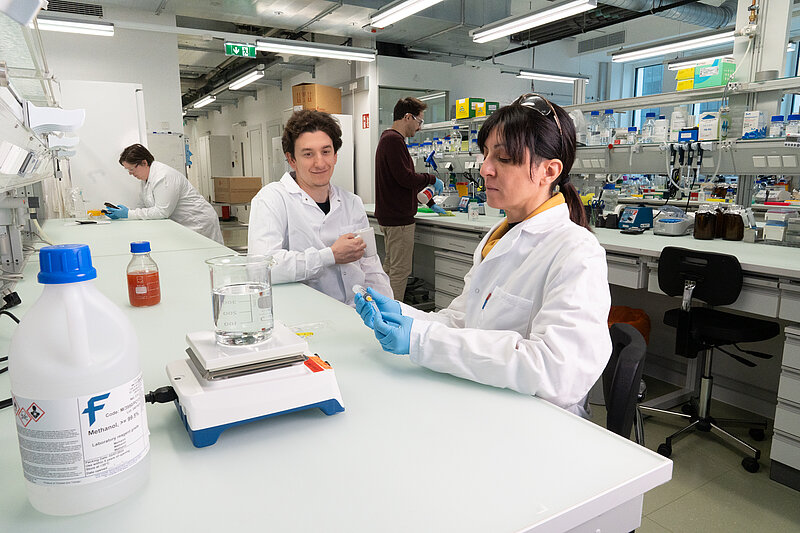

1. No safety goggles
Hazard: Chemical splashes or splinters can get directly into the eyes and cause severe chemical burns or loss of vision.
Correct behaviour: Wear safety goggles
2. Using a smartphone in the laboratory
Danger: The mobile phone can become contaminated. It also distracts and can lead to accidents.
Correct behaviour: Smartphones should not be used in the work area. If necessary, only with clean hands.
3. No lab coat
Danger: The person is wearing their own clothes. If chemicals are spilled, the liquid is absorbed into the fabric and causes skin burns. Hazardous substances are transported with your clothes to other areas, such as the cafeteria, or taken home.
Correct behaviour: A closed, long-sleeved lab coat is mandatory.
4. Incorrect storage of large containers on the work table4. Incorrect storage of large containers on the work table
Danger: The large bottle (methanol) is near a source of ignition (heating plate). Methanol is highly flammable and toxic.
Correct behaviour: Flammables belong in safety cabinets. Toxins have to be locked.
5. Unlabelled container with unknown liquid5. Unlabelled container with unknown liquid
Danger: Risk of confusion! No one knows what is in the bottle, how it should be disposed of or what first aid measures are necessary in case of contact.
Correct behaviour: Every container must be labelled immediately with its contents, concentration, hazard symbols and date.
6. Eating and drinking in the laboratory (coffee cup)
Danger: Risk of incorporation.
Correct behaviour: Food and drinks are strictly prohibited in the laboratory.
7. Use of a spray bottle
Hazard: Spraying produces dangerous aerosols and spreads contamination.
Correct behaviour: Use squeeze bottles to protect the respiratory tract.
8. Blocked escape routes
Hazard: Cardboard boxes on a trolley block the escape route.
Correct behaviour: Escape routes must be kept clear at all times and must not be blocked. Dispose of cardboard boxes and packaging material immediately.
9. Storage on electrical appliances
Hazard: Storing a cardboard box on a refrigerator increases the risk of fire in the laboratory.
Correct behaviour: Avoid storing anything on electrical appliances.
10. Improper handling of needles
Danger: Recapping is one of the most common causes of needle stick injuries. This poses a high risk of infection from contaminated material.
Correct behaviour: Never Recap! Dispose of used needles immediately after use in a puncture-proof waste container.