



IMBA scientists enjoy support from services that combine world-class infrastructure with expert staff. These service units are organised in different ways - scientific core facilities, administration, infrastructure facilities and others - all united by their committment to serving the scientific mission of IMBA.
Facilities and service units such as the Scientific Core Facilities are managed by technical leaders who evaluate and implement a wide range of novel technologies, instrumentation, and techniques. The professional staff scientists in these departments also train users, help with experimental design, and disseminate expert knowledge. They tailor their expertise to individual research questions and are available at any stage of investigation.
Access to the world-class facilities allows IMBA scientists to rapidly generate, interpret and present compelling, high-quality data. This accelerates the pace of their research and gives them a competitive edge.
Below, you can find further information on the services and facilities available to IMBA research groups. Most of the internal scientific core facilities and administrative services are shared with IMBA's partner institutes IMP and GMI; the Vienna BioCenter Core Facilities cater to the entire campus.
Core Facilities
Tissue Culture Support Unit

The Tissue Culture Support Unit supports all research groups and scientists at IMBA who use tissue culture in their work, with services ranging from procurement and distribution of reagents to quality control and development of new protocols and methods
Bioinformatics
Bioinformatics offers a wide range of support to molecular biology research groups, including data analysis, software, training, and assistance with experimental design for high-throughput biological datasets.
- Analysis of NGS and other large-scale data
- Functional and structural characterization of proteins and genomic regions
- Multi-omics data integration and functional gene-set analysis
Biooptics
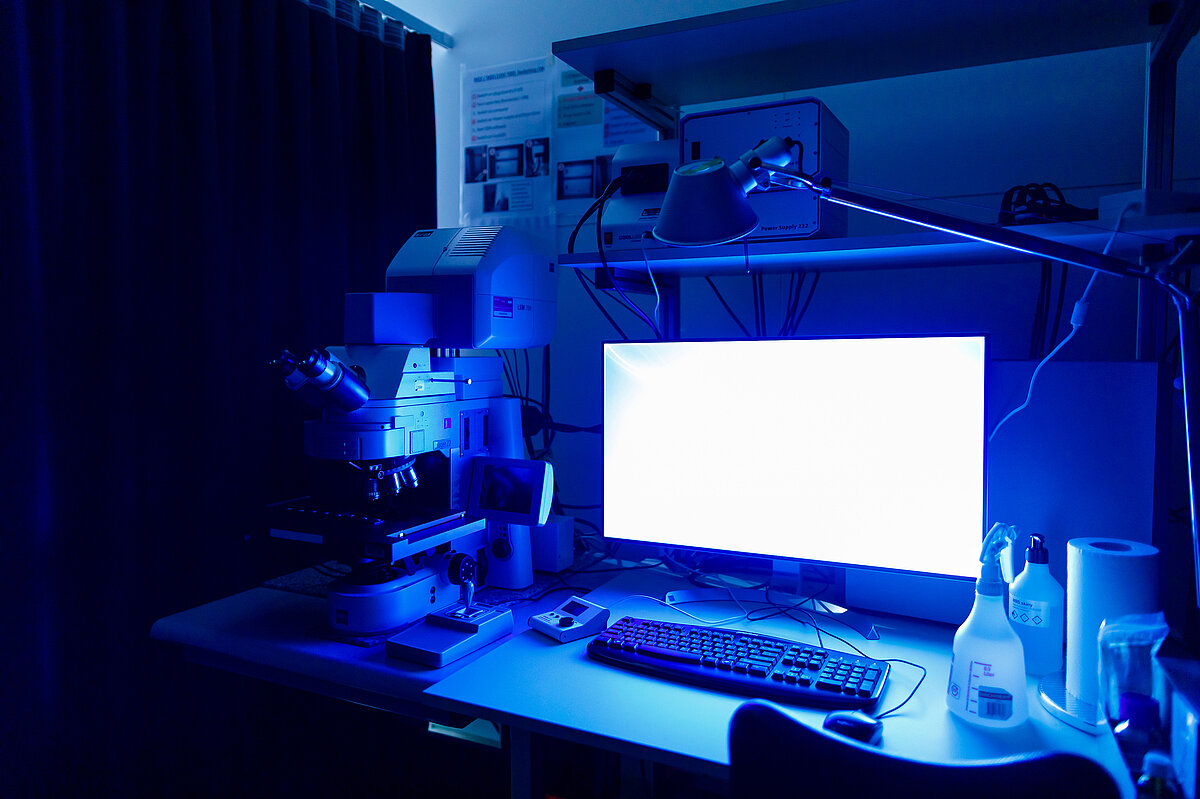
Biooptics offers extensive services, including analytical flow cytometry and cell sorting, 30+ microscopy systems (wide-field, confocal, two-photon, light-sheet, super-resolution, TIRF, FLIM), and advanced image processing and analysis.
Fly and Worm Facility

The Fly and Worm Facility provides micro-injections to generate transgenic animals and offers a CRISPR genome engineering service for precise knock-out and knock-in projects in Drosophila as well as several nematode species, including C. elegans.
Molecular Biology Services

Molecular Biology Services provides services including Sanger Sequencing, E. coli cell preparation, recombinant protein production, mycoplasma testing, and plasmid preparation in 96-well format, along with molecular biology reagents, high-throughput lab automation, and access to a RIKEN clone repository.
Organoid Research Facility
Organoid Research Facility is a specialized IMBA center focused on advancing organoid-based research.
Peptide Synthesis

Peptide Synthesis specializes in peptide synthesis with options for modifications or heavy isotope-labeled amino acids, and conducts purification of antibodies and other proteins, complemented by small-scale RP-HPLC purifications and TAQ purification in collaboration with MBS.
Proteomics Facility

The Proteomics Facility provides mass spectrometry service for protein identification, characterization of post-translational modifications and protein quantitation which includes sample preparation, MS measurement and the respective data interpretation. The facility operates a number of state-of-the-art mass spectrometers that are provided by the VBCF.
Proteomics Tech Hub

With single cell proteomics (SCP) and crosslinking mass spectrometry (XL-MS), the Proteomics Tech Hub currently focuses on two major lines of research and technological innovation both holding great relevance to the Vienna BioCenter research community.
Transgenic Service Department
TheTransgenic Service Department assists in-house investigators by offering services for the creation and preservation of genetically engineered laboratory animal strains.
Infrastructure & others
Mechanical Engineering Center

The Mechanical Engineering Center assists scientists in any hardware challenge: designing and building prototypes, robotics or any custom-made experimental setup that requires expert skills and professional tools to translate ideas into custom-made products in the service of discovery.
CLIP (Cloud Infrastructure Platform)
CLIP (Cloud Infrastructure Platform) provides fundamental High Performance Computing resources with low entry threshold. These resources comprise of the HPC compute cluster itself, as well as support and training for its users.
CLIP comprises approximately 200 compute nodes with 8000 CPU cores and more than 30 terabyte working memory, as well as 120 CPU accelerators and approximately 250 terabyte shared flash storage.
All major system components of CLIP are virtual. This allows the flexible configuration of the computational resources, and seamless upgrades of the underlying hardware. CLIP is operated as a collaboration between IMBA, the IMP, GMI, HEPHY, SMI, the University of Vienna, and the Technical University of Vienna.
Graphics
The Graphics studio provides figures, illustrations, presentations, animations and layouts for scientists. Its services range from advising on design issues to full implementation of scientific illustration and print projects, such as posters, images for papers or presentations, and all print production. Given its comprehensive array of print equipment, many items can be produced in-house including brochures, announcements, invitations, name badges and other products in support of some of the IMP’s scientific events, publications and communications. Graphics is shared by IMP and IMBA.
Other service facilities at IMBA
There are many other services and facilities available to IMBA scientists, some of which support research more directly than others: the grants management team assists scientists to file grant applications and submit reports; the purchasing department and store ensure the timely delivery of any product or external service required by a research group; human resources supports recruiting and staff development; Environment, Health, and Safety ensures safe and sound work conditions for all; the cafeteria provides home-made food throughout the week, and facility management ensures that the building and its appliances run smoothly. All services are united by their committment to enabling world-class research.
Vienna BioCenter Core Facilities
The Vienna BioCenter Core Facilities (VBCF) offer state-of-the-art research infrastructure and scientific services to academic research institutes and companies in the field of Life Sciences at Vienna BioCenter and beyond.
Austrian Bioimaging/CMI
Austrian Bioimaging/CMI serves as the national node for Euro-BioImaging, part of the European Research Infrastructure Consortium (ERIC), and provides open access to a broad range of imaging technologies and data services, supporting research and training in biological and biomedical imaging.
Child Care Center
Child Care Center advocates for career-family balance by offering childcare for children aged three months to six years for employees at the Vienna BioCenter.
Computational Biology
Computational Biology Training is part of the Vienna BioCenter Scientific Training program and provides practical courses on computational data analysis.
Electron Microscopy

ElectronMicroscopy offers training and assisted techniques in electron microscopy, including standard methods and advanced cryo-EM for high-resolution imaging, as well as basic scanning EM for surface structure visualization.
Histology

Histology equips researchers with diverse equipment and expertise to preserve and visualize the microanatomy of their model organisms utilizing classical tissue processing, histochemistry, immunostaining, and in-situ hybridization methods, as well as multidisciplinary approaches, such as spatial transcriptomics, tissue clearing, and multiplex immunofluorescence.
Metabolomics

Metabolomics offers quantitative analysis of small molecules and metabolites using LC-MS/MS, combining liquid separation techniques with advanced mass analysis, enabling targeted and nontargeted insights into metabolic pathways and genome-environment interactions.
Next Generation Sequencing

Next Generation Sequencing provides DNA and RNA sequencing across short (Illumina) and long-read (PacBio and ONT) platforms. A broad selection of library preparation protocols allows for processing samples from many biomedical research areas. The diverse portfolio comprises customized approaches, user consultation, robotics services, and bioinformatic analysis.
Plant Sciences

Plant Sciences (PlantS) operates a state-of-the-art, high-throughput, multi-sensor plant phenotyping research infrastructure (PHENOPlant) and 23 highly specialized phytotrons. We offer expertise and service in high-throughput plant phenotyping, dynamic environmental simulations, soft- and hardware engineering as well as image- and data analysis.
Preclinical Phenotyping
PreclinicalPhenotyping (pcPHENO) specializes in advanced mouse in vivo studies covering behavior tests, metabolic and cardiovascular measurements, as well as surgical services.
Protein Technologies

Protein Technologies (ProTech) aims to advance research in molecular and cell biology, protein biochemistry, and structural biology by offering expertise in recombinant protein technologies and biophysical characterization, with core services including molecular cloning, protein production, purification, and analysis.
Scientific Editing Support
The Life Science Editors are a company that offers expert scientific editing, writing, and illustrations for manuscripts and grants from PhD and MD level editors. IMBA scientists enjoy access to this external service through an umbrella agreement.