


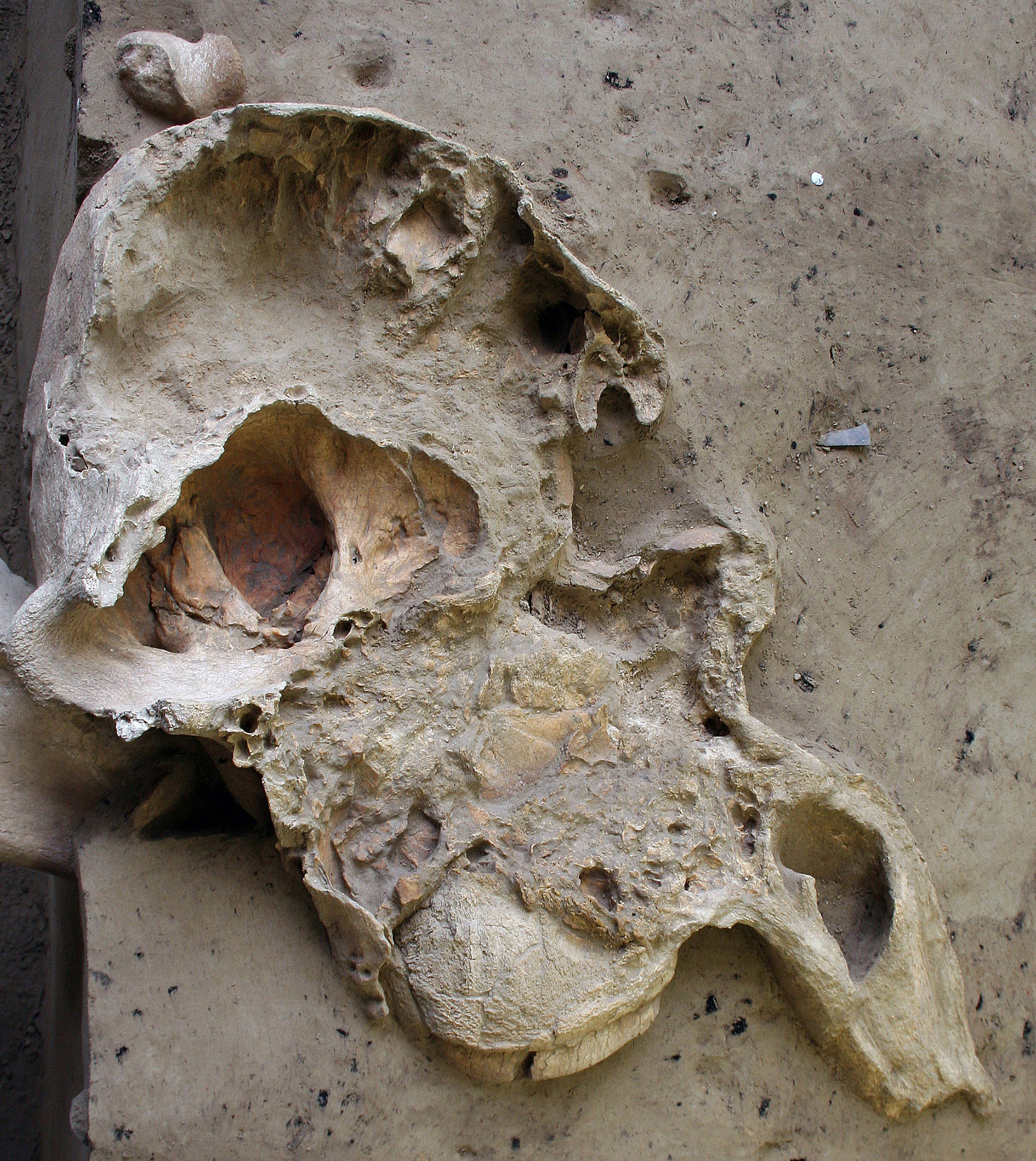
The Quaternary Archaeology research group is a key partner in the new ERC Research Consolidator project MAMBA »Exploring Mammoth Bone Accumulations in Central Europe« with Principal Investigator Jarosław Wilczyński of the Institute of Systematics and Evolution of Animals (Polish Academy of Sciences) in Krakow.
Since the 19th century, the discovery of large accumulations of woolly mammoth remains together with Upper Palaeolithic artefacts has fascinated researchers and the general public alike. Despite many years of scientific research and dispute, our knowledge about these sites and the relationship between mammoths and the contemporaneous Upper Palaeolithic hunter-gatherers remains incomplete. The new project focuses on the mammoth bone accumulations discovered in the forelands of the west Carpathians and seeks to understand how they formed and which function they had for the hunter-gatherer groups 35,000–25,000 years ago – a period of major techno-cultural and environmental change in approaching the Last Glacial Maximum.
In the new project we will study materials covering the full chronological range of this archaeological phenomenon, and consider both existing collections, as well as conduct new fieldwork at the key sites of Dolní Věstonice I (Czech Republic), Kraków Spadzista (Poland) and Langmannersdorf (Austria). Site-specific signals of human-mammoth interaction within their local palaeoenvironmental context will be used to investigate chrono-spatial changes in both mammoth populations and hunter-gatherer societies. In addition to traditional archaeological and bioarchaeological approaches, we utilise recent methodological and technological advances in ancient DNA research, stable isotope studies, radiometric dating, palaeoenvironmental reconstruction and palaeodemographic modelling.
The resulting dataset will allow an integrated investigation of the formation of mammoth bone accumulations and produce a statistically analysable dataset we expect to reveal the interactions between human and mammoth populations in Central Europe in the context of palaeoenvironmental changes. This will have great impact not only for Upper Palaeolithic research in Central Europe, but will, on a general scale, also contribute to an improved understanding of human behaviour, cultural developments, and human adaptation to dynamically changing climatic and environmental conditions.
OeAI project partner/contact: marc.haendel(at)oeaw.ac.at