


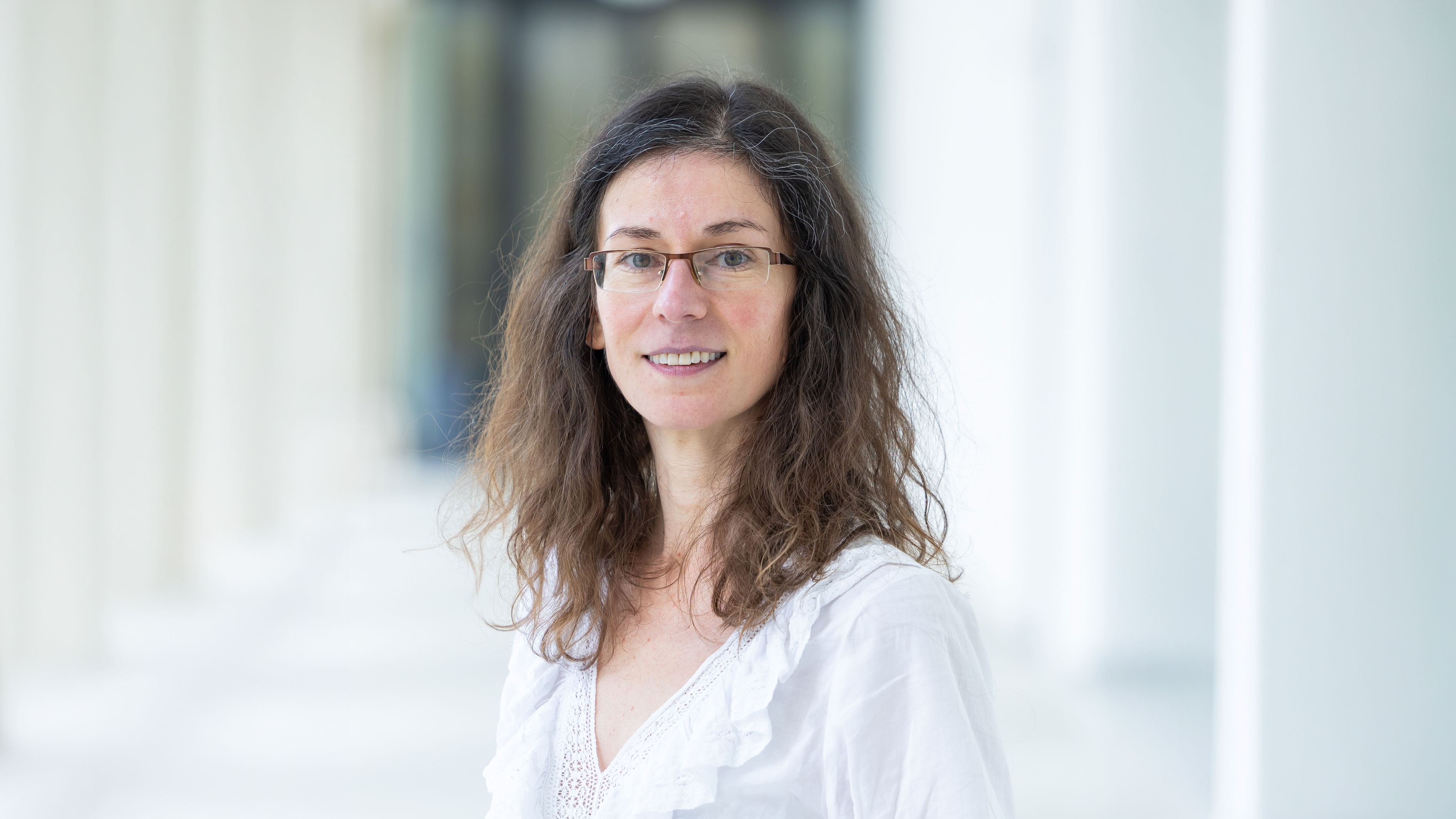
Anna Dolganov: »I am deeply honored by this election and look forward to contributing productively and advancing my research within the learned society. The Austrian research landscape is producing a dynamic new generation of scholars; it is exciting to be part of this process. I look forward to the future with enthusiasm!«
Among the new members are Francesca Ferlaino, Scientist of the Year, and AI researcher Sepp Hochreiter. All new members are distinguished by their exceptional specialist expertise and the highest level of scientific competence. Margit Fischer, initiator of the ScienceCenter network, and the German science manager Andreas Barner have been admitted as honorary members. For the Academy, this year’s elections also mark a turning point: for the first time in its history, women make up the majority of members under the age of 60.
63 per cent of new members are women
OeAW President Heinz Faßmann says: »The Academy is becoming younger, more diverse and more female. Over 60 per cent of the newly elected members are women. The range of research fields is impressive and encompasses subjects of great social relevance – from democracy studies and Iranian studies to computer science, tumor biology and quantum physics. I look forward to the fresh, unconventional and inspiring ideas and perspectives of the new members, particularly the Rising Stars of the Young Academy.«
The Academy is divided into a Division of Humanities and Social Sciences and a Division of Mathematics and Natural Sciences divivion, as well as a Young Academy, whose members are no older than 40 at the time of their election. The Academy also admits honorary members. Elections for members take place every two years, whilst those for the Young Academy are held annually.
The Humanities and Social Sciences Division welcomes, among its newly elected members, the specialist for Eastern Europe Wolfgang Mueller and the political scientist Barbara Prainsack (both from the University of Vienna), as well as the Iranist Florian Schwarz (Austrian Academy of Sciences). In addition to Ferlaino and Hochreiter, the Mathematics and Natural Sciences Division also elected tumor biologist Anna Obenauf (IMP) and behavioural ecologist Sylvia Cremer (ISTA). The Young Academy elected nine new members, including papyrologist Anna Dolganov (Austrian Academy of Sciences) and physicist Gerben Oling (Vienna University of Technology).
Christiane Wendehorst, President of the Humanities and Social Sciences Division of the Austrian Academy of Sciences (OeAW), and Wolfgang Baumjohann, President of the Mathematics and Natural Sciences Division of the OeAW, welcome the new Academy members: »The newly elected members have made a significant contribution to science through their exceptional achievements. We are delighted that they will enrich the Academy’s work with their experience and expertise. We are particularly pleased by the high proportion of women, especially in fields that were once male-dominated. In the age group relevant for new elections, we have exceeded the 50 percent mark this year – a success resulting from many years of work on gender equality and awareness-raising, and a reason to celebrate.«
2026 elected members
Honorary members
Academy
- Andreas BARNER, Vorsitzender des Aufsichtsrats der Frankfurter Allgemeinen Zeitung GmbH, gewählt für seine Verdienste um die Wissenschaft und den Forschungsstandort Österreich
- Margit FISCHER, Vorsitzende des Vereins ScienceCenter-Netzwerk, gewählt für ihre Verdienste als Brückenbauerin zwischen Wissenschaft und Gesellschaft
Mathematics and Natural Sciences Division
- Susan SOLOMON (Department of Earth, Atmospheric and Planetary Sciences, Massachusetts Institute of Technology, Cambridge, USA), Atmosphärenchemie
Humanities and Social Sciences Division
- Günter STEMBERGER (Institut für Judaistik, Universität Wien), Judaistik, Alte Geschichte, Theologie
Full members
Mathematics and Natural Sciences Division
- Francesca FERLAINO (Institut für Experimentalphysik, Universität Innsbruck; Institut für Quantenoptik und Quanteninformation Innsbruck, ÖAW), Atomphysik / experimentelle Quantenphysik
- Sepp HOCHREITER (Institute für Machine Learning, Johannes Kepler Universität Linz), Künstliche Intelligenz, Informatik
Humanities and Social Sciences Division
- Martin KORENJAK (Institut für Klassische Philologie und Neulateinische Studien, Universität Innsbruck), Klassische Philologie / Neulatein
- Wolfgang MUELLER (Institut für Osteuropäische Geschichte, Universität Wien), Osteuropäische Geschichte
- Barbara PRAINSACK (Institut für Politikwissenschaft, Universität Wien), Politikwissenschaft, Soziologie, Ethik der Biowissenschaften, Soziale Medien
- Philipp SCHMIDT-DENGLER (Institut für Volkswirtschaft, Universität Wien), Volkswirtschaftslehre
- Florian SCHWARZ (Institut für Iranistik, ÖAW), Iranistik
- Melanie UNSELD (Institut für Musikwissenschaft und Interpretationsforschung, Universität für Musik und darstellende Kunst Wien), Musikwissenschaft
Corresponding member in Austria
Mathematics and Natural Sciences Division
- Silke BÜHLER-PASCHEN (Institut für Festkörperphysik, Technische Universität Wien), Festkörperphysik, Materialwissenschaften
- Sylvia CREMER (Institute of Science and Technology Austria, Klosterneuburg), Verhaltensökologie sozialer Insekten, evolutionäre Immunologie
- Laura Ildiko KOVACS (Institut für Logic and Computation, Technische Universität Wien), Informatik, Mathematik, Logik
- Anna Christina OBENAUF (Research Institute of Molecular Pathology, Wien), Tumorbiologie, Tumorimmunologie, Medizin
- Sonja WOGRIN (Institut für Elektrizitätswirtschaft und Energieinnovation, Technische Universität Graz), Energiewirtschaft
Humanities and Social Sciences Division
- Judith BOVENSIEPEN (Institut für Sozialanthropologie, ÖAW), Sozialanthropologie, allgem. Sozialwissenschaften
- Martin G. KOCHER (Institut für Volkswirtschaftslehre, Universität Wien), Verhaltensökonomik
- Nina MIRNIG (Institut für Südasien-, Tibet- und Buddhismuskunde, Universität Wien), Indologie
- Stephan MÜLLER (Institut für Germanistik, Universität Wien), Ältere deutsche Sprache und Literatur
- Alice VADROT (Institut für Politikwissenschaft, Universität Wien), Internationale Umweltpolitik, Umweltdiplomatie, Biodiversitätspolitik, Meeresschutz
Corresponding member abroad
Mathematics and Natural Sciences Division
- Michele DOUGHERTY (Department of Physics, Imperial College London, UK), Weltraumphysik/ Planetare Magnetfelder
- Hélène FRANKOWSKA (Institut de mathématiques de Jussieu, Sorbonne Université, Paris, FR), Mathematik
- Kathrin LANG (Departement Chemie und Angewandte Biowissenschaften, Eidgenössische Technische Hochschule Zürich, CH), Chemische Biologie, Organische Chemie
- Karolin LUGER (Howard Hughes Medical Institute, University of Colorado, Boulder, USA), Biochemistry, Structure and function of Chromatin, Nucleosome dynamics
- Miriam MERAD (Icahn School of Medicine at Mount Sinai, New York, USA), Immunologie, Onkologie
- Dawn TILBURY (Robotics Department, University of Michigan, USA), Control Systems, Manufacturing Systems, Robotics
- Matthias H. TSCHÖP (Ludwig-Maximilians-Universität München, DE), Stoffwechselerkrankungen, Prävention und Behandlung von Adipositas und Diabetes, Darm-Hirn-Kommunikation, Insulinresistenz, Wirkstoffforschung
- Jun YE (Joint Institute for Laboratory Astrophysics, University of Colorado, Boulder, USA), Laserspektroskopie, Atomuhren, ultrakalte Moleküle, Vielteilchenphysik
Humanities and Social Sciences Division
- Bijan FATEH-MOGHADAM (Juristische Fakultät, Universität Basel, CH), Rechtsphilosophie, Rechtssoziologie, Medizinrecht (Life-Science-Recht), Strafrecht
- Emilia HRABOVEC (Faculty of Roman Catholic Theology, Comenius University Bratislava, SK), Neuere europäische Geschichte
- Holger KOCKELMANN (Ägyptologisches Institut, Universität Leipzig, DE), Ägyptologie
- Nancy C. KULA (Centre for Linguistics, Universität Leiden, NL), Sprachwissenschaften, histor. Sozialwissenschaften
- Heike PAUL (Institut für Anglistik und Amerikanistik, Universität Erlangen-Nürnberg, DE), American Studies: Culture and Literature
- Marina RUSTOW (Department of History, Princeton University, USA), Near East Studies and History
- Kristina STOECKL (Department of Political Science, Libera Università Internazionale degli Studi Sociali, Rom, IT), Soziologie
Members of the Young Academy
- Philipp BERGHOFER (Institut für Philosophie, Universität Graz), Erkenntnistheorie, Philosophie der Physik
- Anna DOLGANOV (Österreichisches Archäologisches Institut, ÖAW), Alte Geschichte, Klassische Philologie, AI und Digital Humanities, Papyrologie, Epigraphik
- Amelia DOUGLASS (Institute of Science and Technology Austria, Klosterneuburg), Neurowissenschaften (Homöostase)
- Esther HEID (Institut für Materialchemie, Technische Universität Wien), Theoretische Chemie, AI
- Alicia K. MICHAEL (Institute of Science and Technology Austria, Klosterneuburg), Biochemie, Circadian Biology
- Gerben OLING (derzeit: School of Mathematics, University of Edinburgh; ab 2026: Institut für Theoretische Physik, Technische Universität Wien), Theoretische Physik (Hochenergiephysik, Gravitation, Holographie)
- André RENDEIRO F. (CeMM Forschungszentrum für Molekulare Medizin, ÖAW; Ludwig Boltzmann Institut für Netzwerkmedizin an der Universität Wien), Computational Biology, Altersforschung, Computational Pathology, Systembiologie
- Lena SADOVSKI (Institut für die Erforschung der Habsburgermonarchie und des Balkanraumes, ÖAW), Südosteuropäische Geschichte, Venedig, Habsburgermonarchie
- Victor WEGNER MAUS (Institute for Ecological Economics, Wirtschaftsuniversität Wien), Spatial Data Science, Machine Learning and AI