Principal investigator (PI): Robert Baumgartner

Project duration: 01.07.2020-30.06.2025

Funding: Austrian Science Fund (FWF, Grant-DOI 10.55776/ZK66)
Imagine yourself navigating through busy traffic, with cars, bikes and pedestrians moving around you in all directions. In this and many other situations, one of the crucial aspects for survival is accurately determining when and where external events are appearing, and whether and how things move. To allow both fast and accurate responses to external events, the brain continuously generates predictions about the future. For example, your brain predicts where a car will be by the time you want to cross the road. Yet, humans are not the only species for whom it is beneficial to predict the location and timing of sounds. Other primates might share these abilities, as they also need to navigate dense forest areas. To which degree recent evolutionary pressures have shaped human abilities in these contexts is unclear today.

Furthermore, ambiguities in the sensory environment, due to noise or uncertainty about the source properties, require the brain to generate several co-existing predictions and make decisions among them. To date, most of the existing knowledge about perceptual decision making comes from studying visual tasks. However, very little is known regarding this process in the auditory modality, which serves at least as important functions for survival and social behaviour.

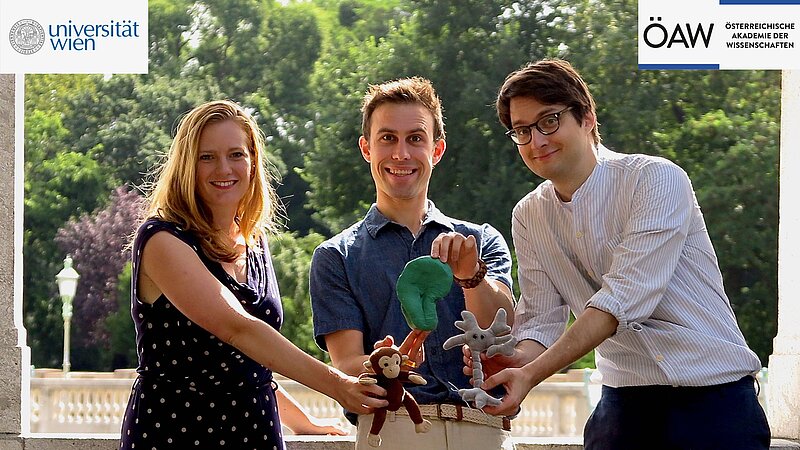
The YIRG Dynamates aims to address those current key challenges in auditory cognition, by empirically testing and modelling the sensory prediction mechanisms in comparison across evolutionarily closely related species and in realistic but highly controllable virtual acoustic environments. Importantly, in humans, these mechanisms will also be investigated on a physiological level by means of high-density electroencephalography (EEG) allowing to examine whether the resulting model complies with biological restrictions on neural computation. Hence, this project rests on a strong collaboration between cognitive neuroscience, cognitive biology, and computational modelling. To this end, Dynamates comprises an interdisciplinary research team consisting of experts in the fields of computational neuroscience and psychoacoustics (Robert Baumgartner), human EEG and sensory processing (Ulrich Pomper), and comparative cognition between animal species (Michelle Spierings).

Dynamates will conduct the first systematic comparative study on dynamic auditory predictions in space and time by both human and non-human primates. The findings of this project will broaden our understanding of the underlying neural mechanisms in humans, which may help future efforts to improve treatments for individuals with impairments or pathological biases in decision making. Moreover, the resulting computational model may stimulate further research by testable predictions of decision making across species as well as in more complex economic and social contexts, and it may be directly applied to improve artificial intelligence and virtual reality systems.

In the following online lecture Robert Baumgartner explains the background to this line of research: ÖAW Science Bites: Gefahr - wie wir sie hören. (German only)

External advisory board

Publications

Data repository: https://osf.io/ravfs 

Preprints and preregistrations

  • Grabner, J. V., Pigmans, E., Mircheva, M., Knoester, J. M., Pomper, U., Bugnyar, T., & Spierings, M. J. (2025). Common marmosets (Callithrix jacchus) do not differentiate between familiar and unfamiliar conspecifics based on pitch contour information. bioRxiv. https://doi.org/10.1101/2025.10.27.684793 
  • Fleischmann, R., Meijer, D., Bayram, B., Pellegrini, V., Pomper, U., Spierings, M., & Baumgartner, R. (2025). Arousal-related mediation of perceptual belief updating across auditory domains. bioRxiv, 2025.09.10.675360. https://doi.org/10.1101/2025.09.10.675360 
  • Dam, N. C. P., Honing, H., & Spierings, M. J. (2024). Artoo-Detoo: What imitating a Star Wars droid reveals on allospecific vocal imitation in parrots and starlings. bioRxiv, 2024.10.10.617563. https://doi.org/10.1101/2024.10.10.617563 
  • Fleischmann, R., Meijer, D., Pomper, U., Spierings, M., & Baumgartner, R. (2024). Is the pupil-linked arousal system mediating adaptive perceptual belief updating in spatially and temporally dynamic environments? OSF. https://doi.org/10.17605/OSF.IO/Q42E6
  • Meijer, D., Bayram, B., Barumerli, R., Dorok, F., Greif, T., Spierings, M., Pomper, U., & Baumgartner, R. (2022). Confirming pupil dilation as physiological marker of Bayesian inference in dynamic auditory localization. OSF. https://doi.org/10.17605/OSF.IO/9BTZE 

Publications

  • Baumgartner, R., Barumerli, R., Brands, B., & Majdak, P. (2026). Short-Term Statistical Learning Mitigates the Ill-Posed Problem of Sound Localization. Trends in Hearing, 30, 23312165261465030. https://doi.org/10.1177/23312165261465030 
  • Nagy, P., Kovács, P., Boncz, Á., Szalárdy, O., Baumgartner, R., Ignatiadis, K., Winkler, I., & Tóth, B. (2026). How the brain predicts timing: Distinct network hubs for predicting and evaluating auditory sensory events. Frontiers in Neuroscience, 20, 1739294. https://doi.org/10.3389/fnins.2026.1739294 
  • Ignatiadis, K., Barumerli, R., Deco, G., Tóth, B., & Baumgartner, R. (2025). Threat-related corticocortical connectivity elicited by rapid auditory looms. Scientific Reports. https://doi.org/10.1038/s41598-025-30552-x 
  • Meijer, D., Barumerli, R., & Baumgartner, R. (2025). How relevant is the prior? Bayesian causal inference for dynamic perception in volatile environments. eLife, 14. https://doi.org/10.7554/eLife.105385.1 
  • Bayram, B., Meijer, D., Barumerli, R., Spierings, M., Baumgartner, R., & Pomper, U. (2025). Bayesian prior uncertainty and surprisal elicit distinct neural patterns during sound localization in dynamic environments. Scientific Reports, 15(1), 7931. https://doi.org/10.1038/s41598-025-90269-9 
  • Grabner, J. V., Kempf, A. E., Nederlof, A. M. N., Varkevisser, J. M., & Spierings, M. J. (2025). Rhythmic Roots: The Adaptive Functions of Vocal Isochrony and Its Role in Human Music and Language Evolution. Psychological Topics, 34(1), Article 1. https://doi.org/10.31820/pt.34.1.1
  • Lladó, P., Majdak, P., Barumerli, R., & Baumgartner, R. (2025). Spectral Weighting of Monaural Cues for Auditory Localization in Sagittal Planes. Trends in Hearing, 29, 23312165251317027. https://doi.org/10.1177/23312165251317027 
  • Bayram, B., Ansorge, U., & Pomper, U. (2025). Rhythmic Fluctuations in Tactile Attention. European Journal of Neuroscience, 62(5), e70247. https://doi.org/10.1111/ejn.70247 
  • van der Vleuten, B. J. R., Hovenkamp, V. A., Varkevisser, J. M., & Spierings, M. J. (2024). Context-dependent rhythmicity in chimpanzee displays. Proceedings of the Royal Society B: Biological Sciences, 291(2036), 20242200. https://doi.org/10.1098/rspb.2024.2200 
  • Lladó, P., Barumerli, R., Baumgartner, R., & Majdak, P. (2024). Predicting the effect of headphones on the time to localize a target in an auditory-guided visual search task. Frontiers in Virtual Reality, 5. https://doi.org/10.3389/frvir.2024.1359987 
  • Ignatiadis, K., Baier, D., Barumerli, R., Sziller, I., Tóth, B., & Baumgartner, R. (2024). Cortical signatures of auditory looming bias show cue-specific adaptation between newborns and young adults. Communications Psychology, 2(1), 1–15. https://doi.org/10.1038/s44271-024-00105-5 
  • Pomper, U. (2023). No evidence for tactile entrainment of attention. Frontiers in Psychology, 14. https://doi.org/10.3389/fpsyg.2023.1168428 
  • Meijer, D., & Noppeney, U. (2023). Metacognition in the audiovisual McGurk illusion: Perceptual and causal confidence. Philosophical Transactions of the Royal Society B: Biological Sciences, 378(1886), 20220348. https://doi.org/10.1098/rstb.2022.0348 
  • Stocker, M., O’Sullivan, E. P., Palme, R., Millesi, E., & Sonnweber, R. (2023). Measurement of Salivary Cortisol in Two New World Primate Species. Biology, 12(9). https://doi.org/10.3390/biology12091181 
  • Pomper, U., & Ansorge, U. (2023). Motor-induced oscillations in choice response performance. Psychophysiology, 60(2), e14172. https://doi.org/10.1111/psyp.14172 
  • Nurmi, N. O., Sonnweber, R., Schülke, O., Moscovice, L. R., Deschner, T., & Hohmann, G. (2023). Bonobo mothers have elevated urinary cortisol levels during early but not mid or late lactation. Primates, 64(2), 215–225. https://doi.org/10.1007/s10329-022-01044-7 
  • Pomper, U., Curetti, L. Z., & Chait, M. (2023). Neural dynamics underlying successful auditory short-term memory performance. European Journal of Neuroscience, 58(8), 3859–3878. https://doi.org/10.1111/ejn.16140 
  • Barumerli, R., Majdak, P., Geronazzo, M., Meijer, D., Avanzini, F., & Baumgartner, R. (2023). A Bayesian model for human directional localization of broadband static sound sources. Acta Acustica, 7, 12. https://doi.org/10.1051/aacus/2023006 
  • Sonnweber, R., Hohmann, G., Stevens, J. M. G., Deschner, T., Fruth, B., Fiedler, A.-L., Nurmi, N. O., & Behringer, V. (2023). Average phenotype but not plasticity in two metabolic hormones covary in wild female bonobos (Pan paniscus). Frontiers in Ecology and Evolution, 11. https://doi.org/10.3389/fevo.2023.1300003 
  • Pomper, U., Duss, C., & Ansorge, U. (2023). Testing the role of temporal selection for stimulus-driven capture of attention. Vision Research, 202, 108141. https://doi.org/10.1016/j.visres.2022.108141 
  • Sonnweber, R., Stevens, J. M. G., Hohmann, G., Deschner, T., & Behringer, V. (2022). Plasma Testosterone and Androstenedione Levels Follow the Same Sex-Specific Patterns in the Two Pan Species. Biology, 11(9), Article 9. https://doi.org/10.3390/biology11091275 
  • Ignatiadis, K., Barumerli, R., Tóth, B., & Baumgartner, R. (2022). Effects of individualized brain anatomies and EEG electrode positions on inferred activity of the primary auditory cortex. Frontiers in Neuroinformatics, 16. https://www.frontiersin.org/articles/10.3389/fninf.2022.970372 
  • Behringer, V., Stevens, J. M. G., & Sonnweber, R. (2022). Salivary Cortisol Reaction Norms in Zoo-Housed Great Apes: Diurnal Slopes and Intercepts as Indicators of Stress Response Quality. Animals, 12(4), Article 4. https://doi.org/10.3390/ani12040522 
  • Majdak, P., Hollomey, C., Baumgartner, R. (2022). AMT 1.x: a toolbox for reproducible research in auditory modeling. Acta Acustica, 6, 19. https://doi.org/10.1051/aacus/2022011
  • Sonnweber, R., Stevens, J. M. G., Hohmann, G., Deschner, T., & Behringer, V. (2022). Blood testosterone levels in sickness and in health: Male chimpanzee testosterone levels decrease in face of an immune challenge. American Journal of Primatology, 84(4–5), e23334. https://doi.org/10.1002/ajp.23334 
  • Ansorge, U., Büsel, C., Forstinger, M., Gugerell, D., Grüner, M., Pomper, U., Stolte, M., Schmid, R. R., & Valuch, C. (2021). Procedural Control Versus Resources as Potential Origins of Human Hyper Selectivity. Frontiers in Psychology, 12. https://doi.org/10.3389/fpsyg.2021.718141 
  • Baumgartner, R. (2021). The balancing act of spatial hearing (Der Balanceakt des räumlichen Gehörs). Akustik Journal, DEGA, Berlin, 3, 31-36. (article)