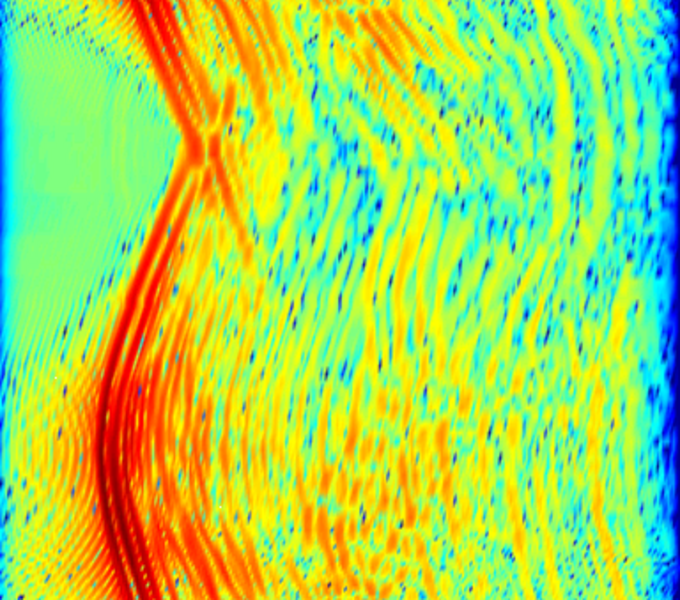
Head-related transfer functions (HRTFs) describe sound transmission from the free field to a place in the ear canal in terms of linear time-invariant systems. They contain spectral and temporal features that vary according to the sound direction. Differences among subjects requires the measuring of subjects' individual HRTFs for studies on localization in virtual environments. In this project, a system for HRTF measurement was developed and installed in a semi-anechoic room at the Austrian Academy of Sciences.
Measurement of an HRTF is considered a system identification of the electro-acoustic chain: sound source-room-HRTF-microphone. The sounds in the ear canals are captured using in-ear microphones. The direction of the sound source is varied horizontally by rotating the subject on a turntable, and vertically by accessing one of the 22 loudspeakers positioned in the median plane. An optimized form of system identification with sweeps, the multiple exponential sweep method (MESM), is used for the measurement of transfer functions with satisfactory signal-to-noise ratios occurring within a reasonable amount of time. Subjects' positions are tracked during the measurement to ensure sufficient measurement accuracy. Measurement of headphone transfer functions are included in the HRTF measurement procedure for a potential equalization of the headphones.
Since 2005, listeners' HRTFs are continuously measured, extending the ARI database of HRTFs. The ARI database is publicly available at http://sofacoustics.org/data/database/ari/. The HRTFs can be used to create virtual stimuli and present them binaurally via headphones. Over the years, small modifications to the measurement procedure have been applied. A single letter encodes the modifications:
The following publications are related with this project:


