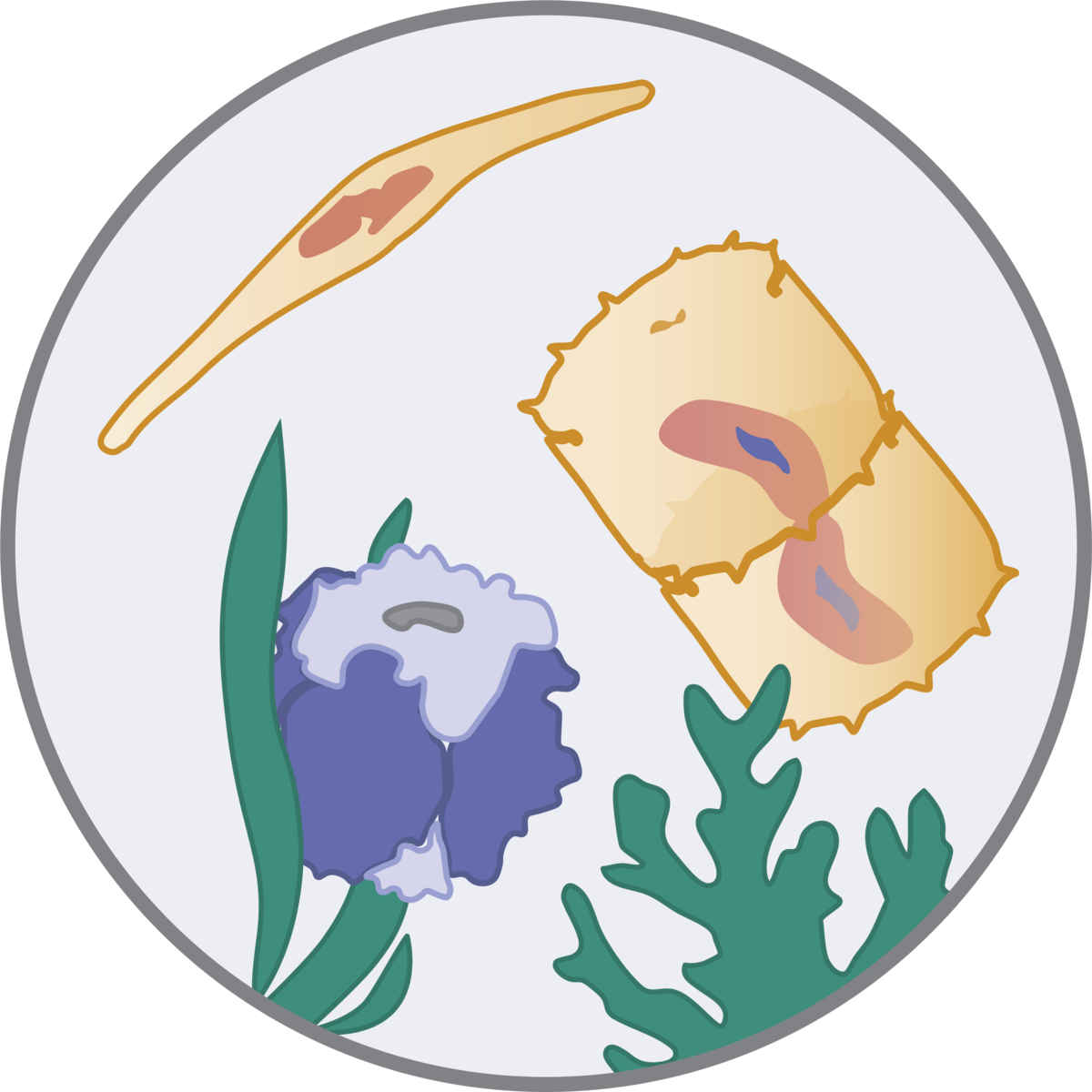
Photosynthetic microorganisms are responsible for a substantial fraction of global carbon fixation. In many algal lineages, CO₂ assimilation occurs within a specialized, phase-separated chloroplast compartment called the pyrenoid, which concentrates Rubisco and enhances its CO₂ fixation efficiency. Despite its global importance, we still do not understand how this organelle is maintained, divided or restructured under environmental stress.
The pyrenoid evolved independently multiple times across algal groups. This makes it a powerful system to study how cells evolve new organelles and reorganize essential biochemical reactions.
We focus on diatoms and other evolutionarily diverse photosynthetic eukaryotes to address three core questions:
• How is the pyrenoid structurally organized and maintained?
We investigate how nutrient depletion (e.g. nitrogen or carbon limitation) and metabolic stress alter pyrenoid architecture and function, and whether selective autophagy contributes to pyrenoid turnover and homeostasis.
• How are chloroplast and pyrenoid division coordinated?
We examine the mechanisms that ensure correct pyrenoid partitioning during cell division and identify the molecular factors linking pyrenoid dynamics to chloroplast division.
• How have different algal lineages evolved distinct carbon-concentrating strategies?
By comparing model species and environmentally derived algae, we identify the molecular components required to achieve similar functional outcomes across independent evolutionary origins.
We combine cryo-electron tomography, advanced light microscopy, and environmental sampling to connect molecular architecture with physiological adaptation in both laboratory models and natural systems. Using tractable model algae, we define mechanistic principles of carbon fixation and extend these insights to environmental samples. Bridging laboratory models and natural systems requires developing dedicated sampling and imaging workflows.
Shimakawa G.*, Demulder M.*, Flori S.*, et al. (2024) Diatom pyrenoids are encased in a protein shell that enables efficient CO2 fixation. Cell. https://doi.org/10.1016/j.cell.2024.09.013.
Nam O., Musiał S., Demulder M., et al. (2024). A protein blueprint of the diatom CO2-fixing organelle. Cell. https://doi.org/10.1016/j.cell.2024.09.025.
Pengliang Wei P., Demulder M., David P., et al. (2020) Arabidopsis Casein Kinase 2 Controls Al Toxicity and Phosphate Deficiency Through Control of the DNA Damage Response. Plant Cell. https://doi.org/10.1093/plcell/koab005.