• EurAsian Transformations
    • Events
    • About
    • People
    • Research
    • Academic Training
    • Digital Lab
    • Outreach
  • Logo Logo
  • News
  • Events
Suchleiste öffnen
Hauptnavigation öffnen
  • About
  • People
  • Research
  • Academic Training
  • Digital Lab
  • Outreach
    • Blogs
    • Exhibitions
    • EurAsia Movie Night
    • Podcasts
    • Science2Public Events
    • News
    • Events
Suchleiste öffnen

Events

  • Conferences
    • Reconsidering Imperial Dynamics and Geographies of Power
    • EurAsian Transformations Annual Conferences
      • 2024: Cultural and Linguistic Diversity
      • 2025: Imperial Dynamics, Borderlands and Resistance: Entangled Worlds of Afro-Eurasia
      • 2026: Bridging EurAsia
    • Other Conferences
      • From the East and Back: Conference on the manuscript tradition, translation and reception of Historia trium regum by John of Hildesheim, 20-22 January 2027, Vienna, Austria
      • Preaching and Preachers as Brokers of (Inter) Communal Dynamics across Late Medieval and Early Modern Eurasia
      • International Conference: "Oil and Empire: Historical, Cultural, and Political Dimensions of Petroleum in Galicia and Beyond" (14-17 April, 2026)
      • Her­mann Graf Key­ser­ling - Der rei­sende Phi­lo­soph als Mitt­ler zwi­schen den Wel­ten
      • Inner Asia and Europe: Archaeological, Historical and Linguistic Interactions in the thirteenth and fourteenth century
      • The Archival Impulse: Knowledge Production, Record Keeping, and Imperial Governance (15th-19th Centuries)
      • Unfolding an Unacknowledged Written Cultural Heritage: Armeno-Turkish Manuscripts, Prints, and Newspapers
      • Language and Culture in the Borderlands of the Eastern Silk Road
      • Regional Mobilities and the Making of the Ancient Greek World
      • Between and Beyond Empires: From the Seleucids to the Sasanians (2nd c. BC – 7th c. AD)
      • Placing China at the Courts of Europe, 1700–1800
      • Elite Multilingualism in Premodern Societies and the Production of Power
  • Workshops
    • Digital Frontiers Artificial Intelligence and the Study of the Ancient World
    • Buddhist Pramāṇa across the Himalayas: Changing interpretations of the rules of inference
    • Irrigation Technologies and Water Management across Eurasia Part II
    • Empires and their Armies in Premodern Eurasia
    • Scripts, Languages and the State in the Mongol Empire
    • Irrigation Technologies and Water Management across Eurasia
    • CEU DH Fest
    • Doing Business in Turkestan
    • Urban Commercial Spaces and their Languages
    • The Mongols in (Western) Eurasia – Perspectives and Problems
    • OCR/HTR Workshop for Under-resourced and Under-represented Languages in Digital Humanities
    • Identity / Identification
    • 1st JEARN Workshop
    • Urban Religious Spaces and their Languages
    • The Growth of Eurasian Empires and the Imperial Radius of Action
    • Administrative Spaces and Administrative Languages
    • Crossing geographical barriers and conceptualizing expansion in Eurasia
    • Manuscript Collections across Eurasia
    • Pahlavi Workshop
    • Entangled Charters of Eurasia
    • Medieval Origin Myths in Eurasian Comparison: Religion and Identity
    • On languages and scripts in the Ottoman Levant
    • Colour Terms
    • Early Medieval Irrigation System in the Kathmandu Valley
    • Farhad Ebrahimi Workshop
  • EurAsia Lecture Series
  • EurAsia Academies
    • Mantras between language, ritual, and materiality
    • EurAsia Academy: The Archives of Islam in the Russian Empire
    • EurAsia Academy Khorog: Cultural Heritage at the Mountain Crossroads of Central Asia
    • EurAsia Summer Academy of Art, Culture and History across the Himalayas 2026
    • EurAsia Academy Tokyo: The Mythmaking of Silk Roads
    • Summer Academy: PHILOSOPHICAL PERSPECTIVES ON LANGUAGE IN PREMODERN SOUTH ASIA
    • EurAsia Academy The Archives of Islam in the Russian Empire (16th-early 20th Centuries) 2025
    • EurAsia Academy Living in and with cultural heritage
    • Summer Academy of art, culture and history across the Himalayas
    • Language and Culture in the Borderlands of the Eastern Silk Road
    • Summer Academy: PHILOSOPHICAL PERSPECTIVES ON LANGUAGE IN PREMODERN SOUTH ASIA
    • The Archives of Islam in the Russian Empire (16th-early 20th Centuries) 2024
  • Lectures
    • Dividing OM, Shaping Mantra Systems
    • ‘Ali Akbar Khata’i’s Book of China: Chinese Qanun as a Model of Political Reform in the Ottoman Empire
    • Critique, Discontent and Protest: Political Advice from Military Encampments, Mosques and Public Squares in the Ottoman Empire during the Seventeenth Century
    • Imperial Infrastructures of Communication across Eurasia
    • Learning from Experience in Medieval Tabriz? Islamic Views on Chinese and Mongol Medicine and the Limits of Cultural Exchange
    • Religious Philosophy in Medieval Armenia
    • Remembering along the Silk Roads: Psychology, History and Conservation in Dialogue
    • Anxious Ancestors: Temple Destruction, Ruler Conversion, and the Contest over Sacred Power in the Mongol Empire
    • Greet One Another with a Holy Kiss’
    • Sanskrit texts of the Buddhist epistemological tradition: Negotiating translations without illusions (but painstakingly)
    • Peeling Back the Layers: How Qanāt Lines Shaped the Landscape and Vice Versa in Iran
    • Translating Sattā: Existence, Being, or Something Else?
    • Sustainable Futures and Adaptive Possibilities for the Aral Sea Basin
    • Echoes in Stone. Refracting the Holy Sepulchre from Ethiopia to Scotia
    • A Presentation of the Current Projects of the Mongolian Academy of Sciences
    • The Armenians of Trabzon between 1461 and 1700
    • Prophetic Conceptions of Time and Space in Insurgent Greece (1821-1829)
    • A tale of two cities: Water and the origins of hydraulic societies in prehistoric China
    • When Words make Worlds
    • The informative history of Buddhism in Mongolia in the 16th and 17th centuries: A reassessment
    • Lecture with Ann Cotten
    • Georg Bühler Lecture: Beyond India
    • Entanglements of the Greek, Neo-Assyrian and Iranian worlds
    • Cycles of crisis and recovery in Byzantine and Ottoman Macedonia
  • EurAsia Jour Fixe
    • Edges and Encounters
    • How to get our Data into the Computer: Tools for Data Collection and Presentation and the need for a joint Digital Infrastructure in the Cluster
  • Poster Sessions
  • EurAsia Retreats
    • Spring Retreat 2025
    • Winter Retreat 2025
    • Spring Retreat 2026
  • Student Orientation Event
  • Archive
  • EurAsian Transformations
    • Events
    • About
    • People
    • Research
    • Academic Training
    • Digital Lab
    • Outreach

Events

  • Teilen über E-Mail
  • Teilen auf LinkedIn
  • Teilen auf Facebook
  • Teilen auf Bluesky
  • Mehr lesen über das Event Call for Paper: From the East and Back: Conference on the manuscript tradition, translation and reception of Historia trium regum by John of Hildesheim
    Mi 20.01.

    Call for Paper: From the East and Back: Conference on the manuscript tradition, translation and reception of Historia trium regum by John of Hildesheim

    Potential presentation topics include (but are not limited to): manuscripts of Historia trium regum: preservation and genealogy vernacular translations Asian origins of the Three Magi legends
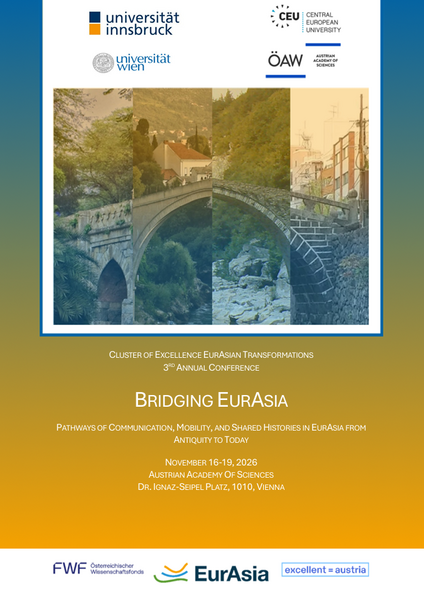
  • Mehr lesen über das Event Annual Conference: Bridging EurAsia
    Mo 16.11. 4 Tage

    Annual Conference: Bridging EurAsia

    16 to 19 November 2026 Venue: Austrian Academy of Sciences (ÖAW) Organizing Committee: Yavuz Köse (University of Vienna), Melanie Malzahn (University of Vienna), Nina Mirnig (University of…
  • Mehr lesen über das Event EurAsia Academy Khorog: Cultural Heritage at the Mountain Crossroads of Central Asia 2026
    Mo 17.08. 13 Tage

    EurAsia Academy Khorog: Cultural Heritage at the Mountain Crossroads of Central Asia 2026

    Cultural heritage is of enormous importance throughout Central Asia. This is not only true for top-down state branding, identity building and the promotion of tourism but also for daily, affective or…
  • Mehr lesen über das Event Dividing OM, Shaping Mantra Systems
    Mi 08.07.

    Dividing OM, Shaping Mantra Systems

    EurAsia Academy Keynote Lecture by Finnian Gerety The division of the sacred syllable "om" into the three sounds, a, u, and m is one of the most enduring ideas in mantra culture. Originating in Vedic…
  • Mehr lesen über das Event Mantras between language, ritual, and materiality
    Fr 03.07. 5 Tage

    Mantras between language, ritual, and materiality

    EurAsia Summer Academy: Vienna Summer School on the Cultural and Intellectual History of Asia This year’s Vienna Summer School on the Cultural and Intellectual History of Asia will introduce the…
  • Mehr lesen über das Event Preaching and Preachers as Brokers of (Inter) Communal Dynamics across Late Medieval and Early Modern Eurasia
    Do 25.06. 2 Tage

    Preaching and Preachers as Brokers of (Inter) Communal Dynamics across Late Medieval and Early Modern Eurasia

    CEU invites you to the following conference: "Preaching and Preachers as Brokers of (Inter) Communal Dynamics across Late Medieval and Early Modern Eurasia", Thursday, June 25 – Friday, June 26, 2026
  • Mehr lesen über das Event ‘Ali Akbar Khata’i’s Book of China: Chinese Qanun as a Model of Political Reform in the Ottoman Empire
    Mo 22.06.

    ‘Ali Akbar Khata’i’s Book of China: Chinese Qanun as a Model of Political Reform in the Ottoman Empire

    This talk takes as its point of departure a new English translation of Khata’i’s Account of China (trans., ed. Kaveh Hemmat et al., forthcoming), a text that has long attracted scholarly attention but…
  • Mehr lesen über das Event Critique, Discontent and Protest: Political Advice from Military Encampments, Mosques and Public Squares in the Ottoman Empire during the Seventeenth Century
    Mi 10.06.

    Critique, Discontent and Protest: Political Advice from Military Encampments, Mosques and Public Squares in the Ottoman Empire during the Seventeenth Century

    This lecture aims to contextualize a particular corpus of political advice works that flourished in the seventeenth-century Ottoman Empire and that exhibited the following three traits. Firstly, the…
  • Mehr lesen über das Event Imperial Infrastructures of Communication across Eurasia
    Mo 08.06.

    Imperial Infrastructures of Communication across Eurasia

    The lecture examines the institutional framework of imperial communication in the Assyrian Empire, focusing on the interdependent roles of messengers, auxiliary personnel, pack animals, and the royal…
  • Mehr lesen über das Event EurAsia Academy: The Archives of Islam in the Russian Empire
    So 07.06. 6 Tage

    EurAsia Academy: The Archives of Islam in the Russian Empire

    Our summer school is designed to explore a range of scholarly approaches to the hermeneutics of records and the formation of archives on Islam in the territories of the former Russian Empire in the…
Zurück

Funded by

Office EurAsia
office.eurasia(at)oeaw.ac.at

Rita Maria Garstenauer
Dr. Ignaz Seipel-Platz 2, 1010 Vienna, Austria
T: +43 1 51581-7217
M: +43 644 73870310
ritamaria.garstenauer(at)oeaw.ac.at

Kateryna Kovalchuk
KovalchukK(at)ceu.edu
Quellenstraße 51 
1100 Vienna

Astrid Rief
Ágnes-Heller-Haus, Innrain 52a | 6020 Innsbruck | Austria
T: +43 512 507-41003
eurasian-transformations(at)uibk.ac.at 

Jeanette Kilicci
Apostelgasse 23, 1030 Vienna, Austria
T: +43-1-4277-41756
jeanette.kilicci(at)univie.ac.at

Impressum Datenschutz Barrierefreiheit

© Copyright OEAW

Hinweis zu Cookies

Diese Website verwendet Cookies. Sie gewährleisten wesentliche Funktionalitäten der Website und ermöglichen uns, Inhalte laufend zu optimieren. Helfen Sie uns dabei, indem Sie der Erhebung statistischer Daten und der Darstellung externer multimedialer Inhalte zustimmen. Die Zustimmung ist jederzeit widerrufbar. Weitere Informationen finden Sie in den Cookie-Einstellungen sowie in der Datenschutzerklärung.

Diese Cookies werden für eine reibungslose Funktion unserer Website benötigt.

Name Funktion Speicherdauer Typ Anbieter
CookieConsent Speichert Ihre Einwilligung zur Verwendung von Cookies. 1 Jahr HTML Web Consent
fe_typo_user Ordnet Ihren Browser einer Session auf dem Server zu. Dies beeinflusst nur die Inhalte, die Sie sehen und wird von uns nicht ausgewertet oder weiterverarbeitet. - HTTP Web User

Mit Hilfe dieser Cookies sind wir bemüht, unser Angebot für Sie noch attraktiver zu gestalten. Mittels pseudonymisierter Daten von Websitenutzer:innen kann die Benutzung analysiert und interpretiert werden. Dies gibt uns die Möglichkeit, Websiteinhalte zu optimieren.

Name Funktion Speicherdauer Typ Anbieter
_pk_id Wird verwendet, um ein paar Details über den Benutzer wie die eindeutige Besucher-ID zu speichern. 13 Monate HTML Matomo-id
_pk_ref Wird benutzt, um die Informationen der Herkunftswebsite des Benutzers zu speichern. 6 Monate HTML Matomo-ref
_pk_ses Kurzzeitiges Cookie, um vorübergehende Daten des Besuchs zu speichern. 30 Minuten HTML Matomo-ses
_pk_cvar Kurzzeitiges Cookie, um vorübergehende Daten des Besuchs zu speichern. 30 Minuten HTML Matomo-cvar
_pk_hsr Kurzzeitiges Cookie, um vorübergehende Daten des Besuchs zu speichern. 30 Minuten HTML Matomo

Mit Hilfe dieser Cookies bemühen wir uns, unser Informations-Angebot für unsere Nutzer:innen durch die Bereitstellung beispielsweise von Videoinhalten zu verbessern.

Name Funktion Speicherdauer Typ Anbieter
YouTube Es wird eine Verbindung mit YouTube hergestellt, um Videos anzuzeigen. - Verbindung YouTube
SoundCloud Es wird eine Verbindung mit SoundCloud hergestellt, um Audio-Dateien abzuspielen. - Verbindung SoundCloud
Twitter Es wird eine Verbindung mit Twitter hergestellt, um Tweets anzuzeigen. - missing translation: type. Twitter
_cs_c Zeigt an, ob der Nutzer dem Tracking durch ContentSquare zugestimmt hat. 394 Tage missing translation: type. Spotify (ContentSquare)
_cs_id Speichert eine eindeutige Benutzer-ID für die Analyse durch ContentSquare. 394 Tage missing translation: type. Spotify (ContentSquare)
_ga Wird verwendet, um Benutzer zu unterscheiden. 400 Tage missing translation: type. Google Analytics
_ga_BMC5VGR8YS Dient Google Analytics zur Aufrechterhaltung des Sitzungsstatus. 400 Tage missing translation: type. Google Analytics
_ga_S0T2DJJFZM Dient Google Analytics zur Aufrechterhaltung des Sitzungsstatus. 399 Tage missing translation: type. Google Analytics
_ga_ZWG1NSHWD8 Dient Google Analytics zur Aufrechterhaltung des Sitzungsstatus. 400 Tage missing translation: type. Google Analytics
_ga_ZWRF3NLZJZ Dient Google Analytics zur Aufrechterhaltung des Sitzungsstatus. 400 Tage missing translation: type. Google Analytics
_gid Wird verwendet, um Benutzer zu unterscheiden. 1 Tage missing translation: type. Google Analytics
_ScCbts Speichert temporäre Sitzungs- oder Wiedergabeeinstellungen. 6 Tage missing translation: type. Spotify
_scid Spotify-Werbe-ID für Analyse und Remarketing. 395 Tage missing translation: type. Spotify
_scid_r Spotify-Werbe-ID für Analyse und Remarketing. 395 Tage missing translation: type. Spotify
eupubconsent-v2 Speichert die IAB-Zustimmungsinformationen gemäß dem TCF. 364 Tage missing translation: type. IAB / Spotify
OptanonAlertBoxClosed Speichert, ob der Cookie-Hinweis geschlossen wurde. 364 Tage missing translation: type. OneTrust
OptanonConsent Speichert die Zustimmungseinstellungen, die über OneTrust gesetzt wurden. 365 Tage missing translation: type. OneTrust
sp_adid Werbekennung von Spotify für Tracking und Personalisierung. 365 Tage missing translation: type. Spotify
sp_landing Zeichnet auf, welche Spotify-Seite zuerst besucht wurde. 1 Tage missing translation: type. Spotify
sp_m Speichert die Marktregion des Nutzers. 399 Tage missing translation: type. Spotify
sp_t Sitzungstoken für Spotify-Wiedergabe und Zugriff. 365 Tage missing translation: type. Spotify