


"Tackling the Challenges of Artificial Intelligence for Public Communication" published in New Media & Society
20.08.2026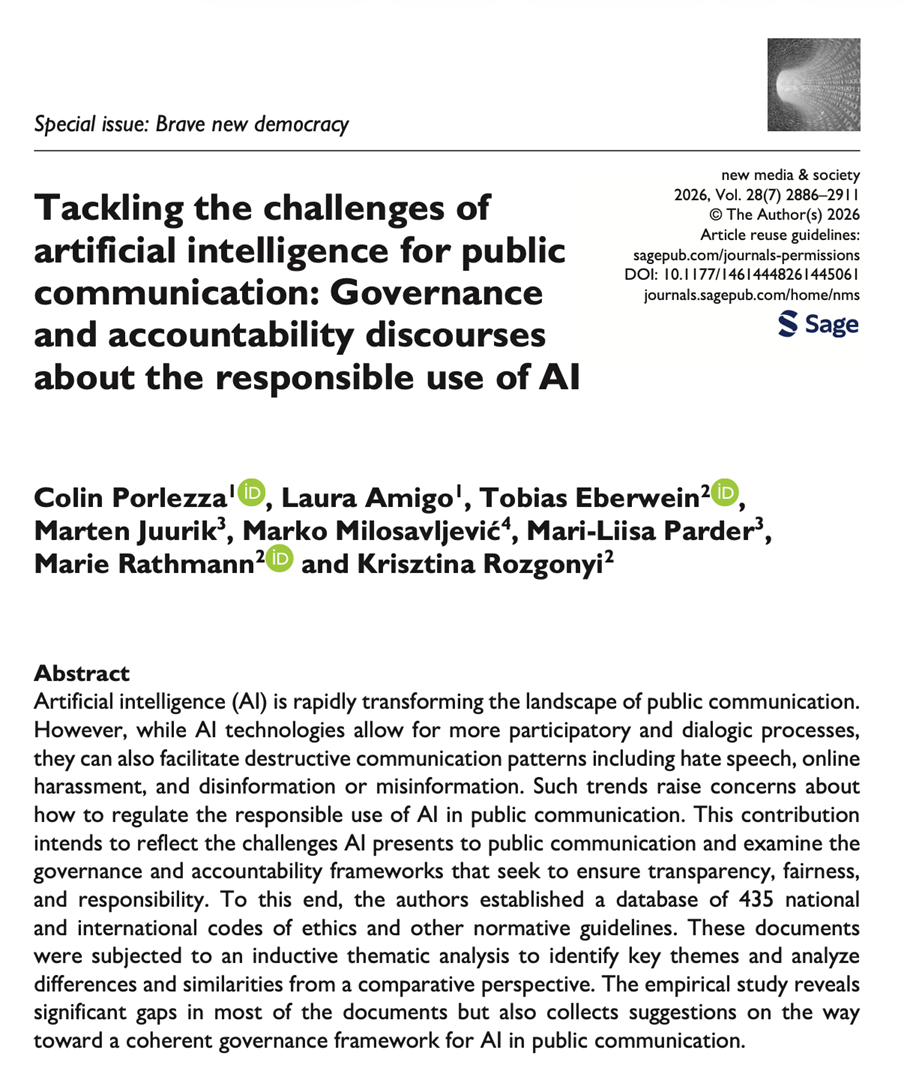
A new article co-authored by Tobias Eberwein, Marie Rathmann and Krisztina Rozgonyi, together with Colin Porlezza, Laura Amigo Weinberger, Marten Juurik, Marko Milosavljević and Mari-Liisa Parder, has been published in New Media & Society. Tackling the challenges of artificial intelligence for public communication: Governance and accountability discourses about the responsible use of AI examines how artificial intelligence is transforming public communication and the challenges this creates for responsible, transparent and accountable communication practices.
Drawing on an analysis of 435 national and international codes of ethics and normative guidelines, the study investigates how existing governance and accountability frameworks address the responsible use of AI in public communication. The authors identify key themes and compare how different guidelines approach issues such as transparency, fairness, responsibility and participation.
The findings reveal significant gaps in existing normative frameworks, highlighting the need for more coherent approaches to governing AI in public communication. At the same time, the analysis identifies promising principles and recommendations that can contribute to developing more transparent, fair and accountable frameworks for the use of AI.
The article contributes to current debates on AI governance, communication ethics and accountability, particularly in light of AI’s potential both to support more participatory and dialogic forms of communication and to facilitate harmful practices such as disinformation, misinformation, hate speech and online harassment.
Reference: Porlezza, C., Amigo Weinberger, L., Eberwein, T., Juurik, M., Milosavljević, M., Parder, M.-L., Rathmann, M., & Rozgonyi, K. (2026). Tackling the challenges of artificial intelligence for public communication: Governance and accountability discourses about the responsible use of AI. New Media & Society, 28(7).
Read the article: