


Open Communication Builds Trust: Science in Dialogue
13.10.2026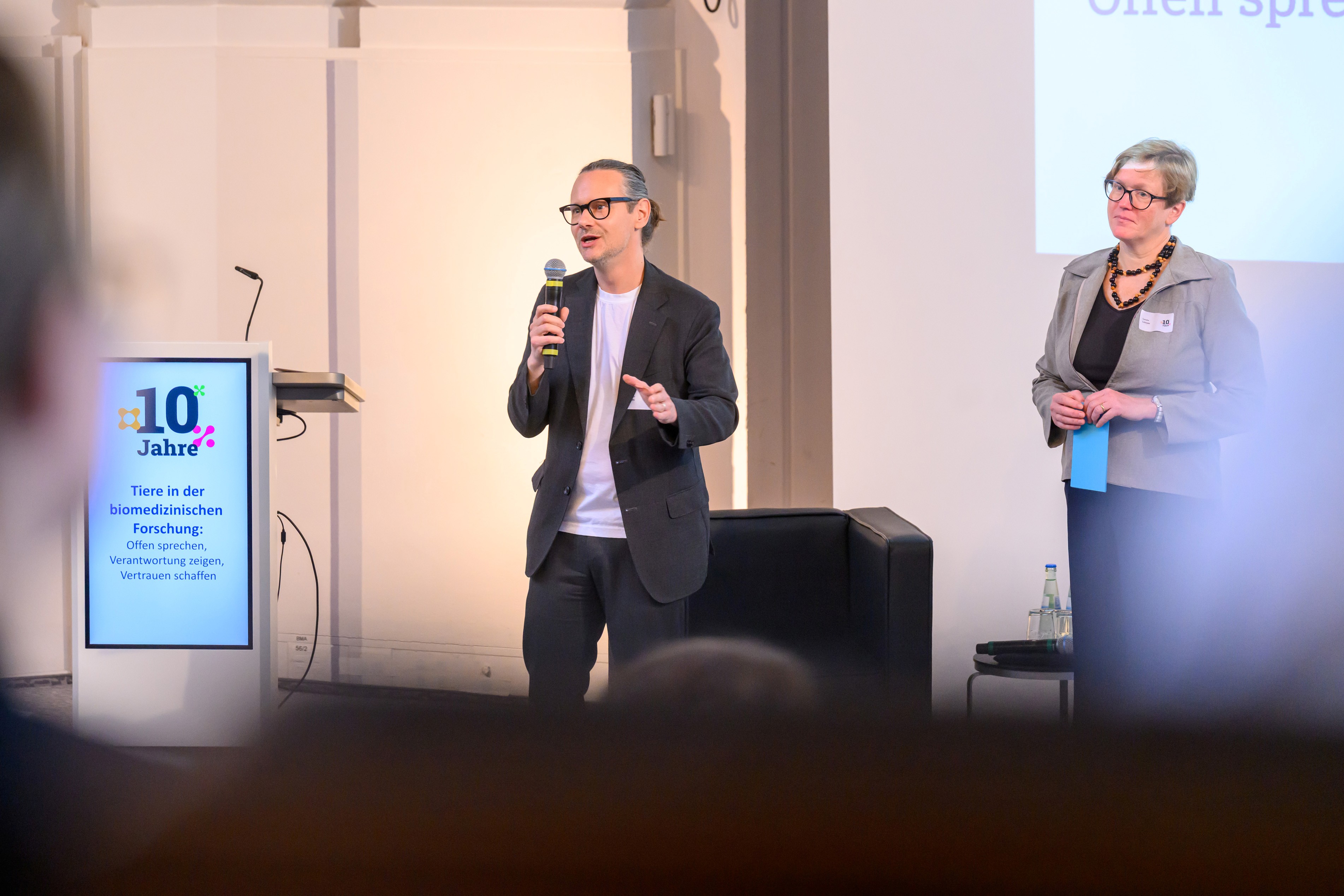
The programme explored the challenges of communicating scientific knowledge and engaging with a society in which opinions are increasingly polarised. Andreas Scheu, Research Group Leader "Science Communication & Science Journalism (SCSJ)” at our institute, contributed an impulse talk entitled “Science Communication 2030: Finding Our Way Through Complex Knowledge and Communication Environments”. His contribution addressed the challenges of science communication in a rapidly changing information landscape and the importance of making scientific knowledge accessible and meaningful in public debate.
Andreas Scheu also took part in the panel discussion “How Can We Foster Constructive Dialogue in a Polarised Society?”. He joined Melanie Brinkmann, Robert Hoffie and Markus Weißkopf for a discussion moderated by Cornelia Lossau, exploring how constructive dialogue can succeed in a society shaped by increasingly polarised views.
The event highlighted the importance of openness, active listening and institutional support in building trust between science and society.
Find out more (German): https://www.tierversuche-verstehen.de/offenheit-braucht-rueckhalt/
Das CMC veröffentlicht einige Texte auch in leichterer Sprache (Deutsch):
Am 1. und 2. Oktober 2026 fand in Berlin die Veranstaltung „Tiere in der biomedizinischen Forschung: Offen sprechen, Verantwortung zeigen, Vertrauen schaffen“ statt. Forschende und Fachleute haben dort über Tierversuche und Wissenschaftskommunikation gesprochen. Sie haben darüber diskutiert, wie Wissenschaft offen über Tierversuche sprechen kann. Und wie Forschende Vertrauen schaffen können. Auch Andreas Scheu vom CMC war dabei. Er hielt einen Impulsvortrag über die Zukunft der Wissenschaftskommunikation. Außerdem nahm er an einer Podiumsdiskussion teil. Dort sprach er mit anderen Fachleuten über die Frage: Wie gelingt ein guter Austausch in einer Gesellschaft, in der Menschen oft unterschiedliche Meinungen haben?
* This article may contain traces of artificial intelligence (summarisation, translation and language refinement).