


Economic Journalism Between Facts and Interpretation
16.10.2024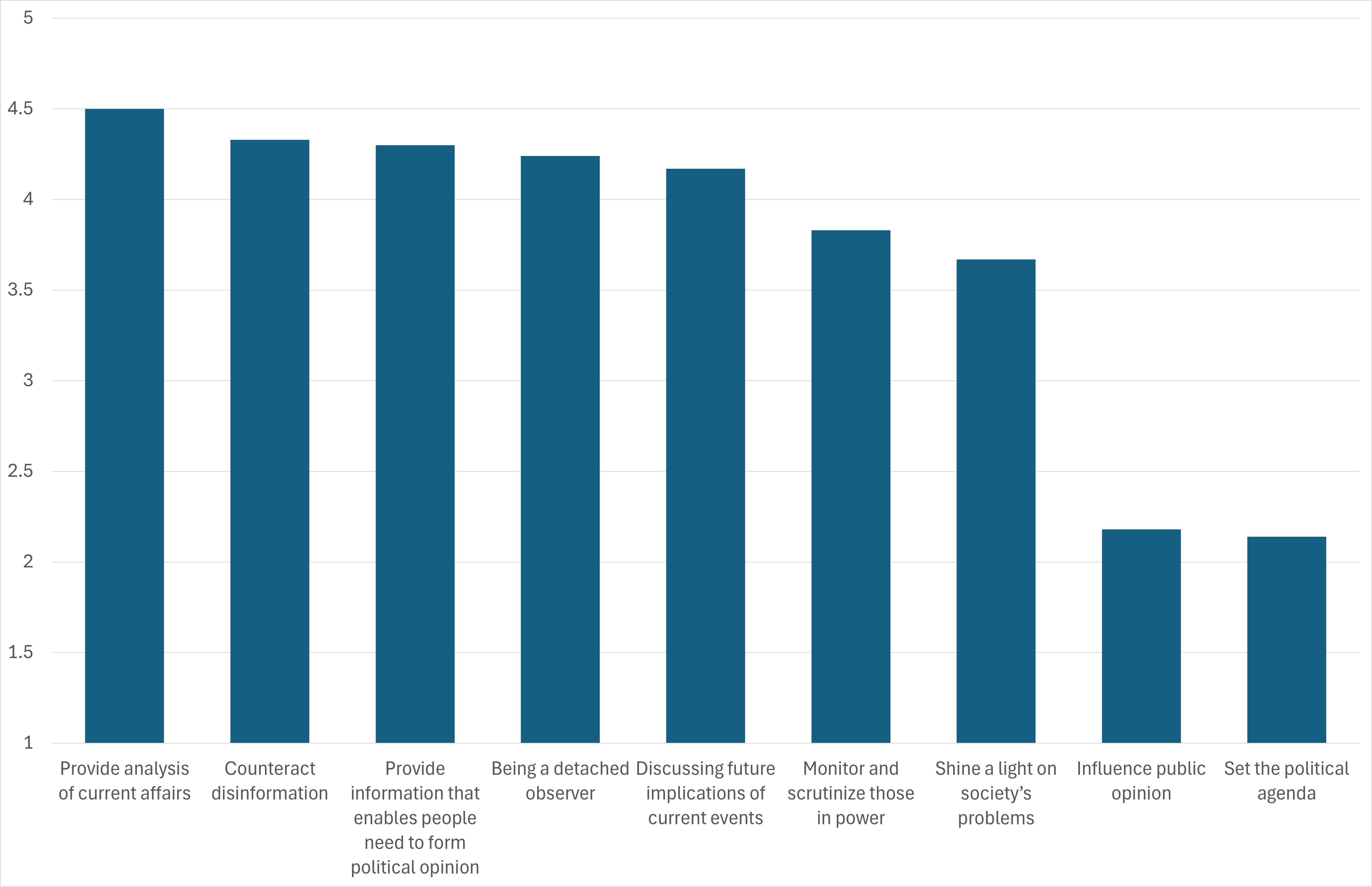
Here are some of the most important results from Austria (compared to Germany and Switzerland):
At an average age of 49, economic journalists are older and, at 60%, more male (60%) than journalists in general - and, at least in Germany and Austria, they are getting older and not more female. However, the degree of academization is high at 70-80%.
Economic journalists see external influences on their work primarily from people in business, interest groups and corporate PR. All these influences are currently perceived as being stronger than nine years ago, but:
The influence of time pressure, insufficient resources, the editorial line and, above all in Germany, the quota is considered to be significantly higher - and also usually higher than before.
When asked about the social roles of economic journalists, "counteracting disinformation" was immediately named in second place in Austria, in third place in Germany and a little further behind in fourth place in Switzerland. Among the top three in all three countries are "Providing analysis of current affairs" and "Providing information that enables people need to form political opinion". This is followed by "Being a detached observer" and "Discussing future implications of current events". The control function and interventionist intentions are less pronounced. In short, it is primarily about information and analysis.
Accordingly, two professional images emerge on the underlying epistemological level: (1.) the classic "ideal of objectivity ("It is possible to represent objective reality in reporting", "Journalists should let the facts speak for themselves"), and (2.) interpretative journalism ("Interpretation is necessary to make sense of facts", "Journalists should make their standpoint transparent in their work"). It is interesting to note that these two job profiles do not correlate: People therefore tend towards either "objective" or interpretative journalism - with the second group being significantly more inclined than the first to "make the audience aware when a source makes false claims", i.e. to take on the function of a fact checker as well. This link between interpretation and transparency indicates a change in the audience's expectations of economic journalism.
The Worlds of Journalism study is an international survey of journalists in around 100 countries, which took place for the third time in 2023 - after eight years. The final data set has been available since the end of August. In Austria, the study was conducted under the direction of Dr Josef Seethaler, Austrian Academy of Sciences, in cooperation with Prof. Dr Folker Hanusch, University of Vienna. Raoul Mitterstainer, BA, contributed to the initial analyses presented here.
Project link: https://worldsofjournalism.org/