Everything that makes us human is contained within 1.4 kg of tissue: the human brain, an extraordinary organ defined by its immense complexity and energy-efficient computational power. In the Knoblich lab, we are fascinated by how this complex architecture arises during development—how distinct neuronal cell types are specified, how they migrate to their precise locations, and how they assemble into functional circuits. To investigate these fundamental processes, we pioneered cerebral organoids: patient-derived three-dimensional tissue models generated from human pluripotent stem cells that faithfully recapitulate human neurodevelopment. Beyond modeling early embryonic brain development, our organoids now allow us to explore protracted postnatal neurodevelopmental processes, such as interneuron migration and functional network assembly. By combining organoid technology with spatial transcriptomics, single-cell genomics, multiplexed electrophysiology, and viral circuit tracing, we decipher the biological mechanisms behind severe neurodevelopmental and neuropsychiatric conditions, including autism spectrum disorders, epilepsy, and brain malformations.
We aim to decipher the fundamental biological principles of human brain development and understand how genetic perturbations cause severe neurodevelopmental and functional brain disorders. To achieve this, we combine advanced human organoid models with functional genetic screening, trans-synaptic circuit mapping, and electrophysiology across multiple scales—from single-cell gene regulatory networks to functional neural circuit activity. Ultimately, our vision is to establish predictive, multimodal models that bridge experimental neurobiology and clinical applications, enabling the translation of cellular and network-level insights into novel diagnostic and therapeutic strategies.

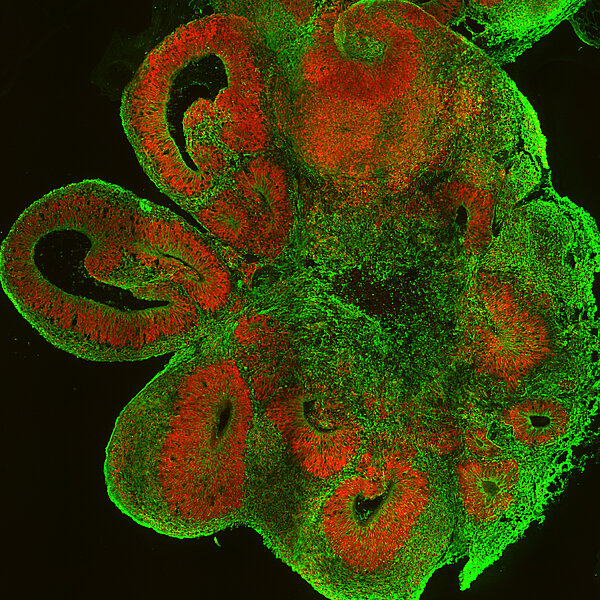
We take an innovative, multidisciplinary approach that leverages state-of-the-art human pluripotent stem cell technologies, advanced bioengineering, and high-throughput functional genomics. By establishing long-term cerebral organoid cultures that develop over hundreds of days, we have unlocked the ability to model late-stage human neurodevelopmental processes—such as postnatal interneuron migration along dedicated glia-guided streams—that were previously inaccessible in non-human model organisms.
To dissect complex disease mechanisms, we develop and deploy cutting-edge genetic and functional screening tools. Systems such as CHOOSE enable multiplexed, cell-type-specific loss-of-function screening in organoids and assembloids, allowing us to link disease susceptibility genes to precise developmental defects in cell fate, neuronal migration, and tissue architecture. Furthermore, by integrating silicon multi-electrode arrays with spatial transcriptomics and barcoded viral connectomics, we functionalize human brain organoids to record complex neural network oscillations and map single-cell connectivity. Our multidisciplinary framework enables us to synthesize neural network activity, identify cell-type-specific drivers of disease phenotypes like epilepsy, and uncover novel therapeutic entry points for human brain disorders.
Jürgen Knoblich talks about the latest research on elucidating human-specific mechanisms of disease using brain organoids in this webinar:


Martins-Costa, C., Wiegers, A., Pham, VA (...) Corsini, NS., Knoblich, JA. (2024). ARID1B controls transcriptional programs of axon projection in an organoid model of the human corpus callosum. Cell Stem Cell. 31(6):866-885.e14
Li, C., Fleck, JS., Martins-Costa, C (...) Treutlein, B., Knoblich, JA. (2023). Single-cell brain organoid screening identifies developmental defects in autism. Nature. 621(7978):373-380
Eichmüller, OL., Corsini, NS., Vértesy, Á (...) Feucht, M., Knoblich, JA. (2022). Amplification of human interneuron progenitors promotes brain tumors and neurological defects. Science. 375(6579):eabf5546
Esk, C., Lindenhofer, D., Haendeler, S (...) von Haeseler, A., Knoblich, JA. (2020). A human tissue screen identifies a regulator of ER secretion as a brain-size determinant. Science. 370(6519):935-941
Lancaster, MA., Renner, M., Martin, CA (...) Jackson, AP., Knoblich, JA. (2013). Cerebral organoids model human brain development and microcephaly. Nature. 501(7467):373-9




What I cannot create, I do not understand