Cells in our bodies display an astonishing diversity of sizes, shapes, and functions. Yet, every one of them carries the same genome and originates from the same fertilized egg. How does such diversity arise? During development, individual cells must continuously make fate decisions, deciding where to go and what to become based on sparse, noisy, and local information about the state of the whole organism. Despite the difficulty of all these individual single-cell decisions, development is extraordinarily robust.
This robustness suggests that cell-fate decisions are governed by simplifying principles that were shaped by a long evolutionary process. In our group, we aim to uncover such principles by combining computational tool development, data analysis, and theoretical exploration to investigate how cells make reliable decisions in unreliable environments. We are particularly interested in questions such as:
We want to uncover the gene regulatory logic that organizes cell-fate decisions such that many individually stochastic and noisy single-cell decisions give rise to robust organismal development. We pursue this goal at two complementary levels.
We combine computational tool development, collaborative data-driven research projects, and theoretical modeling.
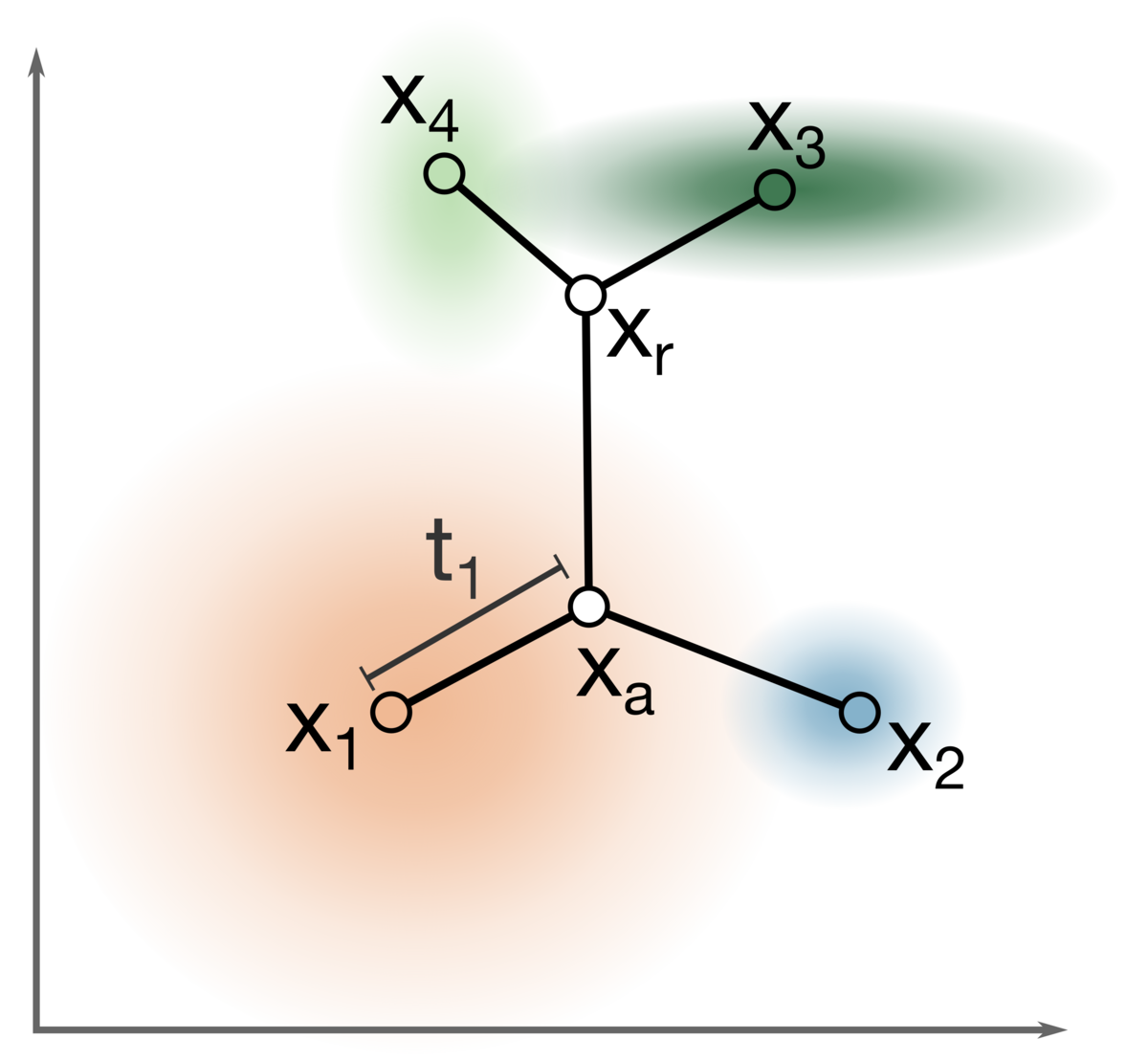
Modern single-cell omics techniques provide genome-wide measurements of gene expression for many single cells that are undergoing a differentiation process. This offers a unique opportunity to extract reproducible features of the differentiation process and simultaneously map the heterogeneity across cells. However, such experiments provide only snapshots at single timepoints, such that dynamics and lineage relations are lost. Recovering the temporal order is crucial to pinpoint when fate decisions are made and to distinguish early, fate-determining regulatory changes from downstream consequences. We develop Bayesian computational methods that take snapshot datasets and reconstruct the most likely gene expression histories that gave rise to them. Our goal is to create broadly applicable, scalable methods with clearly stated assumptions to ensure interpretability.
In close collaboration with experimental groups, we apply our computational methods to a diverse set of biological systems undergoing fate decisions. In these projects, we focus on reconstructing the gene regulatory logic underlying the fate choice of interest. Beyond their direct biological importance, these collaborative projects serve as test cases for our methods, as motivation for new computational developments, and as sources of inspiration for theoretical modeling.
Building on insights from specific cell-fate decisions, we develop theoretical models that capture the principles by which gene regulatory networks achieve robust decision-making under noisy conditions. A key challenge is to take noisy expression trajectories from thousands of genes and distill their essence into systems-level, coarse-grained models that reveal general organizing principles.
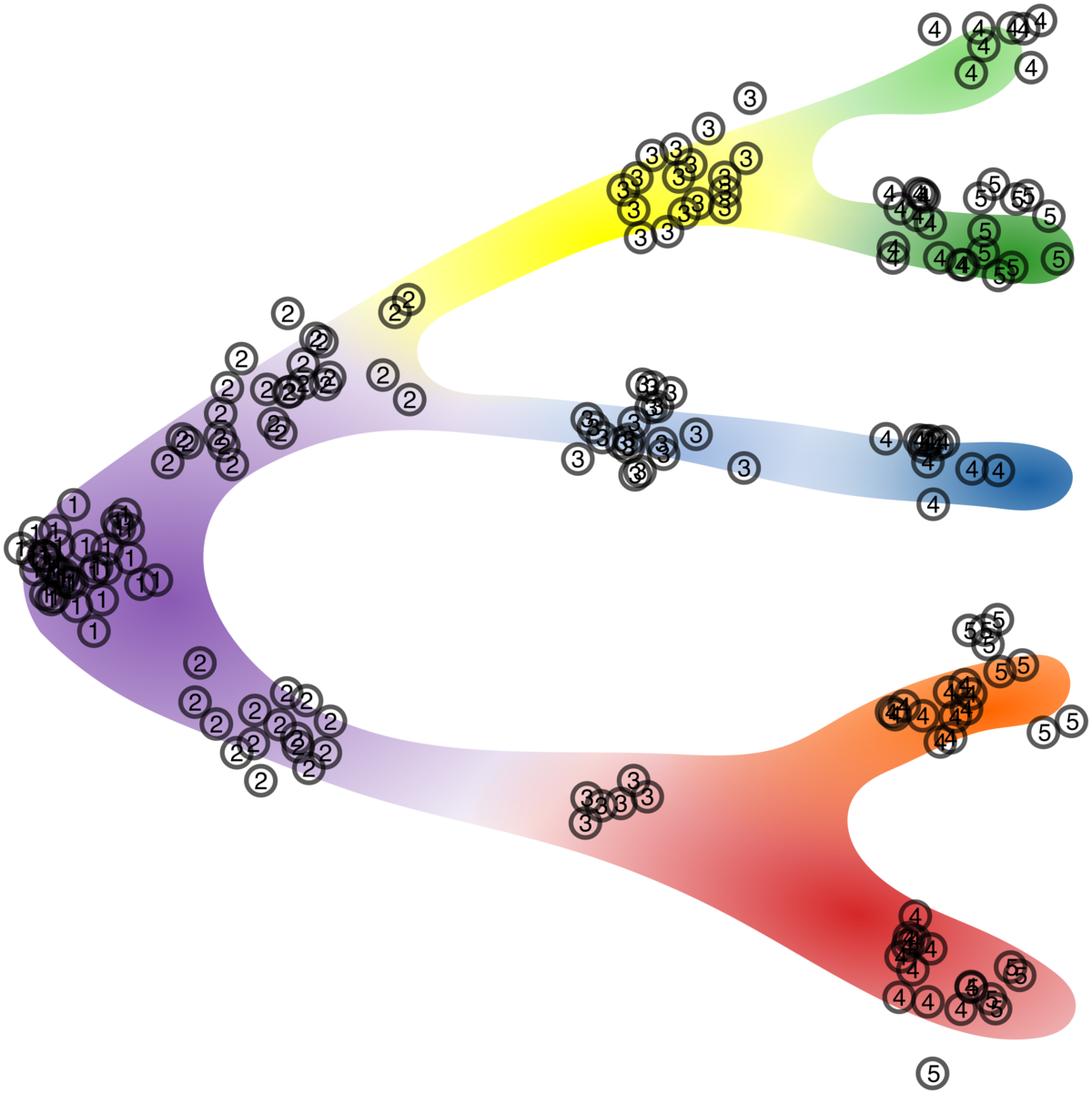
By developing methods that use single-cell omics data to chart gene regulatory networks at key branching points in development, we contribute to building comprehensive reference maps of healthy development. Such maps have immediate medical relevance: they can be used to compare diseased cell samples with a healthy reference, which will help identify the regulatory changes that cause these cells to malfunction. In addition, we can use such a reference to analyze the development of genetically perturbed cells to reveal the roles of specific genes in differentiation.
A deeper understanding of cell-fate decisions can also be used to guide efforts to reproduce developmental processes using organoids. Through close collaboration with experimental labs, we aim to identify perturbations that improve the reproducibility and fidelity of organoid models, bringing them closer to natural developmental processes.
Julou, T., Gervais, T., de Groot, D., van Nimwegen, E. (2025). Growth rate controls the sensitivity of gene regulatory circuits. Sci Adv. 11(17):eadu9279
de Groot, DH., Tjalma, AJ., Bruggeman, FJ., van Nimwegen, E. (2023). Effective bet-hedging through growth rate dependent stability. Proc Natl Acad Sci U S A. 120(8):e2211091120
Clement, TJ., Baalhuis, EB., Teusink, B (...) Planqué, R., de Groot, DH. (2021). Unlocking Elementary Conversion Modes: ecmtool Unveils All Capabilities of Metabolic Networks. Patterns (N Y). 2(1):100177
de Groot, DH., Lischke, J., Muolo, R (...) Bruggeman, FJ., Teusink, B. (2020). The common message of constraint-based optimization approaches: overflow metabolism is caused by two growth-limiting constraints. Cell Mol Life Sci. 77(3):441-453
As you set out for Ithaka, hope your road is a long one.