


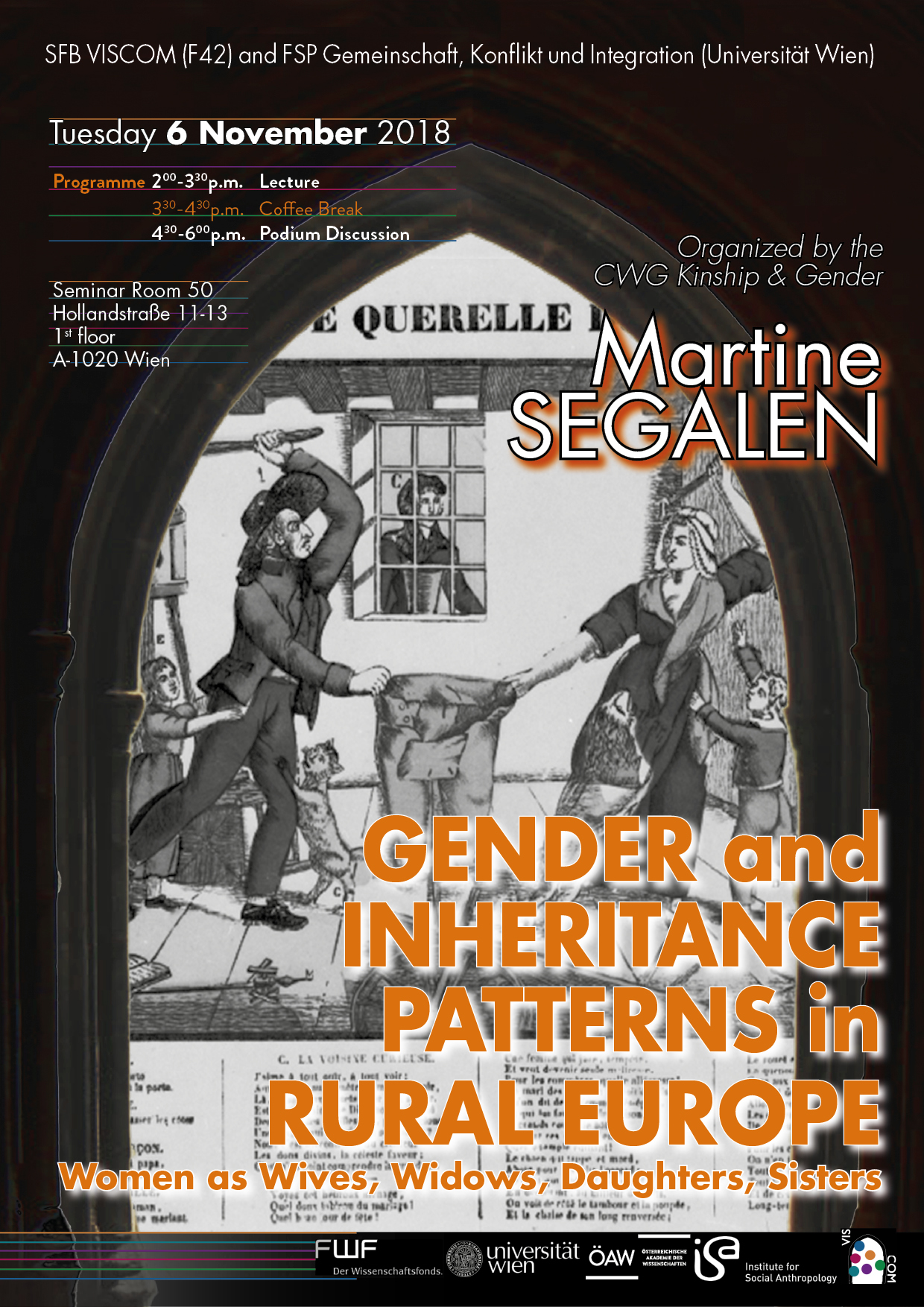
What are the reciprocal influences of prevailing kinship systems and gender roles?
It seems obvious to ask this question nowadays, but it was not on the agenda when research about European kinship systems and marriage first developed. Between 1970 and 1990, a host of publications developed in Europe dealt with inheritance patterns, or with structures and functions underlying domestic groups, using anthropological, historical and/or demographical approaches. Some researchers, for example, focused on the way property affected kinship. Others concentrated on the relationship between residential patterns, inheritance and marriage systems.
The connection between ‘kinship’ and ‘gender’ was thus operated through various research avenues. In this presentation, I will first delineate the reasons and forms of the encounter between ‘kinship’ and ‘gender’. The second part will be devoted to the analysis of the variety of inheritance patterns in rural Europe, inasmuch as they bear consequences to gender roles. The ethnographic presentation of various cases, thematised in the third part, will help us show the complexity of the relation. Gender in peasant society has to be thought of in relation to the family as a production unit and we have to investigate the scope of female agency in this context.
Information
Short biography
Martine Segalen is Professeur émérite of the Université de Paris Nanterre, and former editor-in-chief of Ethnologie française.
Professor Segalen’s threefold interests are kinship, social rituals, and museums of heritage. She deals with those topics within the disciplinary framework of Anthropology of Europe
Venue
Room 50, Hollandstraße 11-13,
1st floor, A-1020 Vienna
Programme
2.00-3.30 p.m. - Lecture
3.30-4.30 p.m. - Coffee Break
4.30-6.00 p.m. - Podium Discussion
Organized by CWG Kinship & Gender
Contact