



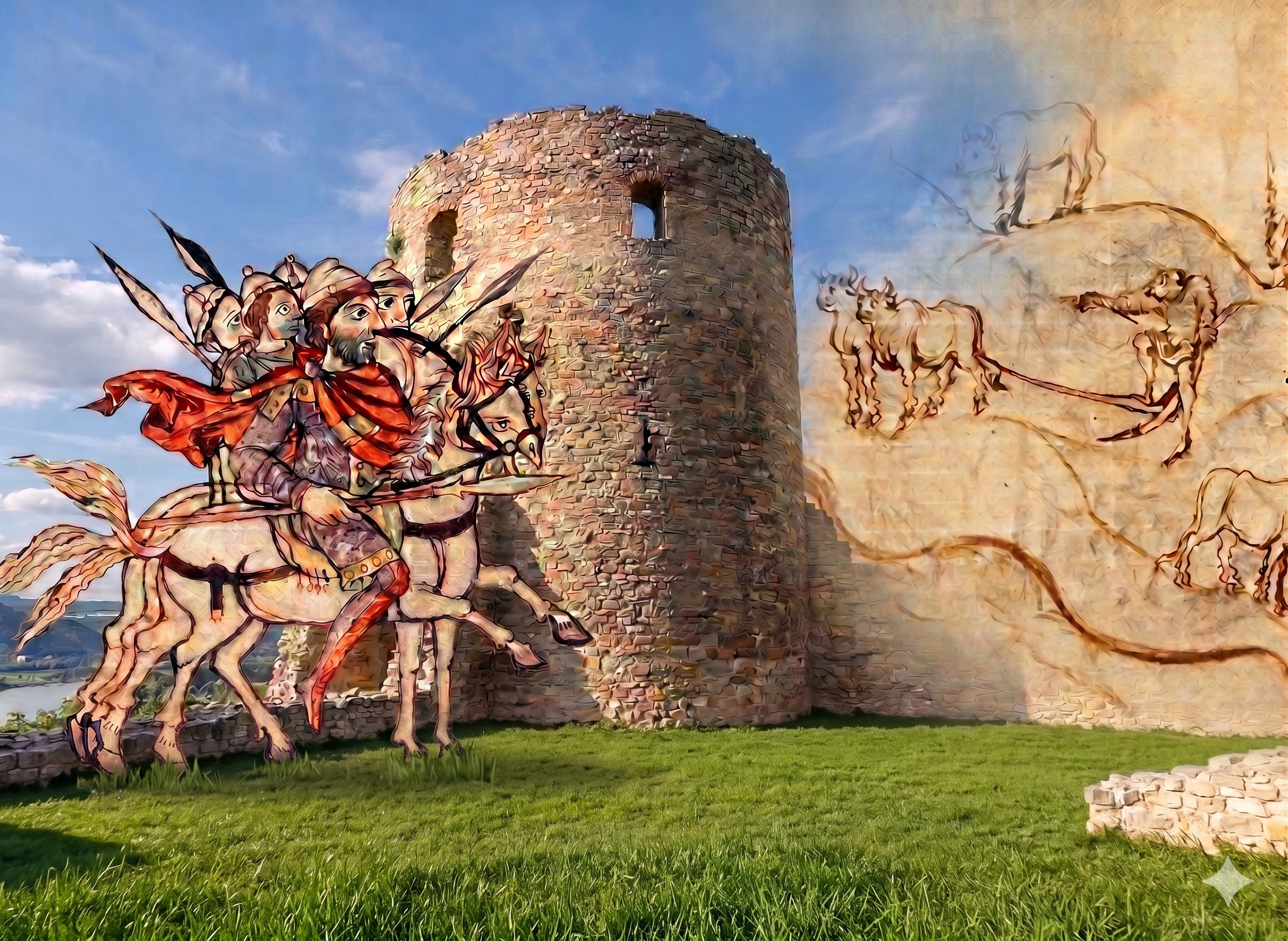
This workshop centers on the cemetery of Mautern (Burggartengasse/Kainzstraße). It explores questions of population continuity, local communities, and transformation in the Middle Danube region between Late Antiquity and the High Middle Ages—an era characterized by profound political, social, and climatic upheavals. The more than 400 already documented and genetically analyzed graves indicate continuous use of the site, which can only be partially documented by written sources. The aim of the lab’s interdisciplinary collaboration is to use this exemplary case to develop new perspectives on population continuity, both stabilizing and disruptive factors, and local as well as supra-regional interconnections.
Programme
(subject to change)
Session 1: 10:00–11:15 — Welcome & Introduction
Welcome — Claudia Rapp
Walter Pohl — HistoGenes: Results and New Avenues
Johannes Preiser-Kapeller, Bendeguz Tobias, Veronika Wieser — LAB ‘Interfaces between Medieval Studies and Sciences’: Introduction
Bendeguz Tobias, Veronika Wieser — Mautern: A Case Study
Chair: Maximilian Diesenberger (HI)
Coffee Break 11:15–11:30
Session 2: 11:30–13:00 — The Mautern Cemetery and Its Archaeological Context
Bendeguz Tobias — The Last Ones Remaining: The Late Antique Cemeteries of Mautern-Burggartengasse/Kainzstraße and Melkerstraße, Austria
Martin Obenaus (NHM, Wien) — Between Wachau und Tullner Feld. The Krems Area from 400 to 1100 from an Archaeological Point of View
David Russ (NHM, Wien) — Between Wachau und Tullner Feld. The Mautern Area from 400 to 1100 from an Archaeological Point of View
Chair: Andreas Rhoby (ABF)
Lunch Break 13:00–14:00
Session 3: 14:00–15:30 — Genetics, Population Development & Anthropological Perspectives
Zuzana Hofmanová (MPI Leipzig) — Mautern a Paradigm for Shifts and Population Dynamics
Margit Berner and Doris Pany-Kucera (NHM Vienna) — Mautern – An Anthropological Challenge
Veronika Wieser, Mapping Mautern — Historiographical Perspectives and Digital Tools (short)
Chair: Bendeguz Tobias
Coffee Break 15:30–16:00
Session 4: 15:45–17:00 — Perspectives on Climate (a dialogue)
Johannes Preiser-Kapeller — MfG, MCA, LALIA, MPI-ESM: Climate Dynamics of the Early Middle Ages between the Regional and the Global Perspective
Ulf Büntgen — Reconstructing Past Climate Dynamics – Input
Chair: Veronika Wieser
Session 5: 09:15–10:30 — The Early Medieval Period
Maximilian Diesenberger — Politics and Economy. The Middle Danube Region in the Ninth and Tenth Centuries
Katharina Winckler — Mapping the Invisible: Territory and Space between the Enns and the Wienerwald (8th & 9th c.)
Chair: Helmut Reimitz
Coffee Break 10:30–10:45
Session 6: 10:45–12:15 — Global Perspectives and Social Networks
Maya Lerner — Mautern and the Sound of Silence: the Absence of Coin Evidence
Janel Fontaine — Forced Migration Networks in Early Medieval East Central Europe (short)
Salvatore Liccardo — Social Networks and Levirate Marriage (short)
Johannes Preiser-Kapeller — Glocalising the Early Middle Ages between Mautern and AfroEurAsia
Chair: Walter Pohl
Coffee & Light Lunch 12:15–12:45
Session 7: 12:45–13:45 — Concluding Discussion: Open Research Questions & Next Steps
Chair: Johannes Preiser-Kapeller, Bendeguz Tobias, Veronika Wieser
22-23 June 2026
Seminar Rooms 8 + 9 | 5th Floor
PSK, Georg-Coch-Platz 2
1010 Vienna
Hybrid Event via Zoom
Zoom Link Monday, 22 June, 10:00-17:00
Zoom Link Tuesday, 23 June, 9:30-13:45
Organisation:
Institute for Medieval Studies
LAB Interfaces between Medieval Studies and Sciences
Contact:
Veronika Wieser
Ingrid Hartl