


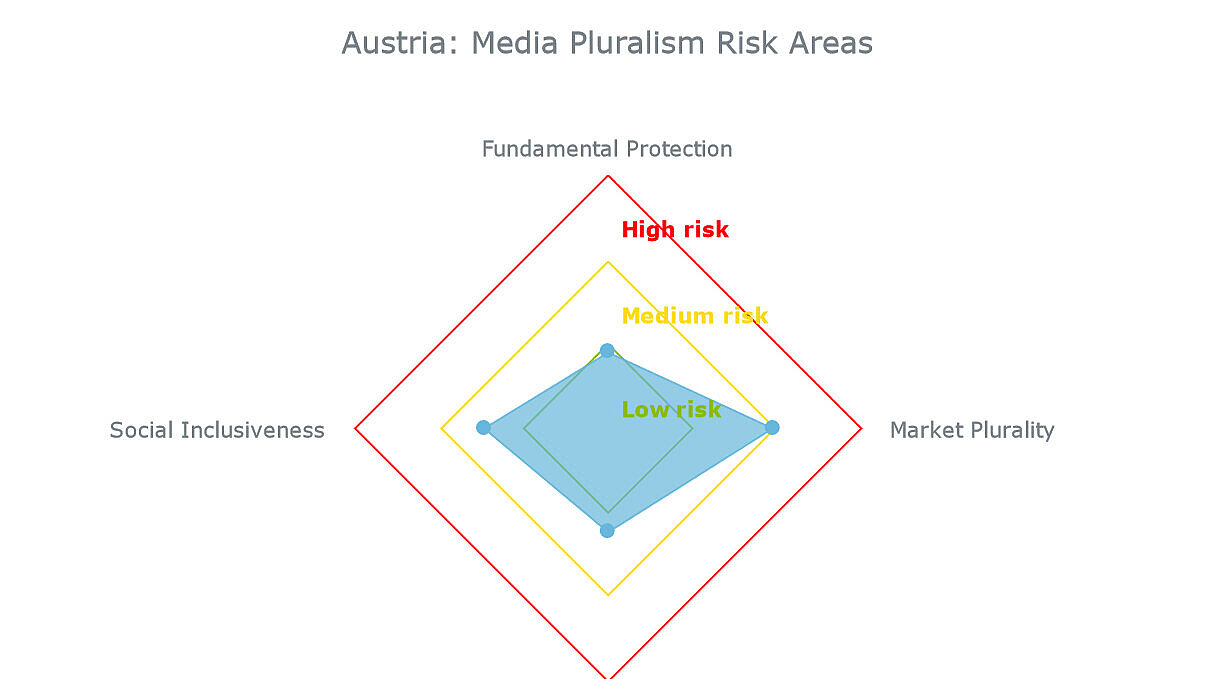
The "Media Pluralism Monitor" commissioned by the European Commission emphasises anew every year that market diversity in Austria is at risk. Horizontal and cross-media concentration, insufficient consideration of changes in media supply and use in competition law, decreases (or, at best, only modest) increases in revenues, the outflow of well over one-third of advertising revenue to a few global platforms, cross-cutting measures for newsrooms, and a system of media subsidies that favours large corporations instead of democratically relevant journalism – all threaten market viability and market plurality. Across all four areas, four out of twenty indicators represent a high risk, eleven a medium risk, and only five a low risk.
Foundations of a democratic media system intact
It has to be emphasised that the foundations of a democratic media system are intact and robust: Freedom of expression is well protected, even on the Internet. Media authorities work independently. Public TV and radio signals reach almost everyone, and access to journalism is unrestricted. There is (still?) a varied supply of regional and local media services, including a lively community media sector. During election campaigns, the public service broadcaster ORF reasonably represents the parliamentary parties in its programmes. Regulatory safeguards that preclude government officials and political parties from media ownership in the audiovisual and radio sector, the Austrian Press Agency’s (APA) professional work, and editorial statutes (wherever they are in place) are among the precautions that seek to make political interference in journalism more difficult.
Significant risk in many areas
However, these results are impeded by other indicators that point to a considerable risk. A comprehensive framework for protecting journalists’ physical, digital and social safety, including protection from strategic lawsuits against public participation (SLAPPs), is still missing at a time of increasing social tensions, which are increasingly being exploited by forces that are ready to use violence – also against journalists. Most newsrooms lack structures and clearly communicated guidelines for dealing with threats, sexual harassment and hate speech against journalists, but also against other people in community forums, and the media industry, in general, suffers from rudimentarily developed self-regulatory systems. Women and minorities are largely underrepresented in media content and media management, and a comprehensive policy (and adequate resources) for fighting disinformation and hate speech and promoting media literacy is missing.
Attempts of political influence on the media
Due to investigations by the Economic and Corruption Prosecutor’s Office, more and more suspected cases of attempted political influence are becoming publicly known (for example, concerning the ORF and the daily newspapers ‘Die Presse’, ‘oe24/Österreich’, ‘Heute’ und ‘Kronen Zeitung’). So, it seems that the existing legal provisions for the private media sector, rated as low risk by the MPM, cannot effectively safeguard political independence and independence from commercial and owner influence in practice. In addition, political influence on ORF is facilitated by some procedures provided by law for appointing the members of the highest management body and electing the Director-General (which have now been ruled unconstitutional by the Constitutional Court). As a result, trust in the media is declining. In too many newsrooms, strong and comprehensive editorial statutes and other self-regulatory measures that ensure editorial autonomy and guarantee transparency of appointment and dismissal procedures are missing. The extraordinarily high state advertising expenditures, amounting to 225 million euros in 2021 and 201.4 million in 2022, contribute significantly to this development.
Lack of transparency
The new Freedom of Information Act represents a missed opportunity to secure a truly democratic right to information. Not surprisingly, there is a certain lack of transparency in the disclosure of political parties' online campaign costs, in the awarding of state advertising contracts and the justification of their extraordinarily high levels, in the criteria for funding decisions, in the labelling of paid content and in the disclosure of media ownership (information on the ultimate ownership structures of media companies is not generally available).
Mentioning some of these risk factors in its most recent assessment, Reporters Without Borders has ranked Austria only 29th in its World Press Freedom Index in 2023. That is two places better than last year, but since 2019, Austria is no longer among the countries where media freedom is best protected. This should set alarm bells ringing among politicians and regulators.
For the past 10 years, CMC’s Josef Seethaler and Maren Beaufort have been responsible for the Austrian report of the Media Pluralism Monitor commissioned by the European Commission.
New publications
Seethaler, J., & Beaufort, M. (2024). Monitoring media pluralism in the digital era: Application of the Media Pluralism Monitor in European member states and canndidate countries in 2022. Country report: Austria. Florence: European University Institute – Centre for Media Pluralism and Media Freedom (CMPF). DOI: 10.2870/98299; Weblink: https://hdl.handle.net/1814/76993
Palmer, M., & Seethaler, J. (2024). Evolution of space and geography in media pluralism: A typology of community media in the European Union. In E. Brogi, I. Nenadić & P. L. Parcu (Eds.), Media pluralism in the digital era: Legal, economic, social, and political lessons learnt from Europe.Routledge.