The principal aim of the master’s programme in Global Demography at the University of Vienna is to give students a strong scientific grounding in the analysis and forecasting of demographic developments across the globe – in particular, fertility, mortality and migration trends.

The Wittgenstein Centre Reports cover the achievements of the Wittgenstein Centre during various periods. The most recent Wittgenstein Centre Report of Activities “Advancing Demography and Global Human Capital Research” summarizes the achievements of the Wittgenstein Centre in the years 2018-2022.
The POPNET newsletter has been issued since 1982 for an extensive network of researchers and institutes working in the field of population and sustainable development. On a regular basis collaborators and interested individuals are provided with details of developments within the program, current research, latest publications, and information on forthcoming meetings and conferences. Since summer 2022 the Wittgenstein Centre for Demography and Global Human Capital highlights the latest News, Publications, Events and other activities of the population network with an electronic POPNET newsletter.
The Vienna Yearbook of Population Research (VYPR) is an open-access journal that features contributions addressing population trends as well as a broad range of theoretical and methodological issues in population research.
For the content of the next Special Issue on Population and Climate Change please see the call.
For the content of the next Special Issue on Population and Climate Change please see the call.

In their recent study M. Sánchez-Romero, A. Fürnkranz-Prskawetz et al. show, that pension reforms might even increase socioeconomic inequality.

In this study I. Buber-Ennser, I. Setz and B. Riederer examine, how the pandemic has had an impact on long- and medium-term thinking about family formation in Austria.

In this paper Brian Buh emphasises the importance of taking population heterogeneity, contextual factors, and model selection into account when studying the connection of fertility desires and employment conditions.

Vanessa di Lego and her co-authors show, that there is a double burden of violence on longevity, as violence not only shortens individual lives, but it also makes the length of life less predictable.

In their new publication Bernhard Hammer and co-authors analyze, which generation or income group benefits from public redistribution.

Isabella Buber-Ennser together with her co-authors explore in this study how opportunity costs and socio-cultural factors influence the transition to higher order fertility.

Bernhard Rengs, Isabella Buber-Ennser and Judith Kohlenberger (WU Vienna) show, that among refugees mothers have more frequent contacts in their host country.
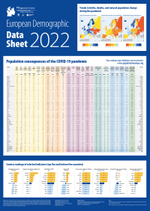
The European Demographic Data Sheet 2022 reviews, explores and visualises recent population trends in 45 European countries and focuses on population consequences of the COVID-19 pandemic.
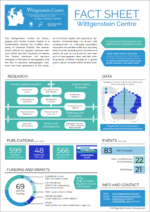
The Wittgenstein Centre provides fact sheets to current demographic topics that inform about the role of demography in science and provide research highlights on climate change and demography; migration; longevity, health, wellbeing; economic demography; fertility and family; Covid-19 and on the Wittgenstein Centre itself. The Wittgenstein Centre fact sheets are provided in English as well as German language.

Explore, select and download data on past reconstructions and future projections of the global population by age, sex and education – and visualize it with the Wittgenstein Centre Human Capital Graphic Explorer

Highlighting the power of multi-dimensional demography, this Advanced Introduction addresses the most consequential changes in our societies and economies using quantitative approaches. (Edward Elgar Publishing)
In der aktuellen Ausgabe finden Sie die folgenden Themen:

This report analyses the impact of the Russian invasion of 24 February 2022 on the longer-term future of Ukraine’s population size and structure. It focuses on the role of migration as a component of demographic change. Based on a review of past demographic trends and an assessment of the size and composition of the internationally displaced population from Ukraine, four qualitative migration scenarios are translated into population projections up to 2052.

This document complements and extends the technical report in Deliverable 8.1 QuantMig microsimulation tool description (Marois and Potančoková 2022) which was underpinning the QuantMig-Mic model code and explaining its structure and the MODGEN user interface. This technical cover document is a full documentation of the Quant-Mig-Mic microsimulation population projection model for 31 European countries (EU27 member states, the United Kingdom, Iceland, Norway and Switzerland, referred to as EU+ in this report), its modules, parameters, assumptions and migration scenarios.
Improving the evidence for European migration policy making
This policy brief synthesizes central results from quantitative migration and population projections on future migration flows to and within the EU and projects the population in EU member states at an unprecedented level of detail, including by age, sex, level of education, and country of origin, produced as part of the FUME project.

Today, approximately 3.4 percent of the world’s population are international migrants – people living outside their country of birth. In the future, the number of people who move from one country to another may increase due to population growth in developing countries, increased mobility, political unrest in some world regions, and climate change. The question is how much may international migration flows increase and where will migrants go?
“Explore, select and download data on QuantMig projections of population in 31 European countries by age, sex, place of birth, educational attainment and labour force participation by migration scenarios of high migration events published in Potancokova et al. (2023).”

Many global trends - including economic, environmental, social and geopolitical trends - depend on the future of the world population. Effectively assessing the future world population is therefore key to better responding to future societal challenges.
IIASA researchers have introduced an innovative methodology for reconstructing data on fertility and education, particularly in developing countries with inconsistent or unreliable data sets.