




During embryonic development, a single cell transforms into a complete organism with diverse tissues and organs. Studying this process and the interactions between the embryo and the mother is extremely challenging, as this development cannot be studied directly within the uterus, and the initial stages unfold rapidly. A stem cell-based model of early development, the blastoid, offers an ethical alternative for studying early human development.
Recently, research using blastoids revealed a potential "pause button" in the earliest stages of human development. This breakthrough resulted from a collaboration between two labs working in different fields, whose merged expertise led to a discovery with significant implications for reproductive medicine. The teams led by Nicolas Rivron at the Institute of Molecular Biotechnology of the Austrian Academy of Sciences (IMBA), who developed the blastoid model, and Aydan Bulut-Karslıoğlu at the Max Planck Institute for Molecular Genetics (MPI-MG) in Berlin, published their findings in Cell.
We spoke with co-first authors Dhanur P. Iyer and Heidar Heidari Khoei, along with co-corresponding authors Nicolas Rivron and Aydan Bulut-Karslıoğlu, to learn more about how this collaboration began, the challenges they faced and the human story behind this major discovery.
Aydan Bulut-Karslıoğlu: Over the past few years, my group has been studying cellular dormancy, a fascinating mechanism that allows a cell to shut down its activity for an extended period and then resume it later.
Dhanur Iyer: To understand how cells decide whether to enter dormancy or continue proliferating, we developed a protocol to induce diapause—a form of dormancy—in mouse embryos and human stem cells.
Dhanur Iyer: Our initial results using human stem cells made us wonder whether the system we developed—based on blocking the mTOR signaling pathway—could also induce diapause in human embryos and halt their development. However, the strict ethical and legal restrictions on human embryo research limited this research avenue.
Aydan Bulut-Karslıoğlu: To overcome this issue, I contacted Nicolas, whose work I was familiar with, to see if he would be interested in testing our approach in blastoids. These stem cell-derived models provide a fantastic ethical alternative for our research.
Nicolas Rivron: We had been working on a similar topic, so when Aydan reached out, I was immediately intrigued by the potential collaboration. I was especially surprised when she mentioned that they had induced diapause in mouse embryos for up to thirty days—I initially thought she must have meant hours!
Dhanur Iyer: Finding the right conditions to inhibit mTOR and induce dormancy in stem cells was challenging, as even minor alterations in the conditions could lead to failure of the experiment. Fortunately, the effort paid off when I succeeded in establishing the system in stem cells. It was even more rewarding when Heidar and Nicolas extended the approach to blastoids.
Heidar Heidari Khoei: Adapting Dhanur’s approach to blastoids was also tricky because blastoids are much more complex. One of the biggest challenges was being able to monitor them for up to eight days.
Aydan Bulut-Karslıoğlu: from different backgrounds, it was very educational to think about what mattered to Nicolas’ group and their own research.
Aydan Bulut-Karslıoğlu: The moment that Heidar managed to induce diapause in the human blastoids was a turning point because it provided the first evidence that our hypothesis is true and that this approach could potentially work in human embryos. It marked the culmination of all the hard work both teams had put into the project, and a confirmation that, as Dhanur once wrote, we should “Believe in the Process.”
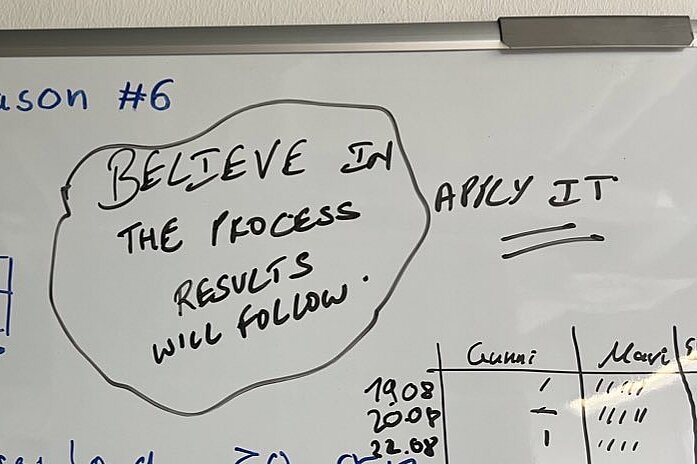
Dhanur Iyer: During one of the social hours at the MPI, I was discussing my project with some lab colleagues who were sharing their own frustrations. I told them that, as scientists, if we stay diligent and work hard without thinking about the results or where they will be published, things will eventually fall into place. So, I wrote down the sentence “Believe in the Process” on our whiteboard, and it resonated with many people.
Aydan Bulut-Karslıoğlu: I took a picture of the whiteboard when the lab was empty, and we have kept that phrase as our motto throughout the project.
Nicolas Rivron: Absolutely. In fact, Dhanur and Heidar are currently working on a protocol and methods article in which they will share the details on how to induce dormancy in blastoids, which is a technically delicate process.
Heidar Heidari Khoei: This collaboration was very rewarding from the beginning. There was this strong sense of teamwork and a shared goal, which made the experience truly special. So, we’re looking forward to collaborating again.
Dhanur Iyer: After working together for so many months, Heidar and I became good friends, so we’re definitely planning to work together in the future.