


Ratish Nanda | Aga Khan Trust for Culture
Conserving Mughal Monuments of Nizamuddin
Summary For several decades now, the Aga Khan Trust for Culture (AKTC) has been engaged in undertaking conservation of significant monuments across the world and leveraging this conservation effort to improve Quality of Life for residents of historic cities where we work. In India, AKTC first became engaged in undertaking a garden restoration at Humayun’s Tomb in fulfillment of India’s commitment to UNESCO on the designation as a World Heritage Site in 1993.
The Humayun’s Tomb Garden restoration (1999 – 2003) undertaken by AKTC in partnership with the Archaeological Survey of India (ASI) was a gift of His Highness the Aga Khan on the occasion of the 50th anniversary of India’s independence. It was the first ever privately undertaken conservation on any of India’s national monuments and AKTC remains the only private agency to have conserved national monuments to date. The garden restoration required removal of Several thousand lorry loads of earth to restore garden levels to the original, hand chiseling of over 3 km of sandstone edging for water channels, planting of over 3000 trees and plants of species favoured by the Mughals. The effort culminated with restoring flowing water at Humayun’s Tomb and led to a 1000% increase in visitor numbers.
In 2004, the then Prime Minister of India, Dr Manmohan Singh requested His Highness the Aga Khan for further partnership projects in the field of Culture. Towards this, the Ministry of Culture offered 50 potential grand sites from across India to choose from.
In order to implement a project that has the potential to couple conservation effort with ecological restoration and a major socio-economic development effort aimed at benefitting a needy community, AKTC chose to return to the Humayun’s Tomb – Nizamuddin – Sunder Nursery area of Delhi. The project, spread over 300+ acres in the heart of the national capital, became possible with multiple government agencies with distinct mandates – the ASI, Central Public Works Department, Municipal Corporation of Delhi – all signing a single agreement.
To implement a mega conservation – development effort, AKTC has forged additional partnerships with a diverse range of partners who have made significant financial contributions to the project. Grants have been received from the Ministry of Tourism, Government of India and other government agencies such as the Delhi Development Authority, international governments including repeat grants from the US Ambassadors Fund for Cultural Preservation and the Federal Republic of Germany, National and International trusts such as the Tata Trusts and Ford Foundation as well as Indian and international corporates such as Havells, IndiGo, Hilti, Titan, amongst others.
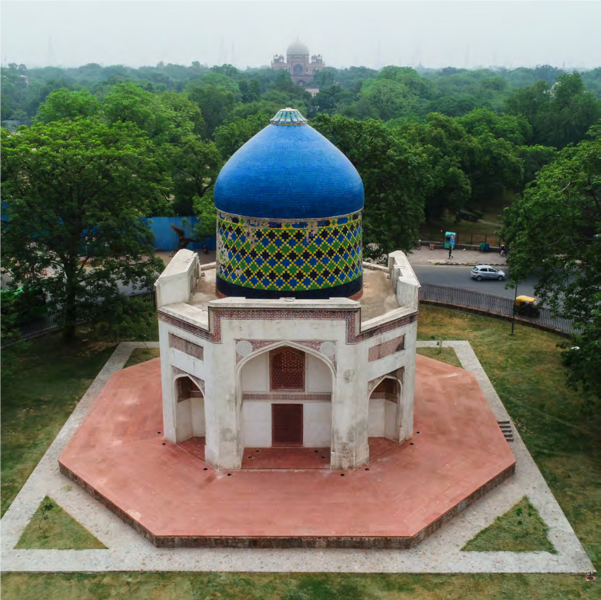
The conservation of Humayun’s Tomb was a major effort but similarly, conservation of over 50 other Mughal era structures was undertaken since 2007, including Rahim’s mausoleum, Sabz Burj, Chausath Khambha, Nila Gumbad, Mirza Muzzafar Hussain’s mausoleum, Lakkarwala Burj, Azimganj Serai, Sunder Burj, amongst others. More recently, the project’s conservation effort has spread to Mughal era structures that stand in Delhi Golf Club – expanding the project area to almost 500 acres.
In undertaking the conservation of Humayun’s mausoleums a definite conservation process and philosophy was defined by AKTC. The Conservation process included significant archival research, architectural & condition assessment as a precursor to defining the Statement of Significance and Conservation Plan.
At the onset of the Humayun’s Tomb conservation it was determined at Peer Reviews, including with Dr Ebba Koch, that in order to retain the significance of the site, a craft-based approach to conservation was required wherein traditional master craftsmen could use traditional materials and tools to restore the design intention of the 16th century builders. At Humayun’s Tomb stone carvers, masons, would clock thousands of days of work to repair or replace damaged stone elements or remove 20th century cement layers and restore lime plaster.
Dr Ebba Koch informed us of the significance of glazed tiles used at Humayun’s mausoleum as a ‘reminder of their central Asian homelands’ for the Mughal emperors. AKTC embarked on a multi-year effort to revive the craft of tile making in India and required support from master craftsmen from Uzbekistan as well as the state of art scientific research. Over 3 years of effort and 20000 samples were made prior to being able to manufacture tiles of the required colours.
An equally incredible project was to create an exact replica of the 6 m tall finial when the original collapsed and was badly damaged. The study allowed us to understand the advances in 16th century metallurgy in India where it was possible to manufacture copper sheets of almost 100% purity. For the restoration, copper sheets of matching purity were specially manufactures, gilded with six kilos of 24 K Gold at the Titan factory.
Conservation of other significant buildings in the Nizamuddin area included a unique effort at the Chausath Khambha, wherein 25 marble domes had to be dismantled to allow each block of marble to be carefully repaired with stone indents prior to rebuilding the domes. Such an effort is not known to have been undertaken anywhere in the world. The courtyard of the Chausath Khambha was converted into an amphitheater where, for several years international music festivals – focused on the associated intangible of Quwwali music were held.
The grand mausoleum of Abdur Rahim Khan i Khanan, the commander-in-chief of the Mughal armies under Emperor Akbar and still renowned for his poetry and famed Dohe also stands in the Nizamuddin area. Conservation works here saved this grand building from certain collapse and revealed hidden ornamentation and significant elements related to lifting of water to great heights. Revealing historic details allowed restoration of the stone façade and incised plaster patterns on the interior wall surfaces. Rahim’s incredible cultural legacy was celebrated with major publications, exhibitions and festivals. Appreciating the conservation effort, Dr Ebba Koch had remarked that it had led to a better understanding of Mughal architecture.
On the removal of the cement plaster from the ceiling of the domed chamber of Sabz Burj, conservation works revealed an incredible painted ceiling wherein pure gold and lapiz had been used as paint. This and other discoveries at this prominently sited mausoleum led Dr Ebba Koch to suggest that this structure was built by Humayun himself to serve a mausoleum for his mother.
Conservation of several monuments in the area, led, in 2016 to UNESCO/ ICOMOS accepting an ASI-AKTC proposal to expand the World Heritage Property to include an additional dozen 16th century ‘garden-tombs’ – contemporary in date and similar in function to Humayun’s Tomb.
Prof Ebba Koch, who has advised on the project since its inception, has considered the Nizamuddin area to be the first Mughal city of Hindustan. Centered at the early 14th century Dargah of Hazrat Nizamuddin Auliya, five centuries of tomb building has been coupled with the building of the Purana Qila by Humayun and numerous Serai’s, Bridges, baolis, amongst other structures during the Mughal reign.
Here, since 2007, AKTC’s efforts have led to the conservation of at least 50 Mughal structures conserved and this conservation effort has been coupled with significant interventions in providing education and health infrastructure for the resident community of Nizamuddin Basti. Here, major urban improvements and housing improvements have included creating neighbourhood parks, providing public toilets, street improvements, setting up a waste collection and management programme covering 1800 households and all commercial establishments.
Along with the physical improvements, the socio-economic development measures have included, addressing malnutrition through monitoring and providing meals, training and placing community teachers, English speaking classes, vocational training for youth and women, establishing community self-help groups, amongst other similar projects. Together these measures have helped us achieve 15 Sustainable Development Goals demonstrating the possibility of conservation effort achieving multiple government objectives. In 2020, 2021, the project received four UNESCO awards including two awards of excellence in conservation and two special mentions for sustainable development.
The creation of a 90-acre city park, the Sunder Nursery, by the AKTC has been the third piece of the urban renewal initiative. The park opening in 2019 after 11 years of design and development works and in 2023 was visited by 1.15 million visitors. Here 20 monuments have been conserved, over 300 tree species planted, creating a habitat for 160 bird species. The park has attractions for diverse interest groups ranging from elaborate Rainwater harvesting, cultural performance spaces, organic food gardens, children’s playhouse amongst others.
As a culmination of a 15 year effort, in 2015, AKTC embarked upon building a site museum. Dr Ebba Koch has been the Principal Advisor to the museum project and also authored ‘The Planetary King’ (Ahmedabad 2022), as the museum publication. This 10000 sqm facility has a permanent exhibition wherein visitors to the World Heritage Site will be able to understand the cultural context of the site, including emphasis on a better understanding of Emperor Humayun, his interests, contribution, travels. The principal focus is the significance and conservation of Humayun’s Tomb. Visitors will be informed of the four significant personalities associated with the Nizamuddin area – the saint Hazrat Nizamuddin Auliya, the 14th century poet Amir Khusrau Dehalvi, Rahim – poet and commander-in-chief as well as Shahjahan’s son Dara Shukoh.