

Ebba Koch and Richard Barraud
Introduction to the Exhibition: Field and Archive or Field as Archive
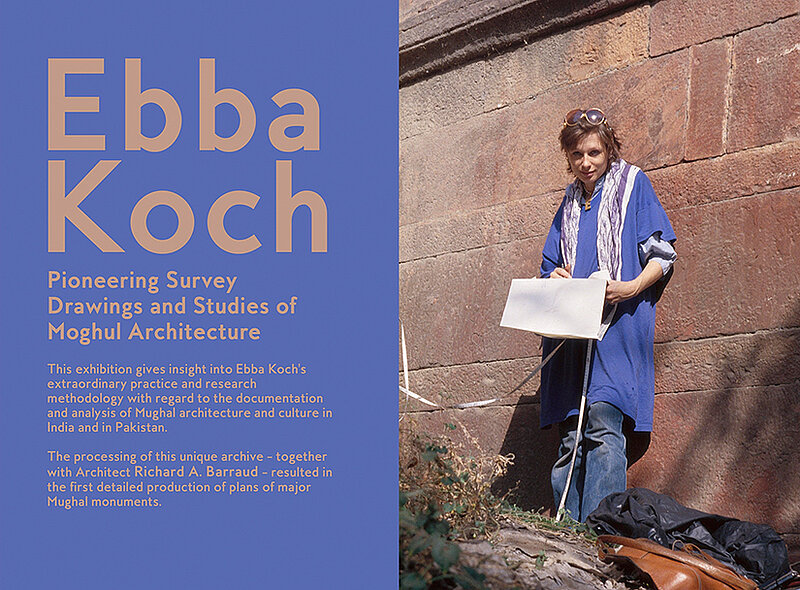
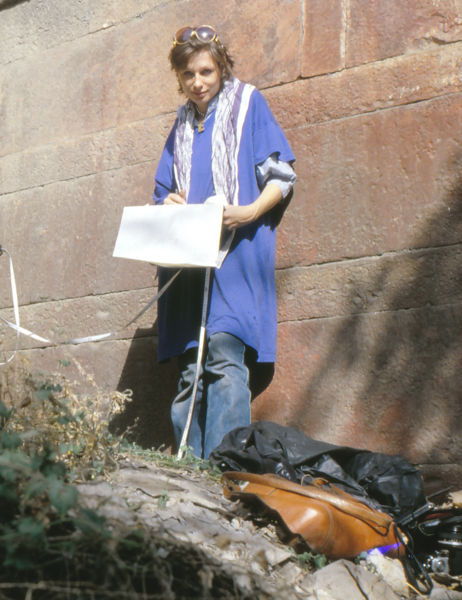
Summary The exhibition was shown on eight panels in the fore room to Seminar Room 2 where the lectures of the symposium took place, it was curated and put up by Christine Bruckbauer and Christiane Kalantari, with the assistance of the staff of the Institute of Iranian Studies of the Austrian Academy of Sciences, Bettina Hofleitner and Nurdan Sentűrk. The installation was to give an insight in the ‘hands-on’ aspect of my scholarly work, my survey of Mughal architecture undertaken since 1976, beginning with a ten year stay in New Delhi. My field research provided the material for a constantly expanding and unique archive of the Islamic architecture of South Asia which today comprises over 80,000 photographs taken by myself and c. five hundred architectural drawings prepared mostly by the Delhi based architect Richard Barraud who joined me in 1982. The aim of the project is the documentation and analysis of the palaces and gardens of Shah Jahan, the fifth ruler of the Mughal dynasty (r. 1628-58); it resulted in a corpus of all his preserved palaces. Another focus was the first survey of the entire Taj Mahal complex and its urban context, the river front garden city of Agra, undertaken between 1995 and 2005; it led to the publication Ebba Koch, The Complete Taj Mahal and the Riverfront Gardens of Agra (London: Thames&Hudson, 2006).
The exhibition illustrated our working method with photographs, field book sketches, working sketches and final drawings. Richard Barraud and me measure the buildings together, often with the assistance of local volunteers. For our survey we use metal and plastic tapes and a laser measuring instrument made by Leica called Disto. Based on our survey Richard Barraud did and still does the scale drawings by hand. With a few exceptions, the photographs were taken by me with a Nikon FS Photomic and later with digital cameras, most recently with my iPhone.