


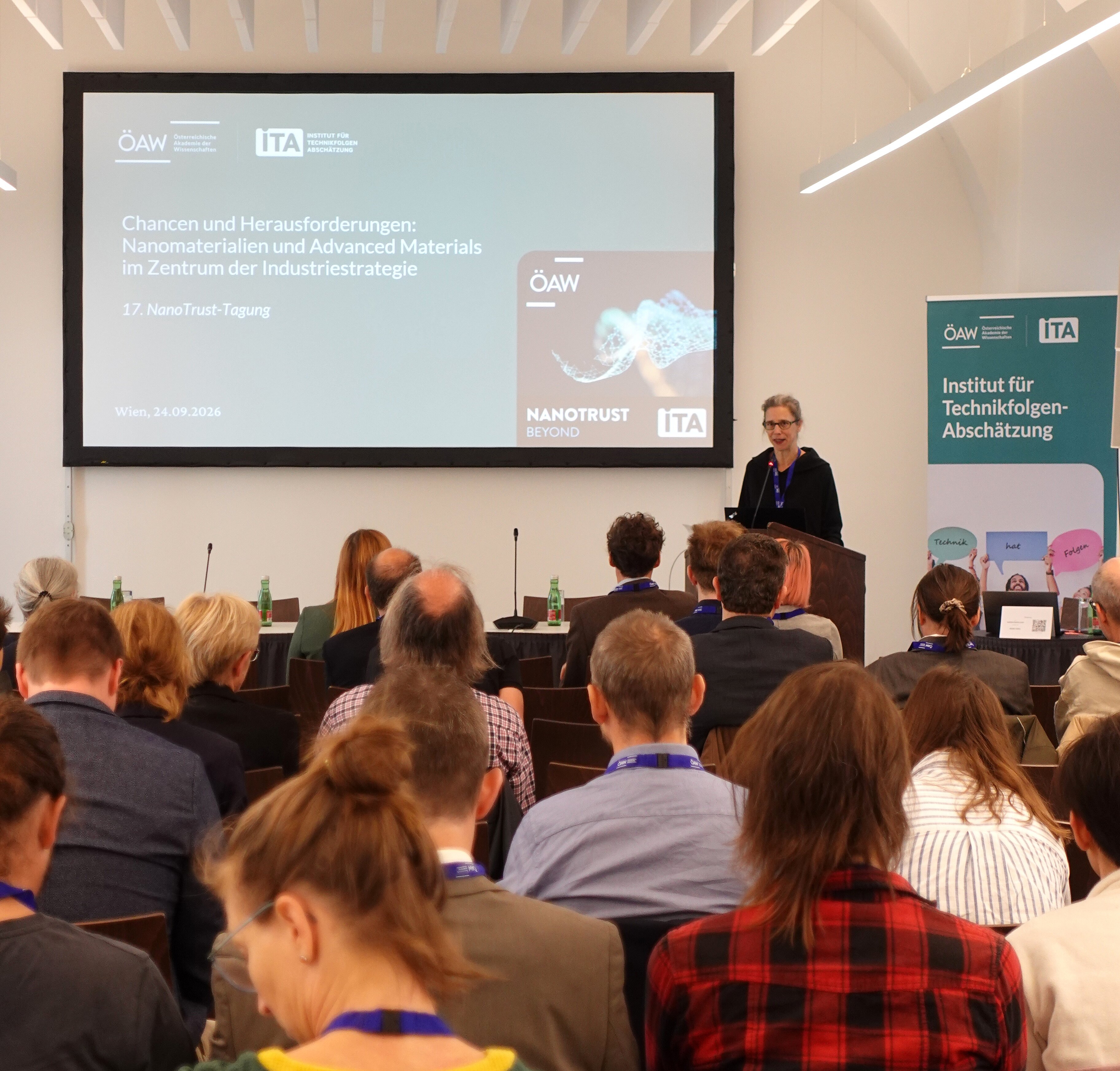
The Austrian Industrial Strategy 2035 aims to strengthen Austria as a business location, tap into new markets, and keep Austria competitive on the international stage. But how do nanomaterials and advanced materials fit into this picture? This was the central theme of this year’s 17th NanoTrust Conference, which took place on September 24 at the Austrian Academy of Sciences in Vienna. The event brought together nearly 50 representatives from the industry as well as experts from research, regulation, industry, and research funding. They presented their research and discussed, among other things, the possibilities for a socially just and environmentally sustainable transformation of industry in Austria.
The so-called key technologies of the Industrial Strategy 2035, in which approximately 2.6 billion euros will be invested by 2029, cover a broad spectrum: artificial intelligence and electronic components, as well as space, aviation, and environmental technologies, are all included. Advanced materials run like a common thread through all of these technologies.
“In three sessions, each consisting of ten-minute presentations and a panel discussion, we discussed the opportunities and challenges of successfully implementing the Industrial Strategy, and in particular the role of nanomaterials and advanced materials as key technologies in Austria as an industrialized nation,” said Jean Schmitt of the Institute for Technology Assessment (ITA) regarding the program of the NanoTrust conference.
To kick off the event, Roland Sommer, Managing Director of the Industry 4.0 Platform, emphasized in his keynote address on industrial strategy the importance of innovation as a driver of competitiveness. He highlighted the unique expertise of Austrian companies in developing new materials, particularly advanced materials. He identified strengths in the flow of all resources that feed into the innovation process of a company or institution, such as financial resources, qualified personnel, technical equipment, and information (R&D input). He pointed out that there is still room for improvement in terms of measurable results, returns, and innovations arising from research and development activities (R&D output)—particularly with regard to scalability.
Roland Sommer was followed in the first session of the day by Marcello Entner (FCIO), who gave a presentation on the chemical industry in transition, and by Maximilian Morgenbesser, who provided an overview of funding opportunities available through the Research Funding Agency (FFG).
Following an intensive discussion, the second session began, focusing entirely on advanced materials, their potential for industrial strategy, and their sustainability: Maximilian Kinzl (Federal Environment Agency) opened this segment with a presentation on the regulation of advanced materials. He was followed by Andreas Falk (BioNanoNet), who provided an overview of circular advanced materials. Julia Wenger (Graz University of Technology) concluded this thematic block by addressing life cycle assessment (LCA) in the evaluation of new technologies and materials.
Session 3 was also entirely dedicated to advanced materials as sustainable materials: Stefan Stadlbauer (Protovation) discussed the path from functional prototypes to commercial technology readiness, while Alexander Opitz (Vienna University of Technology) presented a novel type of battery based on oxygen ions. As the final speaker of the day, Andreas Flanschger (Bionic Surface Technologies) reported on surface innovations in connection with advanced materials.
In a closing panel discussion, the participants sparked new ideas and reflected on the day’s events, insights, and open points for discussion.
“Particularly noteworthy is the wide variety of speakers, who came from basic research, industry, and academia. The networking among conference participants was of particular interest to us, and the lively discussions led to numerous new perspectives,” said Gudrun Lettner of the ITA, expressing her satisfaction.