


What does the world's population look like in 2026?
In 2026, the world population is still growing, but much more slowly than in the past. According to the United Nations, the global population is estimated at about 8.26 billion people, with an annual growth rate below 1%. Fertility remains slightly above replacement level, with a total fertility rate of around 2.3 births per woman, but the crude birth rate is already modest by historical standards, at about 16 births per 1,000 population. Mortality conditions continue to reflect major long-term improvements, with global life expectancy close to 74 years, although the gap between women and men remains substantial. At the same time, infant and under-five mortality have not disappeared, with around 26 infant deaths and 35 under-five deaths per 1,000 live births, showing that survival inequalities remain important. Overall, the world in 2026 is characterized less by rapid demographic expansion than by continued but slowing growth, rising survival, and a gradually ageing population, with a median age of just over 31 years.
As of 2026, the majority of the global population is concentrated in these ten nations (population in millions according to the United Nations):
1. India (1,461)
2. China (1,424)
3. United States of America (344)
4. Indonesia (283)
5. Pakistan (252)
6. Nigeria (237)
7. Brazil (219)
8. Bangladesh (177)
9. Russian Federation (143)
10. Ethiopia (135)
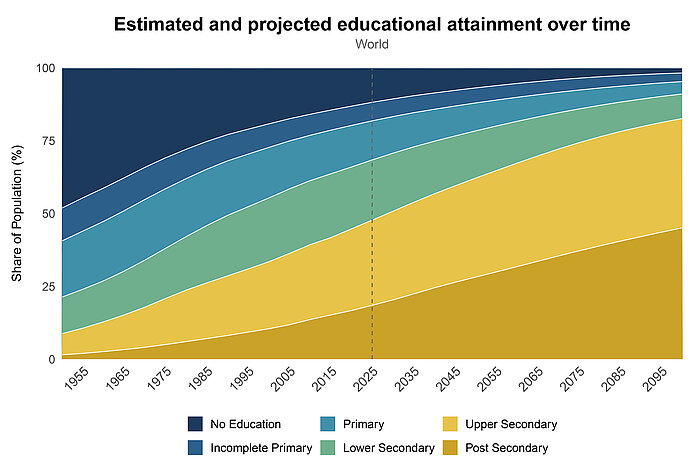
In terms of educational attainment, data from the Wittgenstein Centre Human Capital Data Explorer show that around 12 percent of the world population aged 15 and above has no formal education, while a further 6 percent has only incomplete primary schooling. Another 13 percent has completed primary education as their highest level, and about 21 percent has attained lower secondary education. The largest single group, accounting for just over 29 percent of the population, has reached upper secondary education, while post-secondary education accounts for about 18.5 percent. Taken together, this means that roughly one third of the world’s adult population has primary education or less, while nearly half has completed at least upper secondary education.
How many people currently live in Austria?
The annual average population of Austria in 2025 was approximately 9.2 million. This represents an increase of about 1.1 million people (13.6%) compared with the 8.1 million inhabitants recorded in 2005.
Austria's demographic profile has changed considerably over recent decades. Life expectancy reached 79.8 years for men and 84.3 years for women in 2024, representing an increase of around four years since 2002. At the same time, fertility has remained consistently low. Since the mid-1980s, the total fertility rate has fluctuated between 1.3 and 1.5 children per woman, well below the replacement level. Another important demographic change has been the postponement of childbearing, with the mean age at first birth increasing from 24.1 years in 1984 to 30.0 years in 2024.
How does migration shape Austria's population?
International migration has become one of the main drivers of Austria's recent population growth. However, migration influences much more than population size. It also shapes the demographic composition of Austria by affecting the age structure, fertility patterns, educational attainment, and labour force participation, while bringing together people with different cultural backgrounds. As a result, Austria has become an increasingly diverse society, in which population change reflects not only how many people live in the country, but also the varied backgrounds of those who contribute to its development.
How does migration influence Austria's religious diversity?
The religious affiliation of migrants varies considerably according to their countries of origin. Consequently, changes in migration patterns also influence Austria's religious landscape. While Christianity remains the largest religious affiliation in the country, migration has contributed to the growth of other religious communities.
Between 2016 and 2020, approximately 763 thousand international migrants arrived in Austria. For the period 2021–2025, this number is estimated to have increased to around 953 thousand. Based on the average religious distribution in migrants’ countries of origin, Orthodox Christians are estimated to represent the largest religious group (24%), followed closely by Catholics (23%) and Muslims (21%). The relatively similar shares of these three groups indicate that no single religious affiliation dominates recent migration flows, reflecting the increasing diversity of migrants arriving in Austria.
What do population projections tell us about Austria's future?
Austria's population is projected to continue growing over the coming decades, reaching approximately 9.3 million around the middle of the century before gradually declining as population ageing intensifies. Under these projections, migration will continue to play a key role in sustaining population size and shaping the country's demographic structure.
Future demographic change will also be accompanied by substantial improvements in educational attainment. According to projections from the Wittgenstein Centre Human Capital Data Explorer, the number of people holding a Master's degree or higher level is projected to increase from around 830 thousand in 2025 to more than 1.6 million by 2100. At the same time, the number of people with only primary or lower secondary education is expected to decline markedly, reflecting the continued expansion of higher education.
These projections suggest that Austria's future population will be older, more highly educated, and increasingly shaped by international migration. Understanding these long-term demographic trends is essential for planning policies related to education, healthcare, labour markets, pensions, housing, and social integration.