The European Demographic Data Sheet 2024 explores, visualises and compares population indicators for 45 European countries and regions. The 2024 edition puts a spotlight on population trends during unfolding recent crises, especially the COVID-19 pandemic and the Russian war against Ukraine.

The principal aim of the master’s programme in Global Demography at the University of Vienna is to give students a strong scientific grounding in the analysis and forecasting of demographic developments across the globe – in particular, fertility, mortality and migration trends.
The Wittgenstein Centre for Demography and Global Human Capital highlights the latest News, Publications, Events and other activities of the population network with the electronic POPNET newsletter. Sign up here!
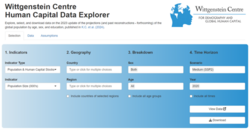
Explore, select and download data on past reconstructions and future projections of the global population by age, sex and education – and visualize it with the Wittgenstein Centre Human Capital Graphic Explorer.

The Vienna Yearbook of Population Research (VYPR) is an open-access journal that features contributions addressing population trends as well as a broad range of theoretical and methodological issues in population research.
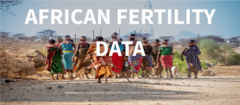
Download Education Specific Fertility Estimates and Plots for African Countries here!

Understanding the vulnerability of the EU population to both slow- and fast-onset climate impacts is crucial. By examining various vulnerability indicators, including age, health, economic status, and housing situation at the territorial level, several areas with higher concentrations of vulnerable populations were identified. Read more!

This collection of short articles sheds light on the current situation of families. It examines aspects of the current partnership, previous relationships, the family of origin, family formation and further planning, as well as the division of labour within the family, participation in employment and the associated economic situation of families. Finally, the implications of the recent global crises for families in Austria are analysed.

Based on GGS-data collected between the end of 2022 and the beginning of 2023, the goal was to investigate the extent to which recent price increases, the COVID-19 pandemic, and the war in Ukraine have led to perceived stress. In addition, this project examined the changes in the desire to have children due to these global crises. The target group was women and men in young and middle adulthood.
50 years of IIASA research, 40 years after the Brundtland Commission, contributing to the post-2030 Global Agenda
In this report IIASA researchers highlight the desirability to focus on the overarching goal of “sustainable wellbeing” in addition to the many more specific Sustainable Development Goals and targets.
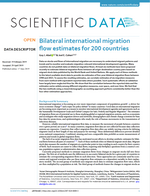
Publication, 2019
In this article, Guy J. Abel & Joel E. Cohen compare six recently proposed methods for estimating bilateral migration flows from global stock data and show that their accuracy varies substantially across indicators, places, and time. They find that the two methods using a closed demographic accounting approach consistently perform better than the other four estimation methods.
Andrea Lisette Aparicio Castro, Arkadiusz Wiśniowski, Dilek Yildiz and Michaela Potančoková present (1) a complete, comparable, reliable, and consistent time series of bilateral migration flows between South America and Europe from 1985 to 2018 and (2) conditional forecasts until 2050. Using a two-level hierarchical Bayesian model, the study integrates one-year and five-year transition census data, corrects for undercounting of native-born migrants, adjusts for census approaches and data quality, and incorporates key migration drivers, including demographics, socioeconomic disparities, historical ties, and environmental factors.
Highlighting the power of multi-dimensional demography, this Advanced Introduction addresses the most consequential changes in our societies and economies using quantitative approaches. (Edward Elgar Publishing)