+43 1 51581 - 7709
maria.winkler-dworak(at)oeaw.ac.at
Dominikanerbastei 16, 1010 Wien
Room 05 01 A B9 01
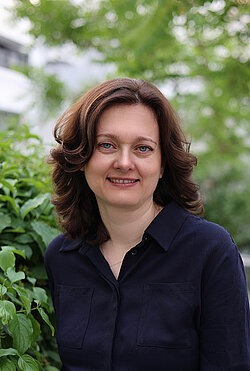
Maria Winkler-Dworak is a Research Scientist at the Vienna Institute of Demography (VID/ÖAW) in the Research Group “Fertility and Population Dynamics”. Her current work examines the complex interrelationship between childbearing and partnership dynamics across European countries from a life course perspective. A central focus is the timing of family events, particularly, the postponement and subsequent recuperation of childbearing and partnership transitions. Moreover, she studies the impact of crises on fertility and partnerships, both on the individual and on the macro level. She is also team member of the Birth Barometer (https://birthbarometer.at) and the Human Fertility Database (https://humanfertility.org).
Maria Winkler-Dworak received her doctorate in mathematics at the Vienna University of Technology in 2002. She also was lecturing population economics at the University of Bamberg (2007) and demographic methods at the University of Vienna (2008-2016). Since 2017, she has been Managing Editor of the Vienna Yearbook of Population Research.
Analysis of recent fertility trends by age of mother and birth order in higher-income countries, 2018–2023
The burden of crises and changes in fertility intentions In Austria
Partnership dissolution in Austria during multiple crises, 2018-2023
Globale Krisen und deren Auswirkungen auf persönliche Lebensbereiche von Menschen in Wien
Buber-Ennser, I., Buh, B., & Winkler-Dworak, M. (2025). Global crises and their impact on the personal lives of people in Vienna and Austria. Vienna Institute of Demography. doi.org/10.1553/Global_crises
Winkler-Dworak, M. Zeman, K., & Sobotka, T. (2024). Birth rate decline in the later phase of the COVID-19 pandemic: the role of policy interventions, vaccination programmes, and economic uncertainty, Human Reproduction Open, 2024(3), hoae052, https://doi.org/10.1093/hropen/hoae052
Sobotka, T., Zeman, K., Jasilioniene, A., Winkler-Dworak, M., Brzozowska, Z., Alustiza-Galarza, A., Németh, L. & Jdanov, D. (2024), Pandemic roller-coaster? Birth trends in higher-income countries during the COVID-19 pandemic. Population and Development Review, 50, 23-58. doi.org/10.1111/padr.12544
Winkler-Dworak, M., Pohl, M., & Beaujouan; É. (2024). Scenarios of delayed first births and associated cohort fertility levels. Demography, 61(3), 687–710. https://doi.org/10.1215/00703370-11315685
Winkler-Dworak, M., Beaujouan, É., Di Giulio, P., and Spielauer, M. (2021). Simulating family life courses: An application for Italy, Great Britain, Norway and Sweden. Demographic Research 44(1), 1–48. https://doi.org/10.4054/DemRes.2021.44.1
Thomson, E., Winkler-Dworak, M., Beaujouan, É. (2019) Contribution of the rise in cohabiting parenthood to family instability: Cohort change in Italy, Great Britain, and Scandinavia. Demography, 56, 2063–2082. doi.org/10.1007/s13524-019-00823-0
Thomson, E., Winkler-Dworak, M., and Kennedy, S. (2012). Education and the family life course. In Evans, A. and Baxter, J. (eds). Negotiating the life course. Life Course Research and Social Policies, vol 1 (pp. 35–52). Springer, Dordrecht. https://doi.org/10.1007/978-90-481-8912-0_3
Thomson, E., Winkler-Dworak, M., Spielauer, M., Prskawetz, A. (2012) Union instability as an engine of fertility? A microsimulation model for France. Demography, 49(1), 175–195. https://doi.org/10.1007/s13524-011-0085-5